(Though it is a really good T-shirt slogan.)
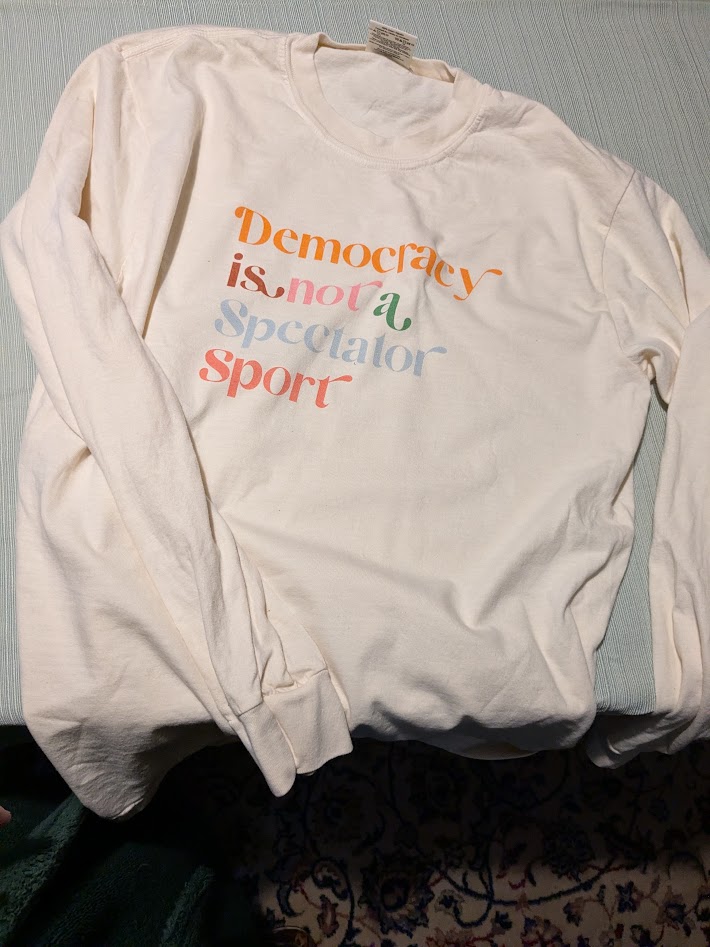
This was my birthday present to myself, fresh from my Virginia-canvassing-and-family trip, and amped up–only a week later–by democracy’s powerful showing in the November 4 elections.
Notice I didn’t say Democrats (though they did well, and I’m glad). Nine months in to this presidency, people on all sides of politics–including no politics at all!–are starting to coalesce around the basic idea that things should work. And democracy, as Churchill famously said in 1947, is “the worst form of Government…except for all those other forms that have been tried from time to time.…” [ellipses added for emphasis]
In other words, for things to work (fairness, food, airplanes–that sorta thing), we need democracy. And when you look at election results more focused on immediate outcome than on party, here are some promising signs:
- Maine anti-mail voting measure loses
- Progressive DAs in Philly and NYC win
- Colorado funds free school meals and SNAP support with taxes on the rich
- Detroit elects first woman mayor
- Cincinnati rejects JD Vance’s brother after endorsement
- GOP Redistricting in Kansas failed
- Charlotte approves transit tax
- Maine passes gun control
- Turnout in blue district US House election in Texas higher than 2024 Pres (thanks to Common Power for this compilation)
See what I mean? I have a lot of company in thinking, the IDEA of democracy is having a moment right now. And for democracy to work, we need all hands on deck.
“Wait a minute,” I can hear you saying. “I loathe phone-banking, and I’m donating all I can to things like food banks and my church. And now you want me to do take on ‘democracy’ too? I am SO not that person.”
Au contraire. I maintain that if you are looking out for vulnerable people; if you are protecting green spaces or animals; if you are reading to kids, or making art to share, or donating to organizations that multiply those values, you ARE a democracy standard-bearer.
I mean–don’t forget (or underestimate!) voting! Do all you can to keep your loved ones from feeling that voting’s not worth it. Point them to this book if they need a little inspiration…

On my walk today I stopped to make a roadside bouquet. November in Washington State = pretty limited wildflowers. But the low-rent, multicolor assemblage I collected reminded me, there’s so many ways to be a flower!

You can be bright, demure, prickly, robust, delicate, complex or simple–and you can still call it democracy. Just do SOMETHING, keep doing it, and keep talking about it.
As Joyce Vance says, we’re in this together. And as Gretchen Wing says, “For things to work, we need democracy.”
What are some of your ways of participating? Anything new, anything especially challenging or rewarding, or both? Please share as many as you feel like.
 Wing's World