
A small article in our regional online journal, Salish Current, caught my eye, its headline much like the title of this post you’re reading.
The Red Dress? A worldwide exhibit making its US west-coast debut at the Pacific Northwest Quilt and Fiber Arts Museum in the tiny town of La Conner, Washington? Just 30 minutes from our mainland ferry terminal? Here, in my backyard?
I read the article (by Ava Ronning, reprinted from The Skagit Valley Herald). And I had to go see it for myself.

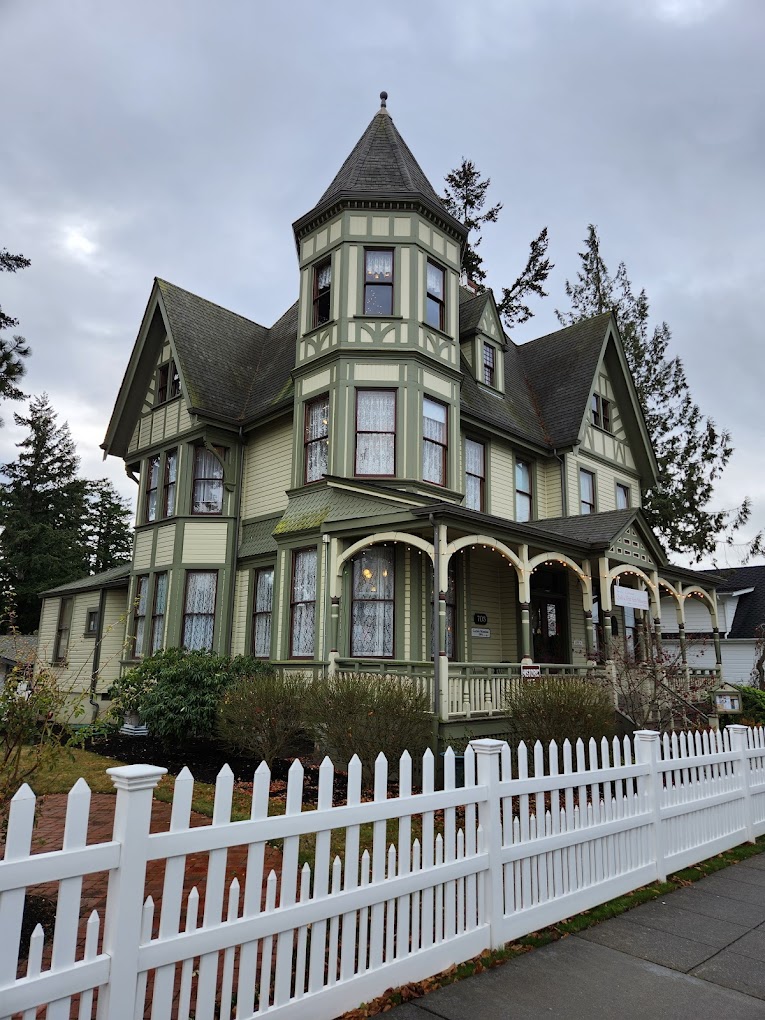
The museum itself is housed in a breathtaking old dwelling on a hill overlooking the Swinomish Channel. I was so excited about the exhibit I forgot to photograph the museum, so here’s a shot I stole from their website:
The dress occupies one small room…and I mean occupies. It fills the space, drawing you in to examine every fold, every flounce.

And that’s before you watch the video in the next room, which unpacks the dress’s stories (in part–there are too many for a 12-minute video). That’s where I learned that the white doves on this panel, sewn by survivors of the Kosovo war, represent their longing for peace.

The Red Dress Project began with UK artist Kirstie MacLeod, as the website says, “as a sketch on the back of a napkin in 2009.” Since then, it “has grown into a global collaborative project involving and connecting with thousands of people all over the world.”
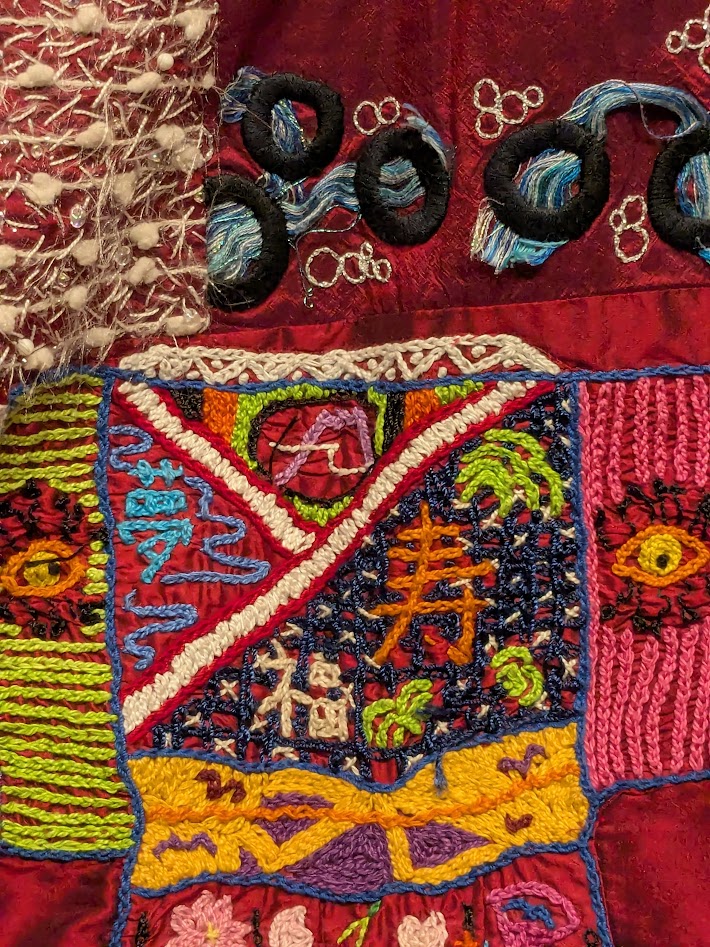
Through the video, I learned the story of this small piece from an artisan in Colombia. She started with traditional symbols–hibiscus, toucán–but after being shaken by a bombing in Bogotá, she added this word in English:

The same word appears in a section from…somewhere else in the world:

The website tells you right off how many women have been involved in its creation: 380. From 51 countries. If you dig around on the site, you will also learn that the dress weighs 6.8 kilos–that’s just under 15 pounds. (I actually thought it might be heavier–there are beads stitched on there!)
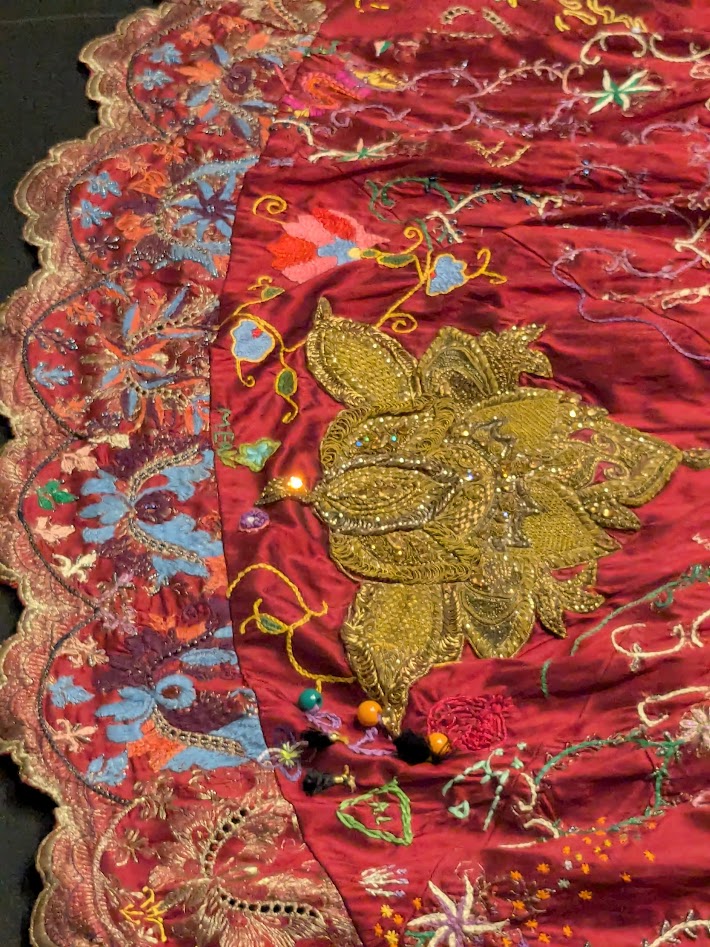
The website goes on to explain,
Initially the project sought to generate a dialogue of identity through embroidery, uniting people around the world across borders and boundaries. However, over the 14 years it was created, The Red Dress also become a platform for self-expression and an opportunity for, often marginalised, voices to be amplified and heard, initiating vital dialogues on important and frequently uncomfortable issues.

The website estimates the number of stitches in the dress from one to 1.5 billion. It reports: “Some of the artisans are rebuilding their lives with the help of embroidery, using their skills or being trained in embroidery to earn a consistent living to support themselves and their communities.”
In other words, these women are paid for their work. From the video, I learned that 50 Bedouin women had been able to achieve financial independence from the embroidery work the Red Dress Project engendered.
The most heartening part of the video is where creator Macleod explains, “The importance has shifted from the dress as an art piece to the creators of the dress.” One country at a time, she is traveling with the dress to allow each embroiderer to see (and in some cases wear!) the entire dress, in most cases for the first time. Seeing that wonder on the face of the 19 year-old artisan in Mexico choked me up.
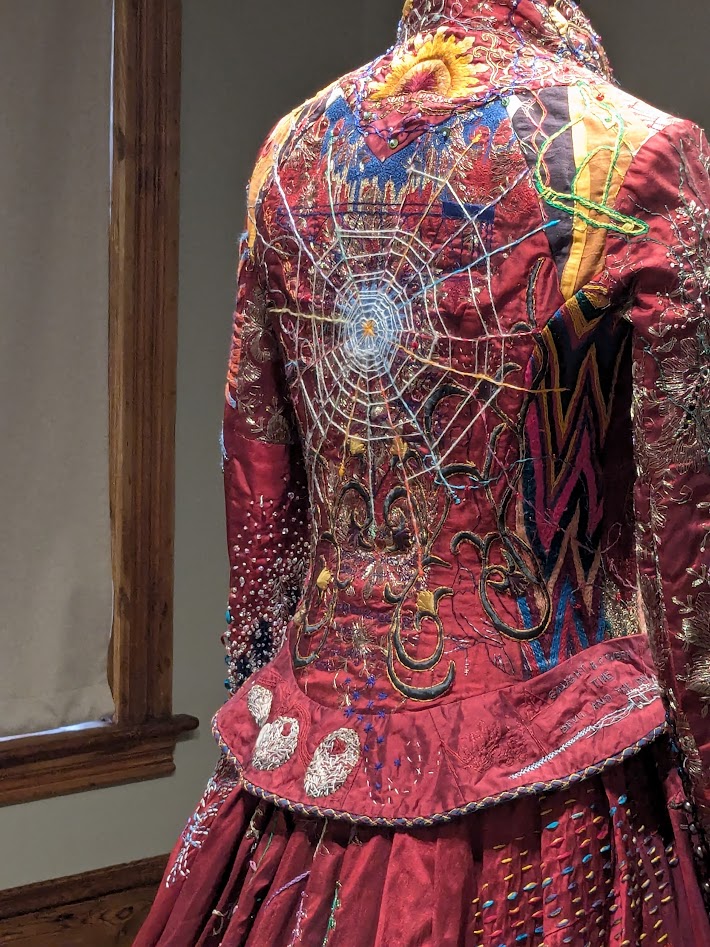
Speaking of choking up: this image from Ukraine: their national colors expressed in a flower:

Only after leaving the exhibit did it occur to me to consider the word “redress”: it means, “to remedy or set right (an undesirable or unfair situation).” As Kirstie Macleod says, in the video, “The voices of the women are just crying out to be heard.”
And in an era of increasing division, borders, walls, aggression and suspicion, this dress is a community object “without prejudice, without boundaries, without borders…”

So, you want to see the dress yourself? Here’s how.
According to the website, after its La Conner visit (La Conner! Not Los Angeles! That still blows me away), the dress will travel back to the UK, and thence to Asia and Australia.

So unless you can go to those places, here’s what I recommend. Go to the website. Watch the video (under “Media”). Then use their really cool Digital Red Dress tool for a DIY tour: https://reddressembroidery.com/DIGITAL-RED-DRESS
You will also find wonderful worldwide examples of projects similar to, often inspired by, the Red Dress Project.

If you’re really bold and/or inspired, Ms. Macleod invites you to reach out to her directly: “Kirstie is able to offer events and presentations with/without the Red Dress tailored to your group/community. Please email her for more info on: reddressembroidery@gmail.com”
That wonderful museum in La Conner is also showing a breathtaking exhibit of bird quilts. I was going to append some of those photos to this post, but you know what? The Dress and the birds deserve their own space. So I’ll save the birds for later.
Go see The Red Dress, in whatever medium you can. And then tell me your favorite part about the experience, eh? It’s all about that web.
 Wing's World