MFA in LA, Part III: Intertwined Inspiration

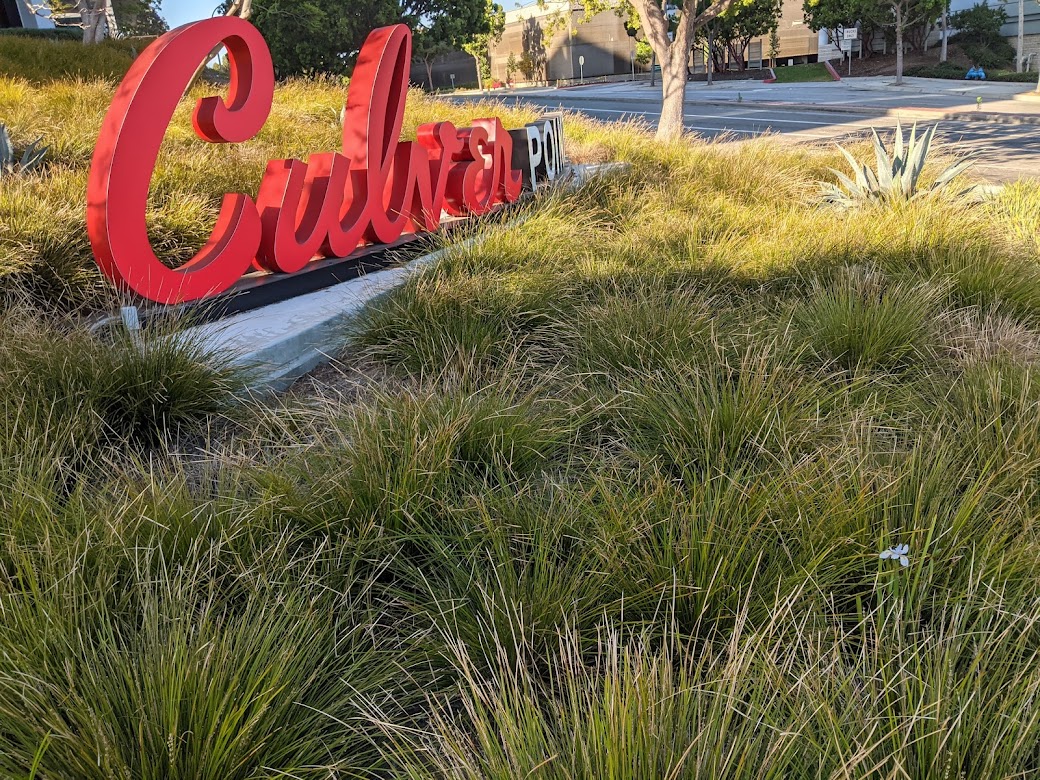
One year ago, I was soaking up the sights and sounds of Culver City on my daily walks to the campus of Antioch University for the first residency of my MFA program in Creative Writing. Mostly I was dazzled by the Southern CA flowers.
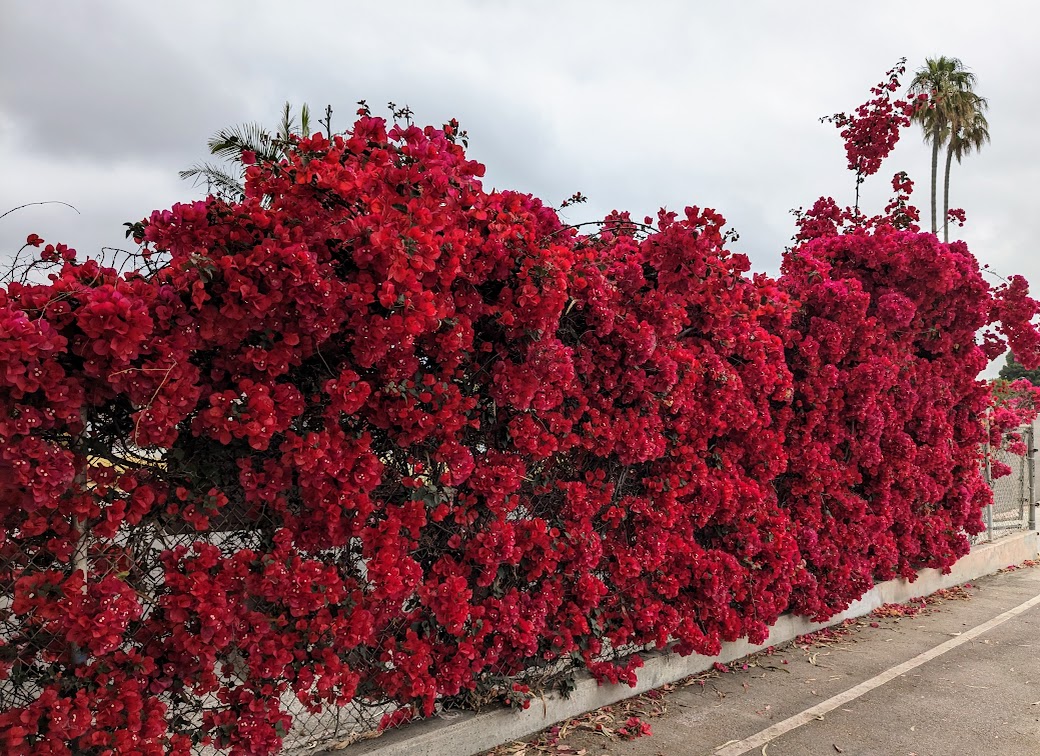
Oh, this old thing along the bike path? I just threw it on…

What I should have used as a photo was a full-blast firehose, because that’s what Residency #1 was like. Back home, I likened my new venture to a switch from hiking to rock-climbing. Not long after, I chose to step away from blogging altogether, devoting all my precious writing time to my most precious writing. Residency #2, last December, received no analysis.

But this summer, riding along that same bike path, I was stopped by a new metaphor: this rainbow tangle of flora:
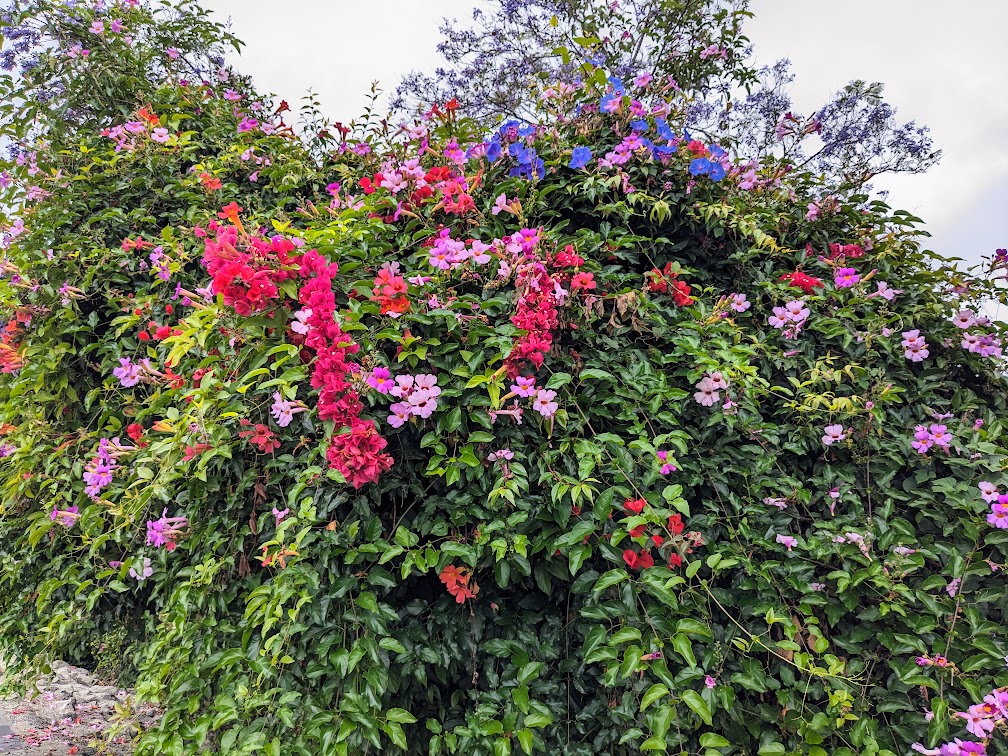
Whose story is this? Everyone’s! Whee!

You gardeners will spot pink and red oleaner, scarlet bouganvillea, orange trumpet vine and blue morning glory, all rampaging joyously over a substrate of purple jacaranda. What I see? A message to stay focused on more stories than mine.

YES, I am writing a novel. YES, it requires my time. But not so much to keep me from this blog’s renewed mission to AMPLIFY voices for justice and understanding. Which is why it felt so perfect, on the same day I took that picture, that I turned on a car radio and discovered House/Full of Blackwomen.

Nighttime Procession, March 2017, Photo by Robbie Sweeney

CreativeCapital.org describes the group this way:

House/Full of Blackwomen is conjure art, the insistence movement, activated in store fronts,  streets, houses, warehouses, museums, galleries and theaters of Oakland, California. House/Full began as a two-year project and morphed into an eight-year process of 15 public “episodes” which unexpectedly appeared as street processions, all night song circles, secret rituals of Black women resting and dreaming, sacred ceremonies on the track, and multi-media offerings. Black women gathered around a dining room table to recall, rage, rally and restore themselves, while creating ritual performance strategies towards shifting systemic evictions, displacements, erasure and the sex trafficking of Black women and girls: all driven by the core question, “How can we, as Black women and girls, find space to breathe, and be well in a stable home?”

Dreaming Blessing, March 2017, Photo by Robbie Sweeney

As I listened to Episode One of The Kitchen Sisters’ podcast on NPR, which describes the group’s mission, I was filled with excitement, hope, awe, empathy…and the immediate desire to share all those feelings.

So here you go! The above description, not to mention the podcast itself, says more than I could about the power of this group of 34 women. All I want to do is steer you toward them. Creative Capital says,

The final episode of HouseFull, Episode 15: this too shall pass will premiere March 4–12, 2023. Performance times, venues and details can be found hereAll events are sold out, but you can sign up for the mailing list to learn about future performances and project iterations.

And me? I still have a few more days in LA. I still plan to drink from that hose–a little more carefully now, sipping the drips, letting them soak in. Or, to go back to florals, I plan to gather some individual roses as they offer themselves…
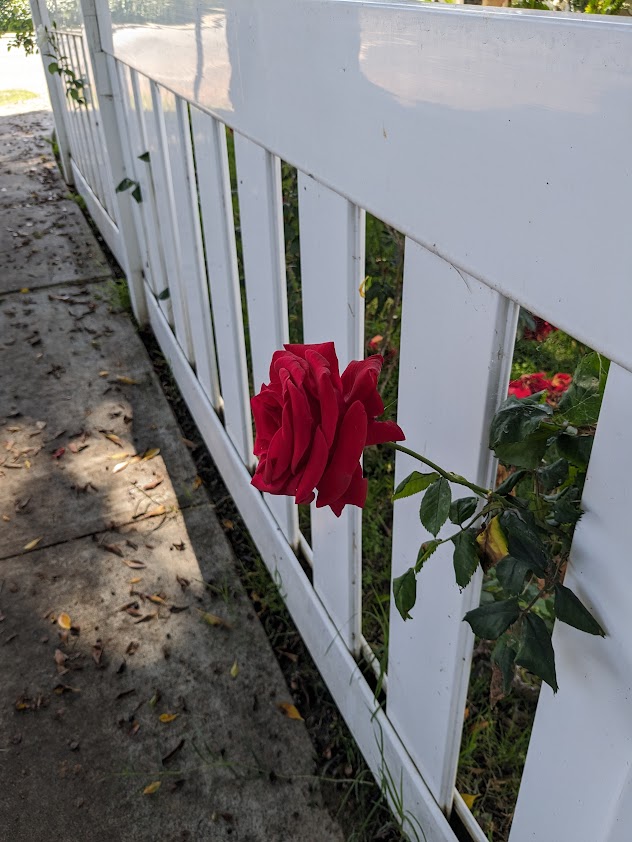
Stop and smell me.

…be they writing advice or part of the more tangled, brilliant stories around me. Please join me in discovering House/Full of Blackwomen!

MFA in LA, Part I: Small-Island Woman Hits the Big City

The first afternoon of my shiny-new Masters in Creative Writing residency in Culver City, a worried-looking man at the bus stop I was walking past stopped me, in halting English, with a question. Based on his appearance, I guessed he had immigrated from central Africa…but when his English failed, he tried a nice, fluent Spanish–and there we found a common place to converse about bus routes (and the fact that I, an out-of-towner, knew less than he did).

“Now that was an LA moment,” I thought. And that’s why I’m here: for the writing instruction, yes–but even more for the moments I cannot experience via Zoom.

Greater Los Angeles is a stunning place, in all the meanings of that word.

just your average Culver City yard

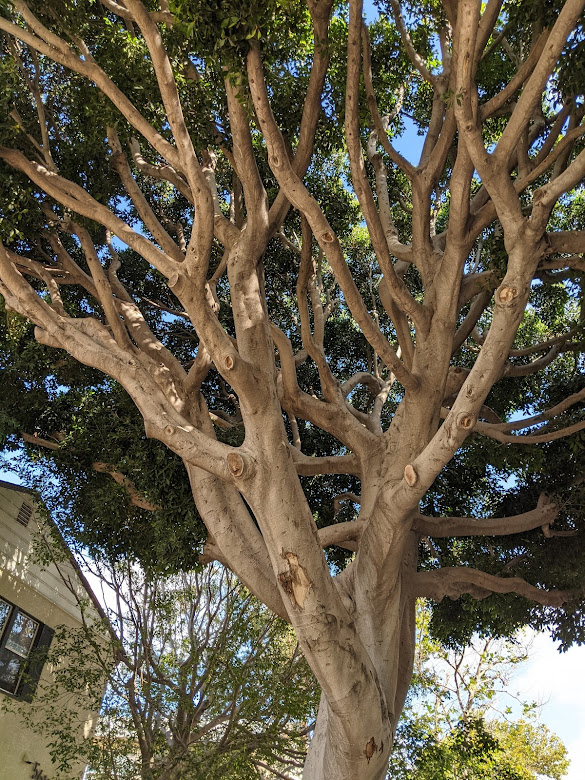
Since I’m here in full Writer Mode, I’m noticing every way that I’m being stunned, mostly on my 2-mile, twice-daily walks between the campus of Antioch University Los Angeles and the wonderful friends who are hosting me. Starting with these astounding ficus trees, planted down multiple Culver City streets…

Must…build…treehouse!

…whose roots are painfully constrained by concrete, and yet–they tower.

I’m so sorry, O Great One!

Since I’m entirely on foot, thanks be, I only have to deal with traffic when I cross the street. But this vehicle caught my eye as an embodiment of SoCal culture:

The decal on the window reads, “It’s always been about style!” Uh huh.

Antioch U itself is housed in a stunningly corporate-looking building, one of a cluster offering office space to such stunningly _____ (insert your own adverb here) corporations as Tik-Tok.

I still don’t get TikTok, but then I’m 60, so I guess that’s the point.

I’ve never worked in a building like this, but this scene through a window on the ground floor tells me that at least someone in there has a good sense of humor:

Yikes. Tough day at work.

Being, y’know, corporate and all, the building-cluster is thoroughly landscaped…

See that one tiny blooming white iris? I felt a kinship.

…and I didn’t know whether to laugh or cry when I found this Pacific Northwestern sister, this madrona tree, literally chained to a concrete block.

Makes me want to rescue her, like that scene in Harold & Maude (go see it if you haven’t)

I have no critique of Angelenos or anyone else who chooses to live in a megalopolis. There’s just so much here here, it takes my breath away. So I’m finding special comfort in whatever feels familiar–not in that creepy, chained-down-madrona way, but like these adorable turtles…

Sorry, buddies, I don’t have any treats for you!

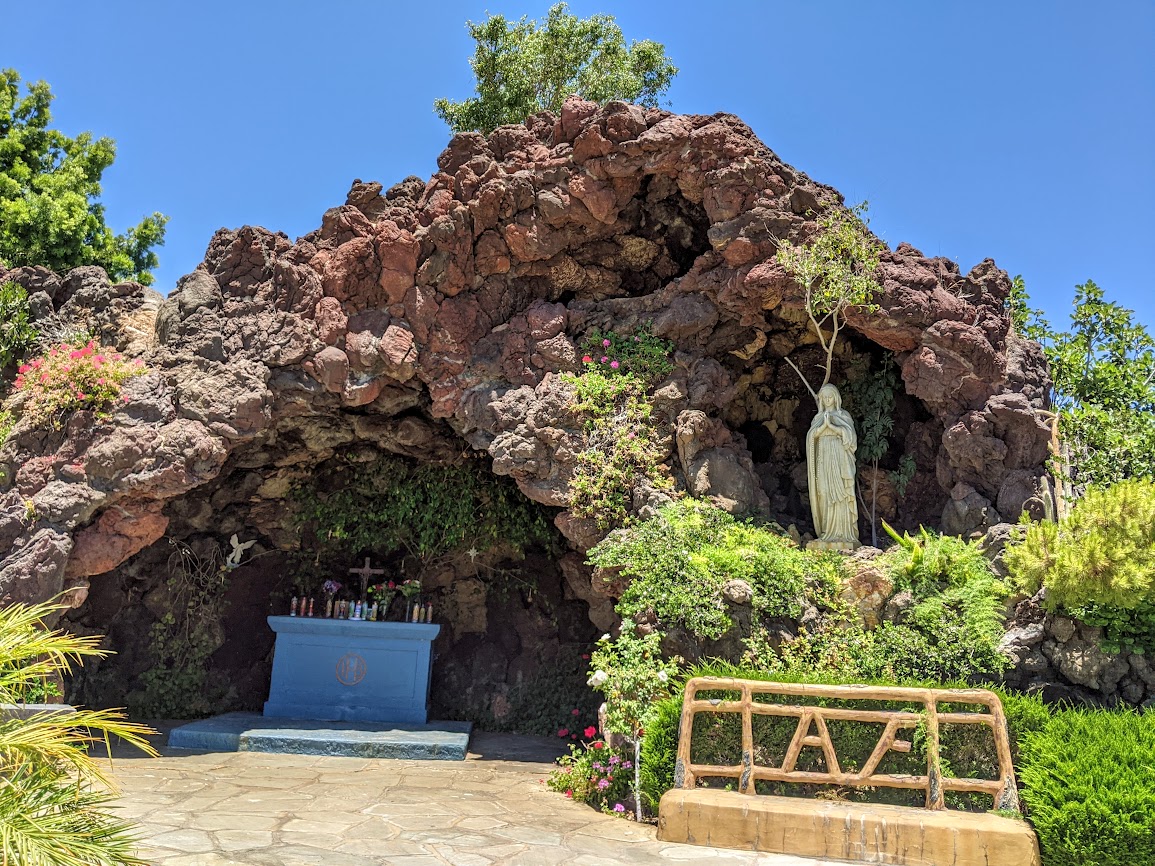
…in the grotto pool of the Catholic cemetery I cross through on my walks to & from campus.

candles burning inside for, in this case, all fathers on Fathers Day

In the end, everyone wants to feel at home, whatever home means, right? Which is a good thing to be pondering as I launch into a brand-new writing project with some brand-new helpers who come from places so very, very different from my little island. In the end, we all want comfort, whether that means a shiny sports car, an untethered tree…or just a sweet cat to lie on our tummy.

my friends’ kitty Drizzle

Until Part II, may comfort be with you!

When Truth Is Stranger Than Fiction-Writing: Iowa Writers’ Workshop as CIA Baby?

When you get involved in fiction writing, you hear “Iowa” a lot. It’s shorthand for the Iowa Writers’ Workshop, operating since 1936 under the auspices of the University of Iowa. It’s also a flagship of American creativity. And, according to an article in The Chronicle of Higher Education, it was also erected as a bulwark against Communism, and partially funded by the CIA.

Iowa, a weapon of the Cold War?! That bastion of individualism? The first program in the US to promote advanced degrees in creative writing, to amplify the voices of writers expressing themselves freely, independently, even iconoclastically?  Oh…wait. I think I get it.

It was a shock to me at first, I must admit, when I read this sentence in an article in Al Jazeera America about the CIA sending hip-hop artists to Cuba to further American ideals: “It was also a CIA front group, known as the Farfield Foundation, that provided seed money for what would become the Iowa Writer’s Workshop.” I had to investigate.

Turns out that quote comes from Professor Eric Bennett,  assistant professor of English at Providence College. [The article adds that Dr. Bennett’s “book on creative writing and the Cold War, Workshops of Empire, is forthcoming from the University of Iowa Press. This essay is adapted from MFA vs. NYC: The Two Cultures of American Fiction, edited by Chad Harbach and published this month by Faber 
and Faber.”–just in case you want to track him down.]

Here’s the part of Dr. Bennett’s article I found most striking:

But it’s also an accepted part of the story that creative-writing programs arose spontaneously: Creative writing was an idea whose time had come. Writers wanted jobs, and students wanted fun classes. In the 1960s, with Soviet satellites orbiting, American baby boomers matriculating, and federal dollars flooding into higher education, colleges and universities marveled at Iowa’s success and followed its lead. To judge by the bellwether, creative-writing programs worked. Iowa looked great: Famous writers taught there, graduated from there, gave readings there, and drank, philandered, and enriched themselves and others there.

Yet what drew writers to Iowa was not the innate splendor of a spontaneously good idea. What drew writers to Iowa is what draws writers anywhere: money and hype, which tend to be less spontaneous than ideas.

So where did the money and the hype come from?

Much of the answer lies in the remarkable career of Paul Engle, the workshop’s second director, a do-it-yourself Cold Warrior whose accomplishments remain mostly covered in archival dust. For two decades after World War II, Iowa prospered on donations from conservative businessmen persuaded by Engle that the program fortified democratic values at home and abroad: It fought Communism. The workshop thrived on checks from places like the Rockefeller Foundation, which gave Iowa $40,000 between 1953 and 1956—good money at the time. As the years went by, it also attracted support from the Asia Foundation (another channel for CIA money) and the State Department.

After reading the whole article, I can’t say that I’m “shocked, shocked!” at the ideas Dr. Bennett expresses. The writing is not muck-raking; it’s a deeply personal statement about the impact of political ideas on a creative movement, and the more I think about it, the less surprised I am that such impact should have been so deliberately built. The Cold War was, after all, by definition, a war of ideas. Why should creative writing be held above the fray?

The only bit that leaves a bad taste in my mouth is Iowa’s own disingenuity when presenting its own history. Here’s what their website has to say on the subject:

One of the first students to receive an M.A. in creative writing was the poet Paul Engle, who assumed the directorship of the Workshop in 1941. During the 24 years of his directorship, the Workhsop gained a national reputation as the premier program of its kind. During World War II enrollment was no more than a dozen students, but after the war it grew, attaining in a few years a strength of over a hundred students, and dividing into the fiction and poetry sections which exist today.

Yep–same Paul Engle whom Dr. Bennett knew personally, and describes as “a do-it-yourself Cold Warrior.” The Iowa website seems to be opting for the storyline of spontaneously-arising program for artists. Given what Dr. Bennett has detailed, that origin story appears to be–perhaps appropriately–fiction.

No problems with those origins–but I would like to see Iowa be a little more open about them.

Do you agree? Are you “shocked, shocked”? Or is this old news to you?