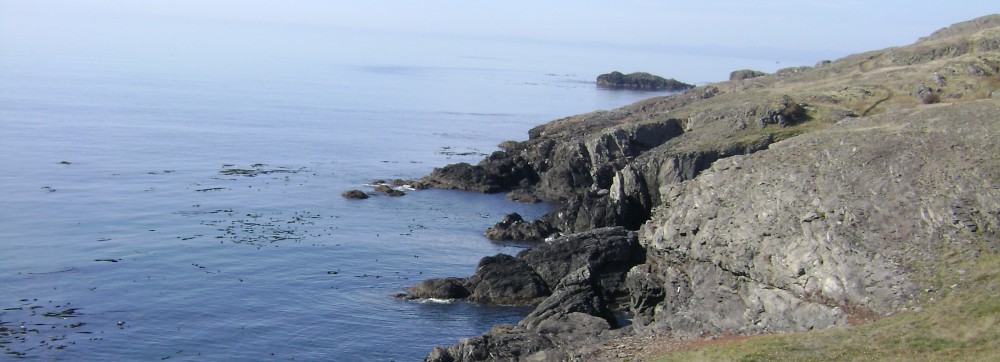
Chop. Swirl. Eddies. Currents. Unexpected wavelets, even waves, hitting from all sides, throwing you off balance, interfering with forward movement. Obscuring forward movement. Where am I headed, anyway? Where’s this interference coming from? Should I drift for a moment or power through? What new challenges will either choice unleash? Which way should I steer?
I am neither historian nor lobsterwoman. But—in case you’ve wondered whether Wing’s World has fallen off the face of the earth—I’ve been living this metaphor for the last several months. Chop, for me, has set blogging wayyyyy back as a priority. Only now am I coming to realize I might need this blog as a navigational marker to sail on through this stuff.
I have always considered myself the person least touched by adversity of any I’ve met. I even wrote a song about it, from the perspective of someone who got all the bad shit I’ve avoided: “Who got my sunshine, who got my ease?/Does she realize her fortune? Will you tell her, please?” The song ends, “Hope she’ll be ready when her skies turn black.”
This year, my skies finally darkened.
In December, my high school bestie died, with no chance to say goodbye. A week later, a close local friend died. In February, the Mate’s health circumstances took a hard turn. And in early June, my amazing father, Peter Klopfer, died.
Add to that the national shitstorm we’re all living through, and…
[photo courtesy Wikimedia Commons]
Another favorite topic of HCR (Heather Cox Richardson) is navigational markers. In my personal chop, I have decided to focus on these few to guide me:
Interdependence on and with family, friends and the Mate, more intentionally than ever in my life
Using historians, legal minds, politicians and activists to keep myself inspired and motivated
Using my own resources of time, money and WORDS to amplify that inspiration and motivation
I won’t blog about the first marker. But the other two? Watch this space.
Fifteen years ago, I interviewed my LA-based cousin, Susi Kaminski Klein, about her experiences as a child survivor of the Holocaust. Over the course of four days, hanging out here on Lopez Island and visiting beautiful Victoria, BC, I recorded Susi narrating her story.
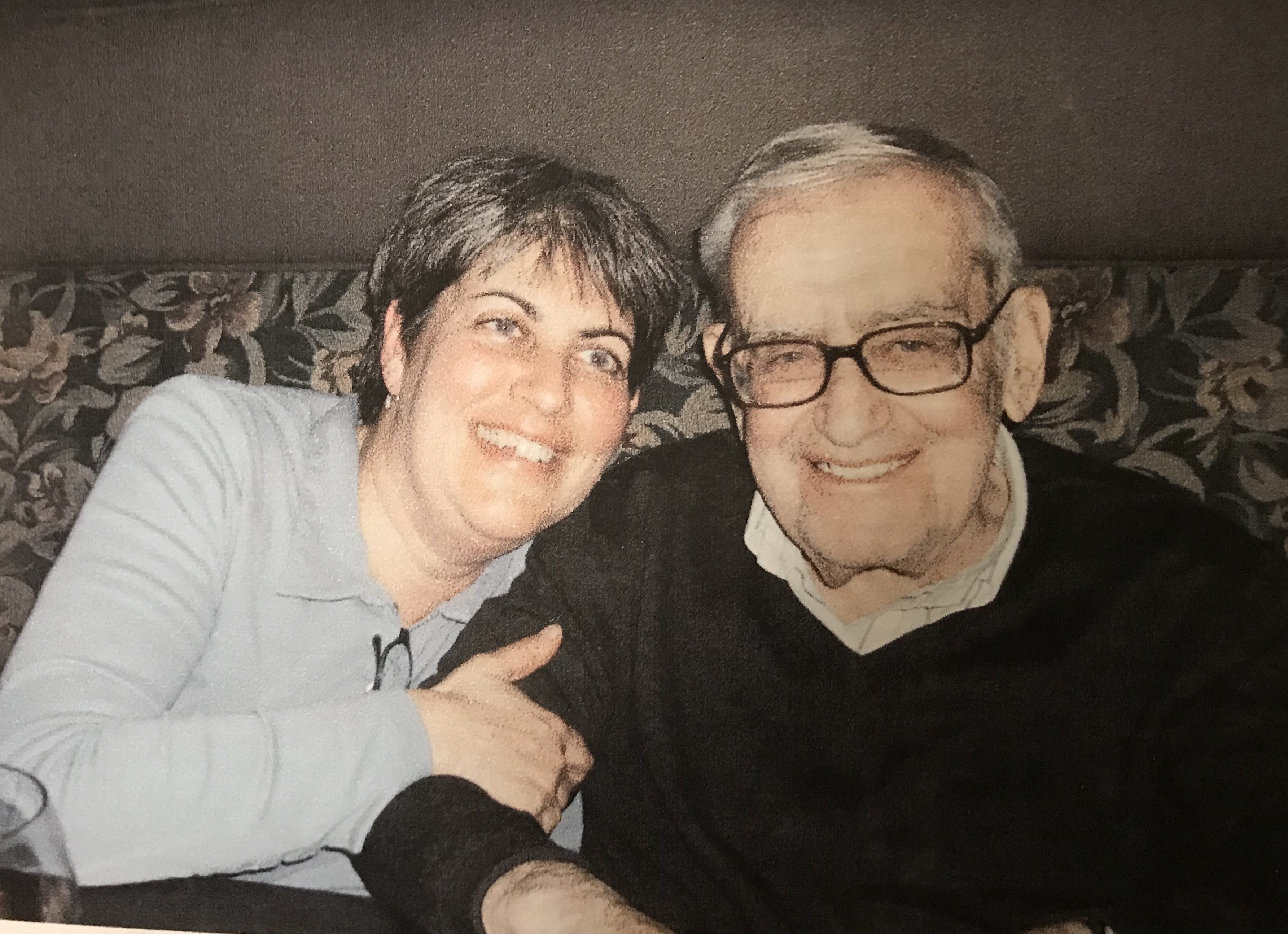
Susi & I taking a break from history in Butchart Gardens, 2010
Nine years ago, I blogged about Susi’s story as depicted in Jewish Journal of 2016. You can read that here.
Five years ago, with some urging, and a TON of formatting, research and illustration help from my cousin Helen (Susi’s daughter), we turned those notes into a book.
Helen should’ve gotten co-author billing!
But the lede I’m burying here is this: COUSIN HELEN WAS WAYYYY AHEAD OF ME! In 2011, four years earlier, she had already published the story of her father, Fred Klein. Here it is:
Something you have to understand: back then, self-publishing was HARD WORK. I’ll get to that part in a moment.
What I wanted to know was how Helen’s experience interviewing her father compared to mine, interviewing her mother, and…well, I’ll let Helen tell it. Cuz?
“This will be a short and possibly unexpected answer. I never interviewed my father to capture his story. My father started writing his book, believe it or not in 1997! He went through a number of iterations. During the process he found several people who were willing to edit his work and give him ideas on organization, grammar, etc. I was not involved in that process at all.”
Fred and Helen in 2015
Well, that tracks. Susi had separated and Fred by the time we met, so I never got to meet Fred. From what I’ve learned, I think he must have been an impressive man. Maybe daunting to interview? Not really, Helen said, but…
“I think I would have found it extremely challenging to interview my father. Not because he would not be willing but it is such a vast subject, I would really have had to figure out where to begin, how to organize and structure the questions etc. so honestly I am grateful my father wrote his story on his own and got some guidance from others on organization and structure.”
Keep in mind, my cousin’s working full-time during this entire period. When I interviewed Susi, I had just left my teaching job, so I had the time I needed to organize her story after capturing it on tape.
Helen and Fred in 2006
Also…as Fred Klein’s book cover intimates: he survived Auschwitz. While Susi’s story was horrific and traumatic, including her father being sent to the concentration camp Theresienstadt…it did not involve Auschwitz.
Full disclosure, I’m only partway through No Name, No Number, which is written as a mix of personal account and history lesson. History, I think, is more and more necessary these days when precious little Holocaust history is taught. But personal stories are the most poignant.
Here’s an excerpt from Ch. 7, where, in 1941, still living “freely” in Prague, teenage Fred is forced to labor on a collective farm. I have bolded sentences that especially capture the personal reality of the horror.
“For me, the worst part about the camp was the strenuous physical effort required. I was in extremely bad shape, not accustomed to the job, never having learned to push myself. Sometimes the grueling twelve-hour workday seemed like hell to me. I thought I would never last through them. I had to shovel some three hundred times earth up to a little metal wagon. Sometimes I had to carry very long tree-trunks with a fellow forced laborer. Most of my fellow inmates were in better shape than me and enjoyed teasing me. They had me carry the thick end of the tree-trunks which was so heavy that I almost collapsed, whereas the other fellow had it easy. Had I been in better shape, the work would have been exhausting, but tolerable.”
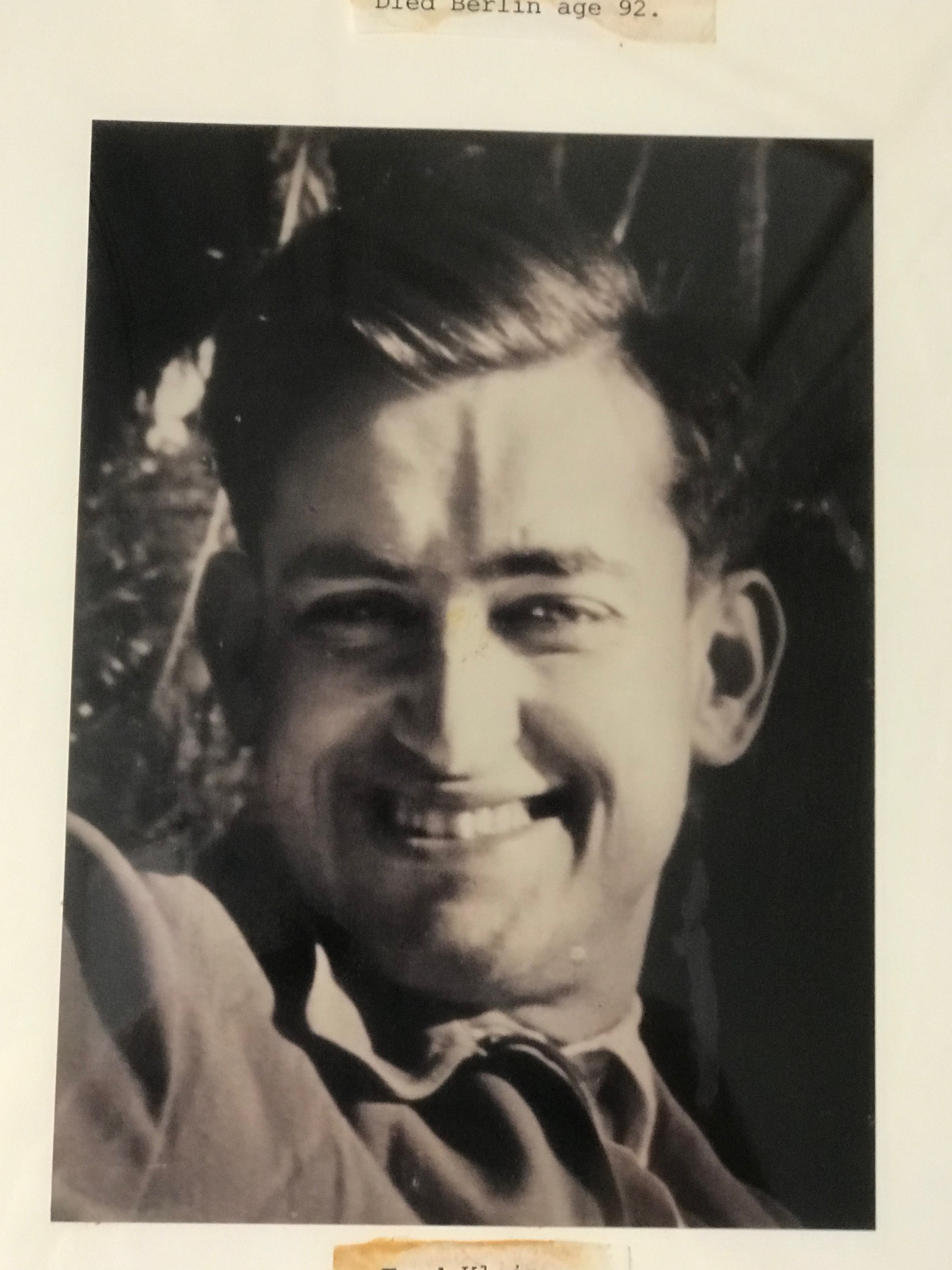
Fred as a still very young man, after the war, now living in Argentina
Here’s another excerpt, from Ch. 11, where in 1944, 22 year-old Fred is unloaded at the dreaded camp. Notice the detail in the middle of the passage:
“I jumped out of the cattle car. Barracks, barracks, barbed wire, gleaming lights. SS men with police dogs, wielding whips. Pajama-clad figures – kapos – and other prisoners, something I had never seen before. This place was cold, frightening, there was nothing soft to humanize it. I stared briefly at the hellish scene, and then I took off my glasses. Shouting and shoving, the kapos and prisoners herded us into rows five men deep and made us stand still. The dogs of the SS were poised to attack us. Somehow the pajama-clad prisoners got us moving forward in a single file.”
“I took off my glasses.” To me that act says, I will not look at this. I will get through it.
Fred with baby Helen in Buenos Aires, 1958
So, Helen– your dad wrote out his own book. Why was it not published right away?
“What I can tell you is that my father tried very, very hard to get his book published. He wrote lots of letters to a variety of publishers, but none of them seemed interested. I don’t even know if he ever got answers.”
It’s painful to reflect on this answer. There are so many Holocaust stories. The simple truth– that the sheer quantity of such traumatic stories affects their “marketability”–hurts my stomach.
Helen finishes:
“He finally gave up looking for a publisher, and sadly resorted to literally going to Kinkos, making copies of his book, getting the books comb-bound, and then trying to distribute his book that way.”
Ouch. But then here comes my cousin, to ease her father’s pathway:
“Originally, I published my father’s book in 2007 using Blurb.com. That process was long and tedious, but I pushed through it as I really, really wanted to get it done while my father was alive. Little did I know back in 2007, when I completed the publishing on Blurb, that my father would live to 100, something I am ever so grateful for!”
Helen & Fred in 2018
Which brings us back to this moment. Blurb.com no longer exists. Fred Klein passed away in 2022 (at the age of 100, as Helen said). But thanks to his daughter, Fred’s story lives on…easily available on Kindle!Click here to download and read No Name, No Number, for free.
I would like to thank my cousin Helen for her perseverance (not to mention all the photos!)…and my cousin Susi for hers. They are both role models for me.
And, in this season of deepest darkness, please say an extra prayer for the Fred Kleins of the world. May their stories find resonance.
Not that Joyce. Nothing against Dubliners or Ulysses; I just don’t think they’ll help get you through another week of our current presidency. I mean Joyce Vance, author of this book that was waiting for me, hot off its October 21st release, when I got home from my canvassing trip this week:
Mine’s autographed! 🙂
To judge a book by its cover, this one looks boring. To me, though, it looks like mental health. I thought I’d take a minute to explain why.
In 2022 and 2024, I canvassed in my home State of North Carolina, where my folks still live. This year Virginia has some important elections, so I went there (visits to sister & niece a bonus).
Part of Team Fredericksburg on the canvass trail
Between doors (we knocked on about 2,000 during the days I participated in Fredericksburg, then Richmond), I split my awe between the lovely big deciduous trees of the east…
O oaks, how do I miss thee!
…and creative Halloween decorations.
(sometimes both!)
But the best part of CP work, to me, isn’t actually the conversations on voters’ doorsteps (though those can be quite moving). It’s the TEAMWORK, the FELLOWSHIP.
especially at a dumpling restaurant at the end of a long day
Which brings me back to Joyce’s book, whose opening line is, “Could I have picked a worse time to write a book about saving democracy?”
My answer is: no, this is EXACTLY the right time. Because now more than ever, we need to know we “have friends everywhere” (as they say on Andor), and we need to get our hands on some how-to.
However, if podcasts are what your life has room for, Joyce is all over that landscape. I first discovered her via Substack, where her Civil Discourse unpacks the week’s latest legal WTF?!! as only a former U.S. Attorney (and current law professor) can. Each post ends with, “We’re all in this together.”
Or you might just as easily find her on the brilliant panel-pod, Sisters in Law…
While I’m only halfway through Vance’s book, I’m happy to report that the final chapter–titled We Are the Cavalry–is chock-full of options for resistance, participation, finding community, pointing yourself towards hope…or, as one heading puts it, “Understand That Protecting Democracy Comes in a Lot of Flavors.” (146)
This is Fredericksburg’s Rappahannock River at sunset. Not a flavor; it just looks like one, eh?
In this moment when the bad guys want us to despair and give up, Vance offers this uplifting reminder:
“Although we may be on our own, we are not all alone. We truly are in this together. We have one another, a community of like-minded people across the country who care about democracy. That may seem to be a slender thread, but it’s how we, like others who have faced similar challenges in the past, are going to get through this.
So, gather your resources and take courage.” (138)
Joyce’s chickens also make appearances on her Substack, so I’ll close with this:
[photo by Joyce Vance]
Do yourself a favor: Read Joyce. [Support her by clicking here to buy her book!] You will feel empowered–because, as she says, we’re all in this together.
USATF Master’s Nationals, Huntsville, Alabama, July 19 2025
That “W 90” means what you think it means: the person wearing that number is a woman at least 90. I only saw one other “90” at the meet, and that was a man.
All weekend, people kept approaching my mom, Martha Klopfer, to tell her how inspirational she is. Her response was generally something along the lines of a shrug and an “All I do is keep going.”
Waving at her fans? No, probably just loosening up before the start of the 800.
Exactly.
Here she is, “keeping going” in the 800, at one p.m. in July in what felt like a caricature of a steamy Southern summer day:
Nice forward motion, up on her toes
And here are the results:
As you can see, she just nipped under the 6-minute mark. This was almost 30 seconds slower than a year ago. Just as she’d kept reminding us, Mom hadn’t been training as much; COVID, then the chaos of the death of their farm’s last two equines (the Brown Boys) had pulled her off her schedule.
That race earned her the rest of the afternoon off. The younger part of her support team–me, my oldest sister & her husband–took our GIANT rental car…
Couldn’t resist this picture of the hood, which a storm decorated with a tiny snippet of pink crepe myrtle!
My brother-in-law kept coaching me: “Not a ‘rocket,’ Gretch–it’s a Saturn V!”
Even for a non-space-geek like me, it was pretty cool.
So much bigger than I’d realized!
Next morning, the 1500 was blessedly scheduled before the heat took hold. Since I’m my mother’s daughter when it comes to competitiveness, I had to give myself quite the talking-to, not to hope for a national record in this longer distance either. (After all, she ran a 10:55 last year, and the record is 11:30!)
The 15 starts around the turn, so we had to watch them line up via Jumbotron.
Sure enough…she ran her hardest…every step an inspiration…
I’m 63, and I can’t do that anymore!
…and finished strong, at 11:59.
And I do mean strong! She beat at least two women–maybe 3?–in younger age groups.
Was she happy and proud? Were we all, especially her coach, my dad?
What do you think?
Go ahead and call her “inspirational,” as I did–reminding her that simply seeing her out there was the inspiration–records, shmrecords.
She’ll laugh and shrug.
Next week: Wait, did you say ALABAMA??? Tell me more.
It’s a chapbook, sometimes called “a slim volume.” (Which, now that I think about it, isn’t a bad description of my friend Kathleen herself, the author of A Cage in Search of a Bird.)
And if you’re like me–needing more than EVER to buffer the beginnings of each day with not-TV-news imagery, universal truths, or just plain fun wordplay–this little chapbook is just the thing.
Since Kathleen is a Lopez Islander like me (and a member of my writing group) it seems most fitting to describe her latest collection in the words of another fellow Lopezian (and onetime member of said writing group), H.M. Sanders:
Sometimes tongue-in-cheek but always insightful and brimming with poetic vignettes provided by nature’s gifts, Kathleen Holliday‘s new collection is thought provoking, wise, and rich with island imagery. Like a beachcomber of her own life, she picks up the most unassuming objects and uses the lighthouse beam of her poet’s eye to show us the beauty and sadness embedded there. These poems are quieter than her previous works; a little richer with imagery and a little darker, with beautifully wrought images derived from everyday occurrences that she elevates to higher observations of our world and our understanding of it. In this age of social media, AI, and the frantic noise of news and the horrors of our world, the profound gift of Holliday’s poems ring quiet and true – this collection of poems is a calm anchor that links us back to our spiritual roots.
–H.M. Sanders, author of The Widowed Warlock, and Ringmaker fantasy series.
“…rich with island imagery” indeed
Please visit Kathleen’s website to learn more about her poetry and to order a copy (or two–Christmas presents?) of her latest chapbook, OR her previous two: Boatman, Pass By, and Putting My Ash on the Line.
Remember what I said about the fun wordplay?
To summarize: Feeling disheartened?Start each day with a poem. Pass it on.
This is going to be one of those participatory posts. Ready? Show of hands: who’s familiar with the term Opportunity Cost?
That’s a term I had to learn about 35 years ago, when I took my first public school teaching job, in North Carolina. I was sentenced to given five sections of the same class: 9th Grade ELP, or Economic, Legal and Political Systems. Thanks to my undergrad classwork, I was pretty up on the Legal & Political part, but Economics? I studied hard to keep a step ahead of those kids.
And I learned about opportunity cost, a.k.a. “the loss of potential gain from other alternatives when one alternative is chosen.” (Thanks, Oxford Dictionary Online.)
In other words: you do one thing; what you don’t do = opportunity cost.
Get up to see the sunrise? Your o.c. is sleep. Sleep in? Your o.c. is…wait for it…sunrise! But also a TON of other early-morning things.
Obviously, for every action, there are a LOT MORE o.c.’s. So you don’t want to let them get the upper hand, right?
The trick is to recognize the opportunity costs, give ’em a friendly nod…and keep doing what you’re doing. That way they can’t blindside you with their secret weapon, regret.
The other day while walking in my Big Backyard, part of the San Juan National Monument, I came upon this particularly beastly lovely flower arrangement:
*shudder*
Bull thistle, seed pods popping. Invasive as hell. I vaguely recalled writing a blog post about my personal war with these devils about a decade ago. Back then, I was actually optimistic about ridding this stretch of public lands from thistles by my own sheer persistence.
So what happened? Opportunity cost.
Choose to save your back & knees by withdrawing from the Thistle Wars? The opportunity cost is living with thistles.
The more I think about it, the more I see opportunity cost at work in my life. Move across the country for the beauty of the Pacific Northwest?
Fine–but your o.c. is a full (expensive) day’s travel away from your folks.
And Dad may still rack up the miles on his e-trike, but he’s not riding to Washington State.
For that matter: move onto an ISLAND? OK…but you better be ready to give up HOURS, waiting in ferry lines.
Because this really isn’t a commuting option.
I chose to devote time (and money) to pursuing an MFA in fiction, so I can write a better novel…
…but my songwriting Muse has taken these past two years to decide to visit some other songwriter. THAT was one o.c. I hadn’t considered.
[not pictured: my songwriting Muse. “Hmph. I can tell when I’m not wanted.”]
On that music theme: I only get to play with friends who are willing to be informal & flexible, rather than join an ongoing band…
Me with “flexible” Justin & Lance!
…because I leave the island WAY too often, for places like this:
(to choose a recent, random example–the Chiricahua National Monument in AZ)
I’ve had to give up Spanish lessons because of (pick one): bakery work/neighborly commitments/ political phone-banking/spending down time with The Mate
OK, that last one: always worth it! No cost!
Choosing not to plant an organized garden gives me extra time, and saves my back…and my o.c. is a Kale Forest (vale of kale) masquerading as a garden.
Hey, at least this o.c. is edible.
Getting exercise means I’m always moving around this beautiful corner of the world at TOP SPEED…which means I’m not LINGERING.
That last one really caught my attention. So the other day, I took my journal, my lumbar support pillow, and a peach with me out to the Point, and we LINGERED.
Do I dare?
What did I journal about? Opportunity cost. I duly noted a long list of things I haven’t been doing, making, accomplishing or experiencing lately, because of all the other things I’ve been doing, etc. I read the list. I thanked it. I whispered promises to a couple of the o.c.’s on there that I might be back at a later time, so don’t give up on me.
And on we go. No regrets. (Or at least none that I feel like sharing in a blog. 🙂 )
Just keep looking at the view…don’t give that o.c. any power!
So here comes the participatory part again. What are some of the opportunity costs you’re currently noticing in your life? How about acknowledging them here? Then wave ’em adieu.
“Sit in this.” That’s what Lisa Locascio Nighthawk, Dean of Antioch LA’s Masters in Fine Arts in Creative Writing program, told us graduates the day before our ceremony.
Here on Lopez Island, some of my own writing group, the Women Writers of the Salish Sea, had the same advice: “Celebrate your achievement. Write it all down–everything you did!”
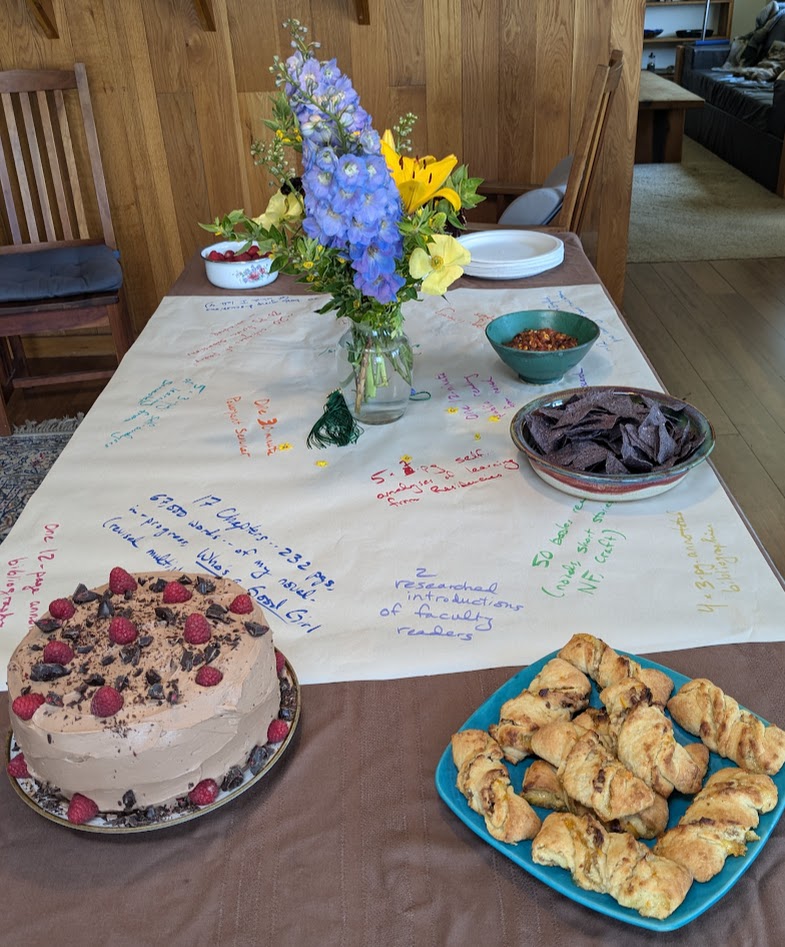
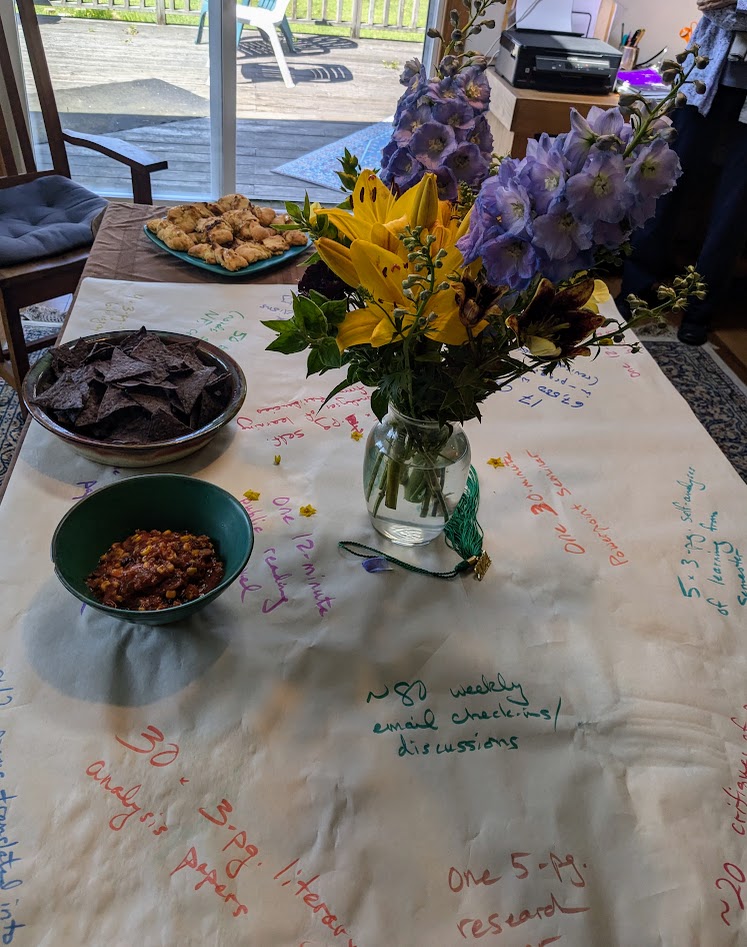
I decided to heed all of them. I sat in my achievement for a whole week. I wrote it all down, on a big piece of butcher paper. And I celebrated–with my writer friends, and with cake.
17 chapters—232 pages, 67,000 words—of my novel-in-progress Who’s a Good Girl (revised multiple times)
50 books read (mostly novels; some short stories, nonfiction, and craft books)
30 x 3-page literary analyses of fiction
One 5-page research paper
One 20-page research paper
One dozen (approximately) poems translated into English, plus commentary on peers’ translations
20 (approximately) critiques of peers’ 20-page fiction submissions in workshop
20 book group discussions (of which I led 4)
80 weekly email check-in discussions
Five 3-page self-analyses of learning
Five 7-page summaries of learning from residency classes
One 30-minute PowerPoint presentation/seminar
One 12-minute public reading
Four 3-page annotated bibliographies
One 12-page annotated bibliography
OK, enough of that! Let’s eat.
While we were noshing & drinking, my friends asked me to reflect on my main takeaways from the past two valuable, packed, and expensive years. Here’s what I came up with:
My instinct to immerse myself among a community of diverse writers–diverse in EVERY SENSE of the word, from age to class to life experience to race to gender identity, and more–was 100% correct. As a writer, I need to be around people different from myself. (As a human being, it doesn’t hurt either.)
[not pictured: all the diversity at AULA. I don’t like violating people’s privacy in showing photos]
2. Confidence is good, in art. Pride is not. I had to have the latter stripped painfully away before I could soothe the raw spots by applying the former. That’ll be a lifelong engagement.
3. Novelists need the help of other novelists. Poets and nonfiction writers can offer EXTREMELY valuable critique. But in the end…see sentence one.
OK, we got it. You worked hard. Now, about that novel-in-progress…
After a week of “sitting,” though, I’m ready to get back to work. Of course, it’s high summer now–a season that always has other plans for me than writing. But the last thing I learned will get me where I need to go, and that is:
4. Writing is writing. JUST DON’T STOP.
(You other writers: right? Feel free to chime in here with your own Writerly Takeaways.)
Back in 2022, in what became the last post for quite a while, I described the program as a switch from hiking to rock climbing. Now, having reached a comfortable ledge called “graduation,” I’d love to linger for a minute and talk about it before climbing on.
As the kids say: this happened
…So?
These past two weeks, I’ve been noticing the balance of my upward climb. Finding a rhythm between “But I’m not DONE yet–my book is only about 2/3 finished!” and “Look at all I’ve accomplished!” Real rock climbers could probably help me refine that metaphor, something about tension vs. slackness of belay ropes perhaps?
But that’s between me and me. What I’d really like to do here is celebrate LA a little–more accurately, Culver City–and the urban experience I benefitted from, which was 100% more lovely and positive than what I’d feared coming in (country girl and small-island woman that I am).
Example #1: this car.
Zoom in on that window decal to see why this was my LA poster vehicle
Two years ago I took its picture–“LA as car!” But this summer, I realized two things: A, I walked past this zippy jalopy every single day for all five residencies. Clearly it lived on that street, so it became a friendly neighbor rather than a symbol of glitz.
And B, this particular car wasn’t the silver of the one I’d photographed in ’22. This one now matched the beautiful jacaranda blossoms of its street.
Is that sweet or what?
Speaking of matching trees: how about one more shout-out to Culver City’s amazing tree-themed streets?
This one’s magnolias
Culver’s a lot closer to nature than you might guess from its situation at the edge of a megalopolis.
Make way for ducklings!
And the vehicle Mama Duck is leading her brood past also surprised me. “Ugh, it’s one of those lawn-spraying trucks,” I thought, but then:
Organic fertilizer!! Good job, Angelenos.
Then there were the Little Free Libraries. Often those are stocked with throwaway books, but I was so impressed with the quality in this one:
all very readable
Finally, the Antioch LA campus itself: two years ago, I noted its corporate ugliness (housed near such artistic fellows as Norton Security and TikTok).
No ivied halls here
I even took a photo of a madrona tree chained to its concrete planter:
SYMBOLISM!
But this time around, feeling mellow and grateful, I focused on the beautiful touches added to that soulless architecture, giving it…
…soul. Thanks, Corporate America.
Because it was my final “Rez,” I took advantage to visit my writing mentor in Pasadena for a hike. Finding a writing mentor was probably my #2 goal in my program, and…
Found her!
Goal #1 = finding a more diverse critique group: check! I’m not going to violate their privacy by picturing them here, but this photo captures how I feel about them:
But maybe you’re still wondering about those cookies?
and these: chocolate-chunk spice w/ cranberries (not pictured: lemon-rosemary-corn cookies)
I hauled three containers in my carry-on: for my mentor; for an incredibly helpful Writing Center tutor who walked me through all the ghastly formatting issues of final requirements, plus an entire PowerPoint presentation; and for our WONDERFUL FRIENDS who shared their home with me, FIVE TIMES over the course of two years. And their car, their bike, and their cats.
Love you too, Joey. Now get off me, I have to finish this edit!
THANKS, Y’ALL.
And while I’m saying my gratitudes: BIGGEST thanks to my Lopez Island writing group, which got me to this point, especially Iris Graville, whose own MFA foray lit the spark for mine.
Lopez Island: home of the Women Writers of the Salish Sea
And to my wonderful Mate and Son Two, who had this waiting for me when I got home:
The mug depicts my AULA graduating cohort–we’re the Goldenrods!
Gratitude for this wacky beautiful community I get to call home:
Just your average mailbox-guarding owl
And biggest gratitude of all for the inspiration and guidance AULA will provide me as I take a deep breath, look up that literary cliff, and continue the climb.
One year ago, I was soaking up the sights and sounds of Culver City on my daily walks to the campus of Antioch University for the first residency of my MFA program in Creative Writing. Mostly I was dazzled by the Southern CA flowers.
Oh, this old thing along the bike path? I just threw it on…
What I should have used as a photo was a full-blast firehose, because that’s what Residency #1 was like. Back home, I likened my new venture to a switch from hiking to rock-climbing. Not long after, I chose to step away from blogging altogether, devoting all my precious writing time to my most precious writing. Residency #2, last December, received no analysis.
But this summer, riding along that same bike path, I was stopped by a new metaphor: this rainbow tangle of flora:
Whose story is this? Everyone’s! Whee!
You gardeners will spot pink and red oleaner, scarlet bouganvillea, orange trumpet vine and blue morning glory, all rampaging joyously over a substrate of purple jacaranda. What I see? A message to stay focused on more stories than mine.
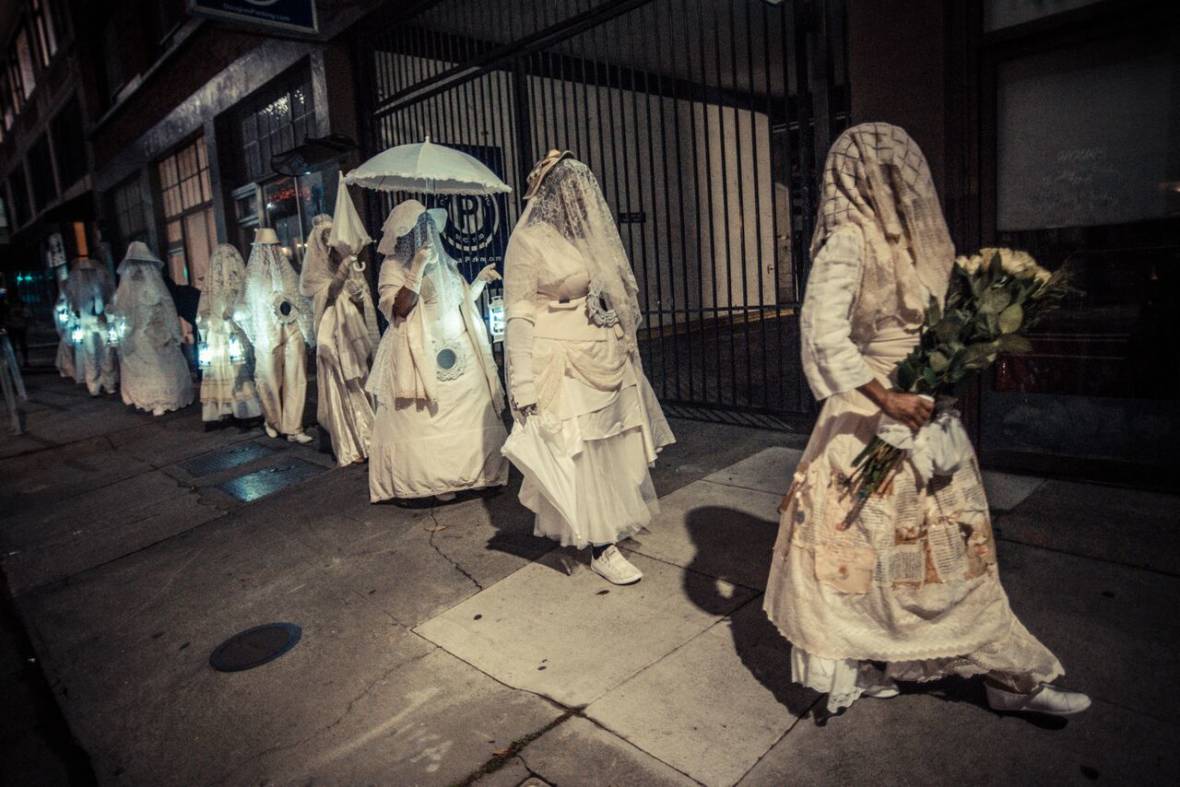
YES, I am writing a novel. YES, it requires my time. But not so much to keep me from this blog’s renewed mission to AMPLIFY voices for justice and understanding. Which is why it felt so perfect, on the same day I took that picture, that I turned on a car radio and discovered House/Full of Blackwomen.
Nighttime Procession, March 2017, Photo by Robbie Sweeney
CreativeCapital.org describes the group this way:
House/Full of Blackwomen is conjure art, the insistence movement, activated in store fronts, streets, houses, warehouses, museums, galleries and theaters of Oakland, California. House/Full began as a two-year project and morphed into an eight-year process of 15 public “episodes” which unexpectedly appeared as street processions, all night song circles, secret rituals of Black women resting and dreaming, sacred ceremonies on the track, and multi-media offerings. Black women gathered around a dining room table to recall, rage, rally and restore themselves, while creating ritual performance strategies towards shifting systemic evictions, displacements, erasure and the sex trafficking of Black women and girls: all driven by the core question, “How can we, as Black women and girls, find space to breathe, and be well in a stable home?”
Dreaming Blessing, March 2017, Photo by Robbie Sweeney
As I listened to Episode One of The Kitchen Sisters’ podcast on NPR, which describes the group’s mission, I was filled with excitement, hope, awe, empathy…and the immediate desire to share all those feelings.
So here you go! The above description, not to mention the podcast itself, says more than I could about the power of this group of 34 women. All I want to do is steer you toward them. Creative Capital says,
The final episode of HouseFull, Episode 15: this too shall pass will premiere March 4–12, 2023. Performance times, venues and details can be found here. All events are sold out, but you can sign up for the mailing list to learn about future performances and project iterations.
And me? I still have a few more days in LA. I still plan to drink from that hose–a little more carefully now, sipping the drips, letting them soak in. Or, to go back to florals, I plan to gather some individual roses as they offer themselves…
Stop and smell me.
…be they writing advice or part of the more tangled, brilliant stories around me. Please join me in discovering House/Full of Blackwomen!
I’ve been doing New Year’s Intentions, a.k.a. Low-Resolution Resolutions, for some time now. Rudder-like, they help center and steer me.
More recently, I’ve broken that habit into several steps.
1. Read back over last year’s Intentions (I write mine in my journal notebook, easy to find)
2. Give myself appropriate head-pats for success, or encouragement for less-than-success
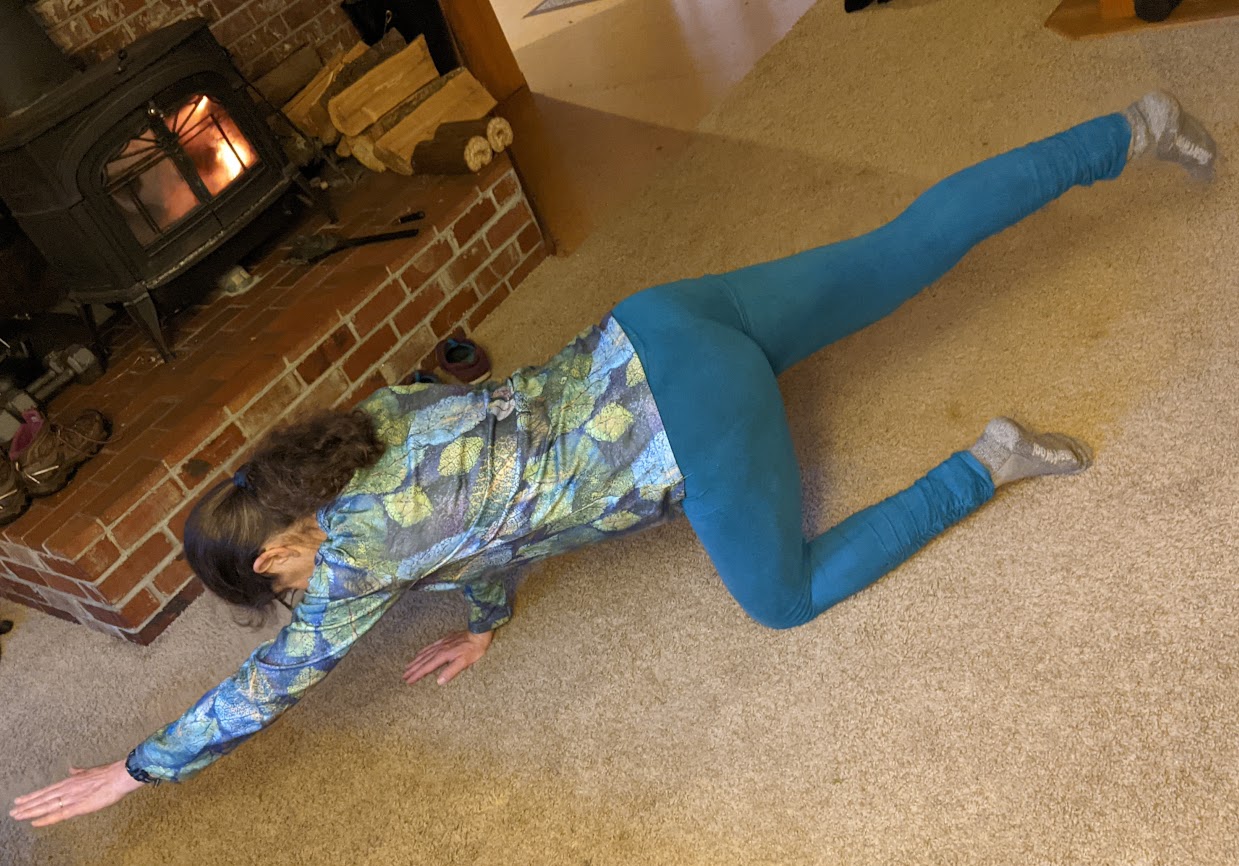
I said I’d incorporate a yoga/stretching session into my daily life, and I have! Thank you, back surgery.
3. Write new ones. This year I have seven, several of which are riffs on last year’s. Example: When your coauthor needs to pull out of your book project…turn the book into an article and get that published. Some are brand-new: Find myself a new “mentee” to mentor in our community mentorship program, since COVID effectively ended my previous mentorship.
‘Cuz I need a kid in my life to do this with!
And a couple of my Intentions are secrets. Not telling anyone till I understand them better myself.
But in this time of worldwide COVID uncertainty, when the word “plan” seems downright outrageous, I’m finding my Intentions less “what” and more “how.” Sure, I want like crazy to go to Costa Rica next month, as my Mate and a friend help Son One inaugurate his new ecotour company. But do I have my heart set on it? No–I’d be a fool. Instead, if our trip gets cancelled, I will pivot to the next thing.
Ditto with Road Trip XI, which the Mate and I have been SO looking forward to, after staying home in 2021.
I promise: whether Road Trip XI brings this…(Palo Duro Canyon, TX)…or this (southern AZ sandstorm on I-10)
…or doesn’t happen at all, I will be grateful just to be safe and healthy as possible.
And I’ll focus on what I CAN control, like Intention #3: I will play and sing three times/week for 30 minutes, EVEN IF I have no group gigs to prepare for. (I can hear my guitar gently weeping from here, and not in a good way.)
With Beth Geever, Ann Palmer and Lance Brittain last June. Oh, for more o’ that! But that’s not up to me.
So that’s me. How about y’all out there? Any Intentions for 2022? I might even borrow one of yours.