Martha and Peter’s Excellent Aldabra Adventure, Part VI: Drunken Christmas and Tortoise Sex

I decided to give my mom top billing from here on in. Got to see the folks safely in from their adventure 43 years ago.

In case you’ve forgotten, the whole point of their self-marooning on Aldabra Atoll was to collect data on feral goats. Take it away, Mom.

23 December

Another disappointing pair of watches.  Last eve, we flung ourselves down the beach, one of us on each of the three major dunes.  Visibility was great but naught in the way of goats was to be seen. [OK, guess it’s not just Dad who uses words like “naught”.]  P. arose at about 5 am this morning, well before it was light, and stumbled back to his dune outpost to catch a glimpse of any caprine early risers [This scientific lingo is really rubbing off on her!]. An early lightning storm reduced visibility for a while, but by 6:30 it cleared enough that  P. could confirm the absence of goats.  There was no sign of them in the Pemphis either.

Have we described the Pemphis?  It’s a particular association between shrubs and substrate. The former grows to a height of up to 2 meters, very dense and brittle, with twigs from the ground up, small oval leaves, and tiny white blossoms year around.  It is so dense that visibility through it is no more than 1-2 meters, and sunlight cannot penetrate. It grows in rough, unweathered coral, which also houses a multitude of other shrubs, some herbs and occasional scattered groves of casuarinas or small palms, usually pandanas.  The height of the foliage is generally below two meters and it’s patchy – there’s lots of exposed surface. On the coast and around the lagoon there is campignon, the very rough, jagged, razor sharp coral that derives its name from the  giant mushroom shape isolated pieces we assume.

This stuff, right, Mom?

24 December

We’re now back at Main Station, following an uneventful two hour crossing of the lagoon.  We saw several rays and a green turtle en route, but the rays were unimpressive, merely 1½ meters tip to tip. [Oh, is that all? Y’all are getting kinda jaded.]

The sights and sounds of civilization, pop music and loud talk, are not attractive to us after the near solitude of our camp.  We find ourselves even resenting the presence of other people. Not exactly conducive to a proper Christmas spirit.

Tomorrow, the Seychelloise workers will unite everyone for a service in their chapel.  It will be Catholic, more or less, though there is no priest or other clergy on hand.  The overall atmosphere is definitely colonial, a condition which is resistant to change as the workers insist on addressing as with “Massa”, and refuse to eat until the Europeans have finished. [Yikes.] Shades of the 19thcentury. This will surely change when the next generation arrives here, and Meg has already observed signs of this. [Phew.]

25 December

Happy Christmas. Ours has certainly been unusual . We’d found the return to base jarring, what with loud, unremitting pop music tapes playing constantly, much alcohol, and silly talk, all dominated by the meteorologists, the met-men, and technicians who are in the majority here. The scientists are clearly subordinate, inasmuch as they spend most of their time in the field and only occasional days for R and R at Main Station. [Do I detect a note of self-pity? :)] The food here is also a comedown after fresh seafood stews: mostly tinned stuff, though fresh bread was a welcome change from the British army biscuits, our usual source of carbohydrate (the reserve rations in the field are world war II army ration boxes – cheese, biscuits, chocolate, and some kind of meat paste). We escaped the hubbub briefly with a  mile run down the beach [they’re marathoners, remember?] on the west coast, and a swim in the seaside lagoon, here largely shark-free, thanks to a clear and unproductive sand bottom and a reef 300 meters seaward.

The evening celebration was a drunken bash, held, as a mark of courtesy, at the home of the Seychelle headman. There was much dancing, animated and drink inspired.  As women here are a small minority, Martha was called upon for heroic performances. [Oh –clearly Dad has taken over narration again. Given how different they are as people, I enjoy how similar their prose becomes in this narrative.] Though drunk, the men were still polite and respectful. Often, P. would first be asked for permission, then M. formally asked to oblige. The dancing involved a sedate two-step, which frequently froze for some moments, after which it would resume, leaving M. with the rather thankful feeling of being quite uninvolved, even forgotten for a spell, just a necessary factor on the dance floor. Some of the faster music inspired a few more lively gyrations – no contact, but one could just shuffle around and still be a good enough partner. [OK, take it back–this must be Mom talking after all. Wonder if they can even discern their different pieces themselves?]

While the larder was well stocked with European brand spirits, on this occasion we sampled the local home brew, “kalu”, which we’d earlier observed being made. It’s derived by fermentation from the sap of coconut palms, which is collected from the base of new fronds high up in the trees. The only thing to be said about it is that it smells far worse than it tastes, which is bad enough. [OK, but they might say the same about gin, right?]

After the festivities began to die down, a procession, still inebriated, wound its way into the small, attractively decorated chapel  for a R.C. service, improvised, monotonous, noisy, but still providing a fascinating glimpse into the lives of a people trapped between two different worlds and centuries. The old mourn the passing traditions and English colonialism. The young, we’ve learned through fragmented discussions, are developing rather considerable hostility towards the remnants of the colonial rule the Royal Society here represents.  For all the smiles and “Bon jour, Massa, Madam”, an underlay of hostility is evident.  [No shit. Remember, this is 1976.]

The workers’ contracts specify a fixed food ration and wages, but no family supplements.  A man with his family here must buy additional food and pay rent, with no hope of ever being able to save any money, as the prices are high, fishing is restricted, hunting forbidden, and wages low. In the Royals’ defense, it should be added that conditions for workers in Mahe are no better. Jobs everywhere in the Seychelles are scarce. On Aldabra, however, the contrast between the workers’ plight and the conditions of the Europeans is particular stark. The logic of our killing animals for study while forbidding them to be killed for food escapes the Seychellois  (me, too, for that matter). [Tell it, Mom. Or Dad.] We suspect the Royals’ presence here will not be long term. Aside from the impending labor unrest, the Seychelle government seems eager to develop Aldabra as a tourist destination, along with the Amirantes to the northeast, as part of an Indian Ocean island tour package.  Aldabra may then sink from the weight of tourists on its shores, after having been saved from the RAF’s bombing practice after WWII. [Note to self: look this up. How IS Aldabra these days? Sunk?]

26 December – Boxing Day

We rose early for a solitary run and swim.   By the time we returned for breakfast, some of the workers were staggering about trying to kill a pig for tonight’s feast. Poor pig: we’d have offered to dispatch it humanely, but the Seychellois were too drunk to understand us, so we had to stand by as they banged it with their pangas. Later, we hiked back to the beach to watch the butchering of a green turtle which the workers had been granted permission to catch for Christmas.  Afterwards, we lazed about in one of our most private beaches, a small bit of sand with an overhanging coral ledge bordered by coral cliffs that one can pass only at low tide. Lovely. Once there, you must remain until the tide retreats again. You can be sure that we’ve memorized the tide tables: with tides of up to 4 meters, one doesn’t fool around, especially as the tidal currents can attain speeds of up to 6 knots.  We returned to Main Station singing all the Christmas songs we could think of, along with a few favorites from work camp days.

This afternoon was devoted to reading and napping, in preparation for a big BBQ, this time  with the Europeans hosting the Seychellois.  A traditional turkey dinner is planned, the bird having been brought over with us on the Nordvaer [their freighter transport].

The party in the evening was rather more sedate than that of the previous eve, the most potted of the workers having stayed in their settlement (all had been invited, but admonished to come sober). The food was sumptuous and we gorged to a degree that more than compensated for the deprivations of the field. [OK, gotta be Dad again.]

This photo doesn’t seem to be relevant to any of the narrative, and I want to know why. Is that a giant bat?!

27 December

We’d expected to be off to Dune Jean Louis this morning, by ourselves, with Meg going to Middle Camp, but our boatmen needed another day recover from their three day orgy.  We’d beaten them in a soccer match yesterday, an annual affair between the Sechellois and the Europeans, and one which the latter had never before won.  I suspect this also influenced their refusal to work today, as they did not lose graciously. [I’ll bet!]

Also, yesterday, we had the staff/scientist Christmas dinner and party, a jolly and surprisingly sober affair. It did make the language differences between us evident, viz Scots vs Welsh, to say nothing about such as us!

[Sad to say, no pics of any holiday festivities, drunk or sober.]

28 December

It would be overly dramatic to compare our lot to that of Robinson Crusoe, but, relative to our survival skills, and for a limited time, there were similarities. The main difference was that we elected to be marooned here in order to try to unravel the mystery of the whereabouts of over-abundant but invisible goats.  Harry had raced across 20 kilometers of lagoon early this morning in order to be able to return to Main Camp before the tide turned. But, rough water and a headwind threatened so there was no alternative but for us to depart our boat before we reached our planned disembarkation point, bid Harry adieu, hoping he’d not be stranded on a sandbar. We shouldered heavy packs -all sorts of gear, telescopes, rain gauges, tinned and dried food, along with personal stuff. (The tinned food ultimately proved to be dead weight, as almost all of it had spoiled). 😦 Then, we slogged through deep, soft clay, teetered over broken champignon, to finally arrive at our camp on the Dune.  Now we were entirely on our own, no radio contact and tides precluding a rescue for at least 10 days.  Our companions were a dozen or so  giant tortoises straining against the fence across the front of our thatched hut, a pair of sunbirds whose nest hangs from the entrance just at M.’s head height, and tame pair of sacred ibis, flightless on this island.

On our way across the lagoon, we rescued a water-logged tortoise, about 500 meters from shore. Evidently they can swim, though this one did looks as if he’d intended to do so. [Now THAT sounds like a study worth marooning oneself for!]

Our plan is to watch for goats each morning and evening, when they are most likely to be active. During the day, we’ll hike along the coast, seeking fresh spoor. Meg, meantime, will be at Malabar, doing her regular rounds. She’ll be ferried over to us on the 4thor 5thand then we’ll all hike eastwards to Camp Cinq Cases, on the eastern tip of Grande Terre. Tides permitting, we then hope to catch a boat back to base on the 10thfor R and R. All of this is quite tenuous, so we are not fretting about schedules.

29 December

A long weary day! Yesterday had ended later than planned when we discovered ants nesting in the timbers of our canvas shelter. With but one mosquito net for both of us, we abandoned the shelter and raised a tent by moonlight and improvised some padding for our tired bodies. We were up early and walked westwards to Dune de Messe. Though only 5 kilometers distant, our steady walk took a full 2 ¾ hours, which should tell you something about the terrain. [Seriously.]

The return trip took even longer, both because we finally spotted goats and because we more often forsook the  goats for a slower plod on soft sand: the prevailing winds bend the sharp spikes of glass towards the west, so the return trip had us impaling our legs and shins, a good reason to opt for the slower route.  It was getting cooler rather than hotter by then and as we grew more fatigued, the southwest breeze brought us some rain from a nearby storm, even while the sun warmed our bare backsides: we are now tan enough to dispense with clothing almost all day; evenings millions of man-eating mosquitoes compel us to dress. [I can attest to this: when Mom and Dad returned home, they were a nice, even brown–no tan lines anywhere! Very Adam & Eve-y, before the whole figleaf thing.]

Scenes viewed en route included a puzzled green turtle repeatedly patrolling “her” beach: the turtles return to the beach of their birth to lay their eggs, it is presumed, but what happens when the beach is only accessible at high tide? The highs this week are only 2 ½ meters, compared to a maximum of nearly 4!

Also seen, two giant tortoises in copulo, the male grunting loudly, then collapsing in an exhausted heap while the female sedately wandered off, grazing.  [In copulo, seriously? Take a moment to imagine what my dad’s version of “the birds and the bees” talk to his kids must have sounded like.]

Unlike the west coast beaches, and the few small ones to the north of Aldabra, the southern beaches have much debris, carried there by the southeast trade winds. Mostly this is ship’s timbers, including what appear be masts and yards of ancient sailing ship material decomposing slowly here. Next most common are fishnet floats, mostly plastic, but some of glass, and flip-flop sandals everywhere.  Well congealed blobs of oil occur every now and again, too, of course.

I know, that was a bit of an anti-climax after the “in copulo” tortoises. Whoops–did not intend that pun. Or did I? 

Tune in next week for the second-to-last installment. What other exciting phenomena of Nature can my dad describe in Latin?
The Time Has Come…Really? Or, Does Anyone Else Have This Hanging-On-To-Old-Stuff-Way-Too-Long Thing?

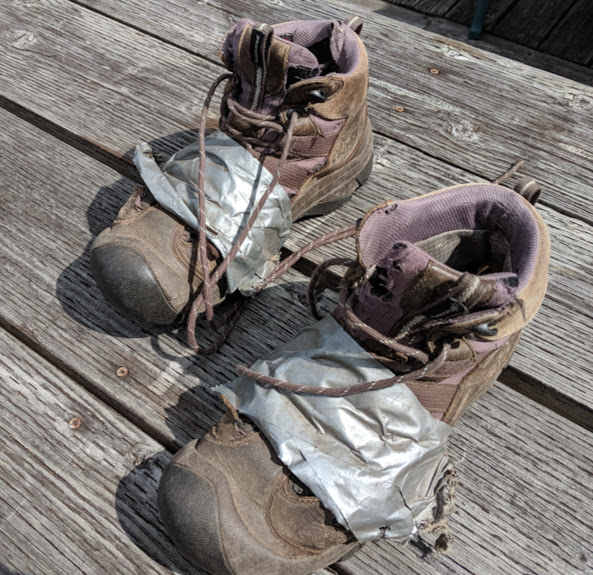
“I want to be thoroughly used up when I die,” wrote George Bernard Shaw. I think he was talking about my hiking boots.

Don’t laugh. They’re COMFY.

Seriously–stop laughing. The only thing wrong with them, for years, was ripped fabric up top–nothing a little duct tape couldn’t fix.

OK, a lot of duct tape. I mean, the duct tape on TOP did just fine, but the part that wrapped around the soles…well, you get the idea. But I was willing to sacrifice a few more feet of the silver stuff just to keep my boots doing what they were made for (walkin’).

But recently, they developed rips in the lining, which turned the simple act of pulling them on into a bit of a struggle. It was finally time to say goodbye–right into the trash. I know even our island’s Take It Or Leave It would revolt at taking these guys.

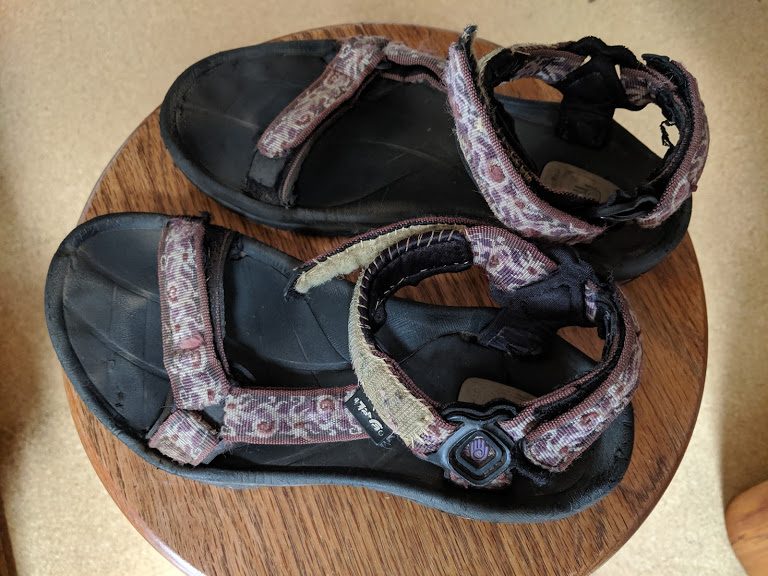
Then the very same week, while camping, I noticed deep cracks in the soles of my beloved Teva hiking sandals…whose Velcro I had long ago repaired. Suddenly their life span seemed to wither before my eyes. (It’s possible that the arrival of the REI Outlet Sale catalogue had a teensy bit to do with that.)

Might’ve used a bit more Velcro than needed, but man–it did the trick for years!

No, I am NOT trying duct tape on this.

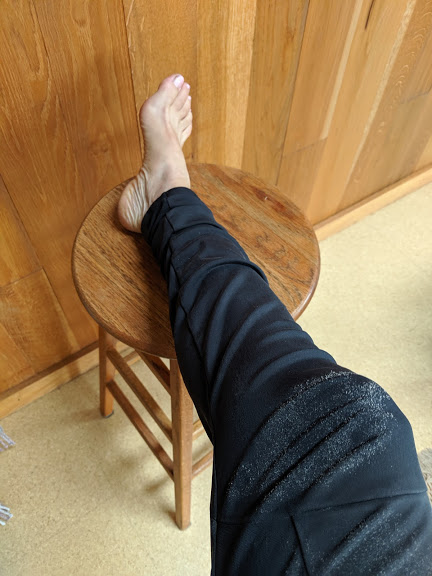
And then, would you believe it? It happened again today: my ancient gear just gave up the ghost. I wore my special just-for-biking tights around town after riding into work, and noticed that I was shedding tiny bits of Spandex, or whatever the stretchy stuff’s made of. I knew the tights were the worse for wear–hell, they were a gift, I never would’ve paid for something so specialized–but turns out they were really COMFY and warm, which is why I wore them to literal shreds.

Et tu, biking tights?

So is this just me? It’s certainly not my Mate–he loves getting new gear for himself. “If it doesn’t work well, why have it?” he says. And I agree in THEORY…but in reality? I hate to let my old friends go.

So, two questions:

  1. Anyone else have this issue with stuff? 
  2. Where did I put that REI catalogue?

That’s Dirt, Not Blood on My Hands–But Yes, I Perpetrated a Mossacre :(

If you are about to de-moss your roof, OR about to read Robin Wall Kimmerer’s book Gathering Moss: A Natural and Cultural History of Mosses, please, by all means, go ahead and do either one. But for your own sake, I beg you not to do what I did: both simultaneously.

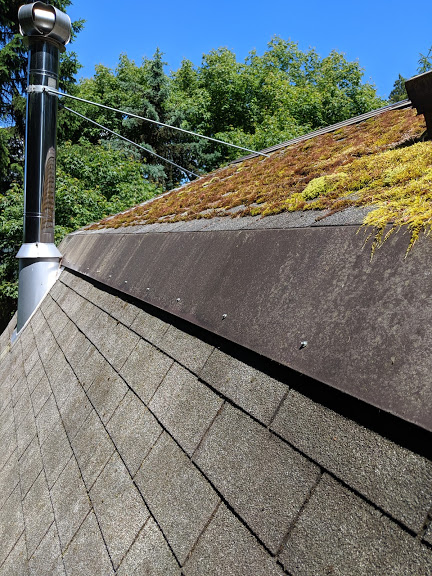
It all started innocently enough, with me trying to keep up with The Mate and pull my weight in outdoor chores. With our barn roof doing its best to become a forest floor, I joined in on the de-mossing project, 100% committed.

Committed to getting rid of THIS.

Of course we didn’t use any chemicals to remove the moss. Our only tools were a sort of vicious, giant metal ogre-toothbrush, and our own muscles.

Like so.

At first the job was actually pretty fun. Hard work, and–way up high, in a harness–a little scary, but fun.

Can’t call myself brave ’cause I’m not afraid of heights. But I did move…let’s say…cautiously up there.

But then, on Day 2 of Project Kill the Moss, I happened to pick up Dr. Kimmerer’s book on a recommendation. Dr. Kimmerer, as I mentioned in my last post, is a Bryologist–a moss expert. In the opening pages, I realized she was opening my eyes to a world I had always admired but knew NOTHING about. 

The “moss” is many different mosses, of widely divergent forms. There are fronds like miniature ferns, wefts like ostrich plumes, and shining tufts like the silky hair of a baby. A close encounter with a mossy log always makes me think of entering a fantasy fabric shop. Its windows overlow with rich textures and colors that invite you closer to inspect the bolts of cloth arrayed before you. You can run your fingertips over a silky drape of Plagiothecium and finger the glossy Brotherella brocade. There are dark wooly tufts of Dicranum, sheets of golden Brachythecium, and shining ribbons of Mnium. The yardage of nubbly brown Callicladium tweed is shot through with gilt threads of Campylium. To pass hurriedly by without looking is like walking by the Mona Lisa chatting on a cell phone, oblivious. (p. 10)

That last line? She could have been talking about me. And I LIKE moss! I mean, mosses. Sorry.

You can tell where this is going, right? I stared noticing the different types of mosses I was murdering, wondering which was which. I realized the importance of names, as she mentions in a passage I quoted last post:

…Often, when I encounter a new moss species and have yet to associate it with its official name, I give it a name which makes sense to me: green velvet, curly top, or red stem. The word is immaterial. What seems to me to be important is recognizing them, acknowledging their individuality. In indigenous way of knowing, all beings are recognized as non-human persons, and all have their own names. It is a sign of respect to call a being by its name, and a sign of disrespect to ignore it. (p. 12)

Bad enough, I thought, to be scraping away at these works of Nature’s art, these tiny, persistent beings. But how much worse not even to acknowledge them by name!

Fare thee well, ye feathery and ye silky-fronded alike!

To make matters worse, around Day 4 of the project, I ran into this passage:

Allegedly, the moss rhizoids penetrate tiny cracks in the shingles and accelerate their deterioration. However, there is no scientific evidence to support or refute this claim. It seems unlikely that microscopic rhizoids could pose a serious threat to a well-built roof. One technical representative for a shingle company acknowledges that he’s never seen any damage by mosses. Why not let them be? (p. 95)

Wait, what? I’m perpetrating all this murder and mayhem and it might even be FOR NOTHING?

But I wasn’t about to talk myself into stopping 2/3 of the way through the project, let alone The Mate.

Coming for ya, whether you like it or not. Me–I don’t like it anymore.

I pushed on. But the joy was gone from the job. All I felt was guilty. Well, and a bit sweaty and dirty too.

But you tough little rhizoids? Kinda cheering for ya now.

The barn roof is free of mosses now, and if Dr. Kimmerer is right, it might be years before they’re fully back. When they are, I think I might argue to let them be this time. Meanwhile, as penance, I’m noticing their individuality as much as possible on my walks, and talking up Gathering Moss to whomever will listen.

And I’m thinking about the importance of names: how we name what we value, and value what we name.

Maybe, as part of my penance,  I could learn those Latin names. Or even, God help me, turn my attention to those other unnamed companions of my spring and summer walks…the grasses.

Oh dear God, not the grasses!


Road Trip IX, Days 38-40, Denver to Moab: Mecca’s Crowded–Who Knew?

By now you’re probably tired of hearing me talk about sandstone. Too bad.  So far on Road Trip IX, I haven’t had the pleasure of talking about RED sandstone.

This stuff!

After zipping across western Kansas and eastern Colorado (please somebody tell me something interesting about western Kansas or eastern Colorado!), we spent the night with a friend in Denver. Full disclosure: this stop was in full Carolina Tarheel Fan Mode, not our usual Outdoor Adventurers In Search Of the Ultimate Bike Path or Hike Mode. Our friend is from Chapel Hill. Together we ate pizza and happily whooped the Tarheels into the Round of 32. Mission Accomplished.

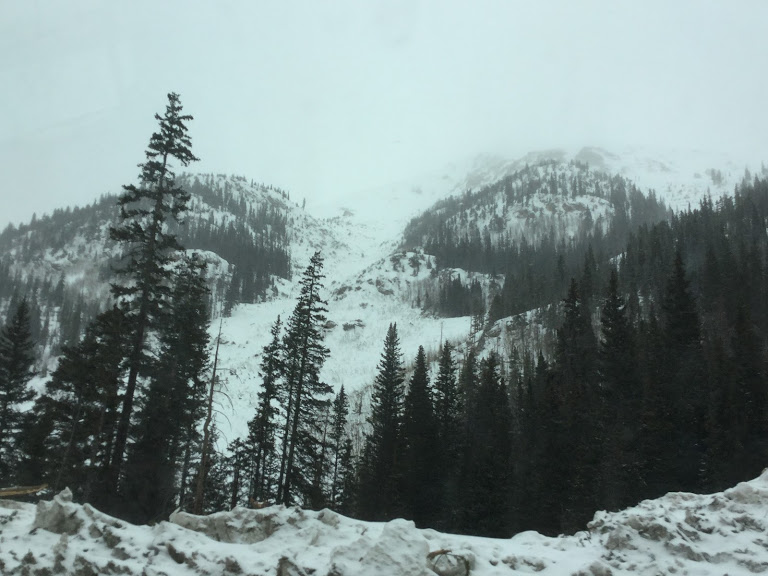
Next day we braved the passes of I-70 through the Rockies, blessing the weather gods and Colorado DOT for keeping the roads clear, even though the roadsides looked like this:

11,000+ feet, 20 degrees…and 55 mph!

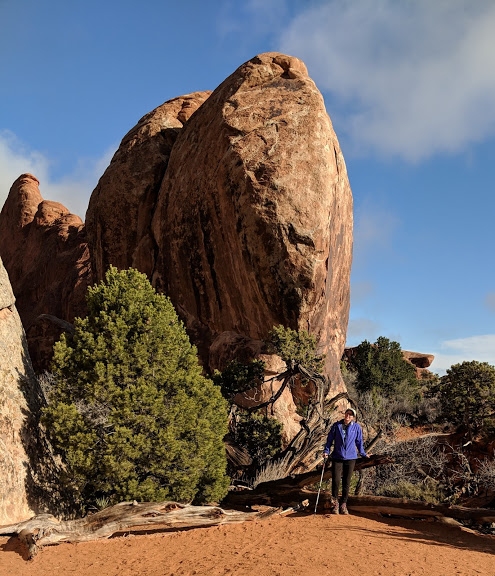
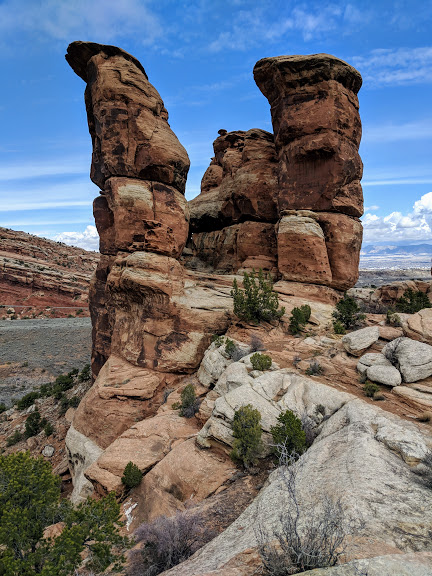
Safely on the other side, temperatures back in the 40s, we took a recreational stop at Grand Junction’s not-so-hidden treasure, Colorado National Monument. We’ve camped there before, and know that its red sandstone towers and hollows and who-knows-what-to-call-its are the equal of anything outside of Arches National Park. We didn’t have the time to go deep into the park, but a single swift hike through the very corner yielded this:

“The Devil’s Kitchen”

Inside The Devil’s Kitchen. The Devil has some cool appliances!

After that, we said goodbye and thanks to Colorado, and zipped on down to Mecca Moab, Utah.

Why do I call it Mecca? Because Moab is the holy city for people of The Mate’s and my religion, The Church of the Great, Dirty, Sweaty Outdoors. In Moab, every other car looks like ours.

Red Rover says, “Finally! I’m one of the cool kids here!”

Wheels, wheels, wheels! Granted, some are attached to monster engines on scary-looking jeeps and ATVs. But most are some form of bike. And even those folks who aren’t there to ride around on something are still there to play hard and get dirty.

These families are climbing this super-steep red dune to race and slide back down. That could be the definition of cheap thrills.

While patiently waiting for the Heels to play their Round 2 game, we delighted ourselves with bike rides and hikes in some of the most perfect, astounding, God-given terrain available to mankind. Now when I say bike rides, I do NOT mean this:

I’m sure mountain biking is fun. I’m equally sure that I would kill myself if I tried to do it.

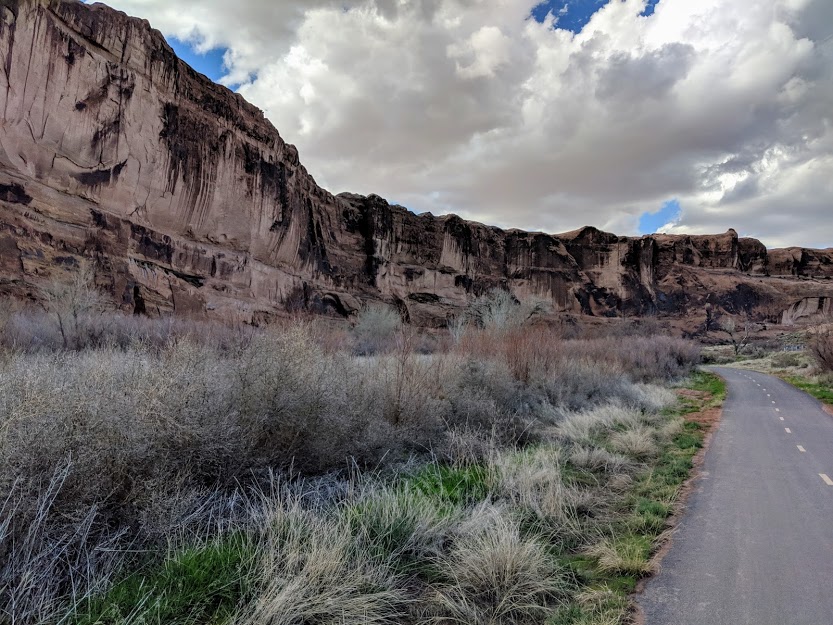
I mean this–this amazing trail that runs all the way from the rim of the valley,

Yes!!!! 7% grade…but the scenery takes your mind off the grind.

through town, and along the Colorado for who knows how many more miles (I had to turn around before finding out).

Sun started disappearing. Scenery stuck around.

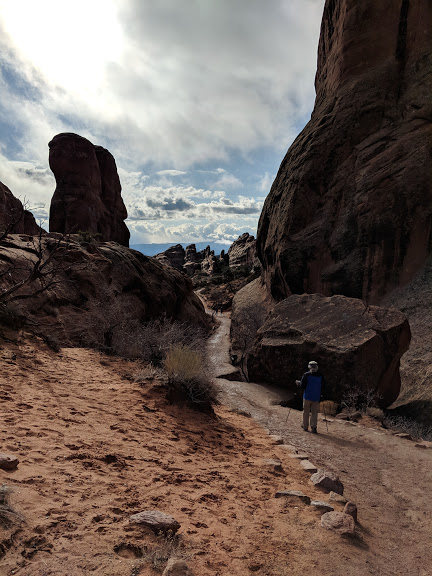
As for hiking, well…the entrance to Arches National Park was two miles from the campground we were staying in. And if you don’t know Arches…

…please allow me to introduce you! This is the famous Landscape Arch.

And this is Balanced Rock. Not sure where the name comes from.

Pine Tree Arch is one of my favorites, mostly because it’s off the main trail. We actually had it to ourselves!

My hope was, if the weather was decent, we could spend a night camping after having safely seen our beloved team into the Sweet 16. (Pause for wild cheering from Tarheel Nation.) But stupidly, I’d been so deeply enjoying the fact of all these other fans of the Great Red Outdoors, I’d missed the obvious: those fellow red-rockers were our competitors for camping spaces. And unlike us, they’d been smart enough to make reservations. Months in advance, probably. The Arches campground was, of course, FULL FULL FULL.

You–keep walkin’.

So much for my “Peaceful, Easy Feeling” image of “I wanna sleep with you in the desert tonight/With a million stars all around.” Yes, there are first-come, first-served BLM campgrounds scattered about, but you can camp in those for up to two weeks. What were we supposed to do, hang around all day waiting on the off chance of being there when someone pulled up their tent stakes? C’mon! We have trails to hike, basketball games to watch!

No room at the inn for these ol’ lovebirds.

So…Irony. The very thing that draws us to Moab–the joyous celebration of its dirty, sweaty beauty–prevents us from engaging in that highest of ceremonies, spontaneous camping. Yeah, I suppose we could’ve acted like our younger selves and just pulled off the road somewhere to pitch our tent. But in the Church of the Great, Dirty, Sweaty Outdoors, I guess these days we’re those Establishment types who claim front pews. Next time, if I possibly can…I’m making reservations!

One last morning hike before we have to go… 😦

Road Trip IX, Day 6-10, LA to Tucson: Climate Change And Other Extremes

THIS was our gateway to sunny SoCal, on I-5 South just above LA:

Tejon Pass. The northbound highway was closed.

Once there, in the city where my mom was born & raised, where my grandparents & uncle are buried, we holed up for a few days with my dear college housemate & her husband, visiting with them as well as some of my cousins AND a dear almost-sister of the Mate’s, Rhonda.

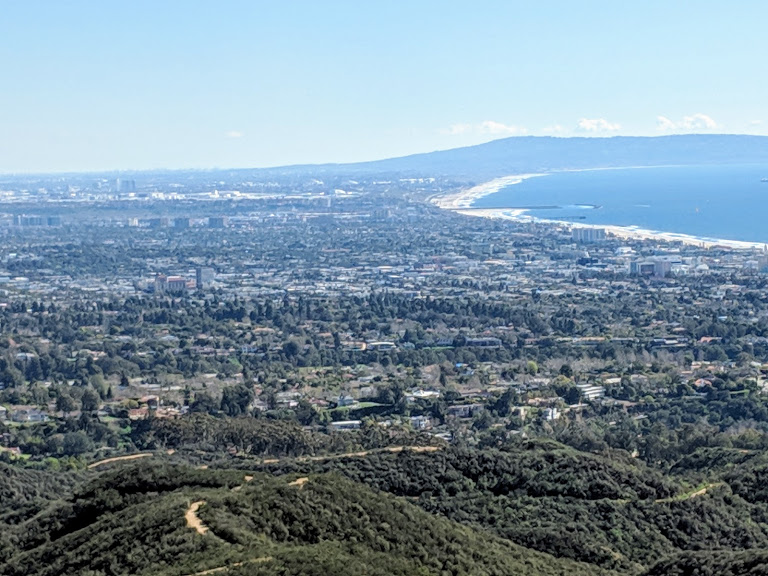
I’ve been to LA more times than I can count, since childhood. Since I can no longer visit my grandparents, this time I chose to notice contrasts and extremes. For example…LA is this:

Looking south from Will Rogers State Park

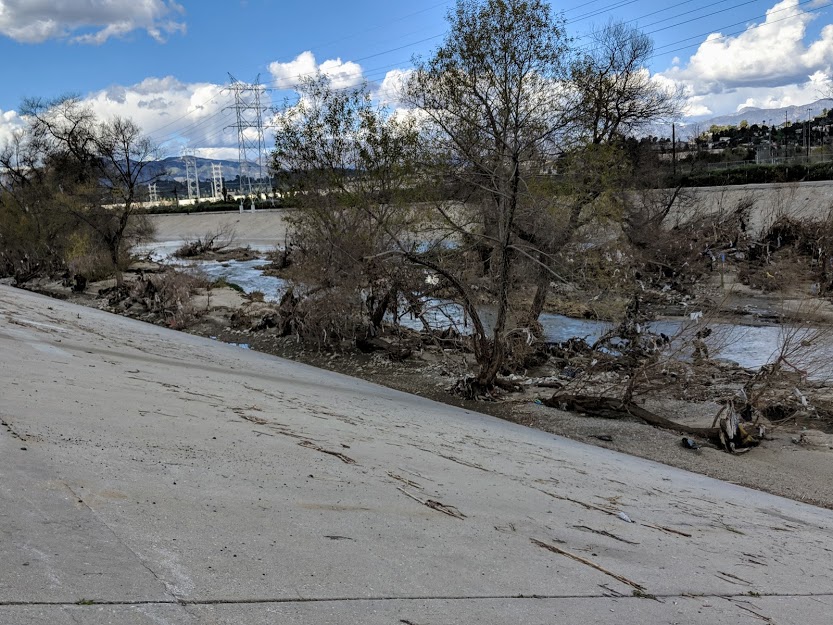
and this.

The LA River, with trees full of garbage and the former belongings of homeless people, flooded out

It’s the 100 year-old avocado tree whose fruit my wonderful cousins gifted us with

We got a whole bag full! Thanks, guys!

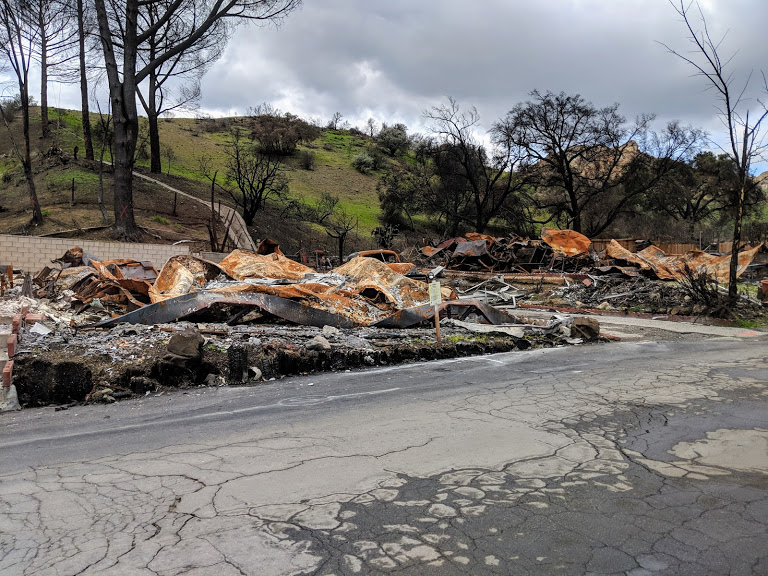
and it’s the Woolsey Fire, which spared Rhonda’s house (and chickens–a miracle) but destroyed the art studio where she and her late husband Alisha made and kept all their creations (she’s a metal artist; Alisha did glass).

That slab is all that’s left of the 2-storey studio.

Part of one of Alisha’s pieces that survived the fire

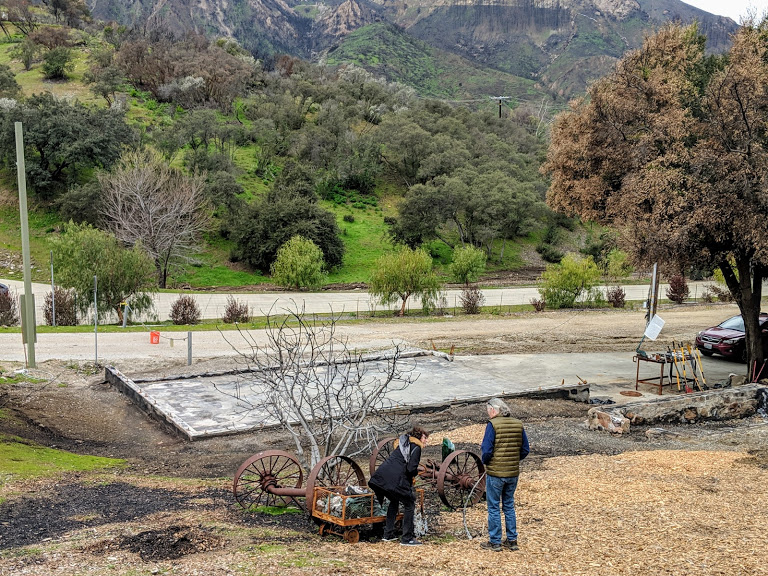
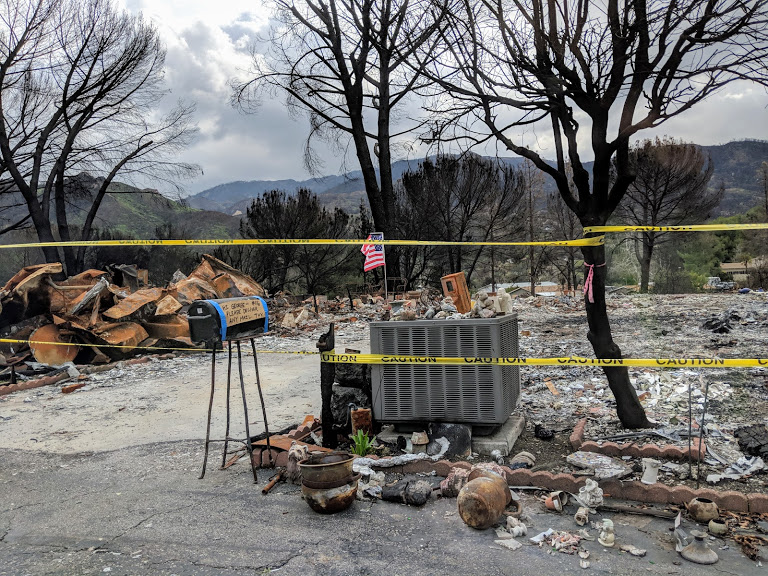
If you think about it, that fire from last November–California’s largest ever–is itself a symbol of extremes. Too much drought mixed with too many people = misery. It burned nearly 100,000 acres and over 16,000 structures…including these, Rhonda’s neighbors across the road:

I’d seen it on TV. But it’s so different when it’s all around you.

I can only hope these folks can recover their lives. Their mailbox has a personal note to “George,” their mailman.

Leaving LA for what we call The Big Left Turn to cross the rest of the continent, we made our recreational stop in one of our favorite, accessible national parks, Joshua Tree. The first set of trails is only 8 miles (but a world away) from the interstate.

We are so lucky to be able to walk so safely into the desert like this. Think of all the people for whom the desert means danger.

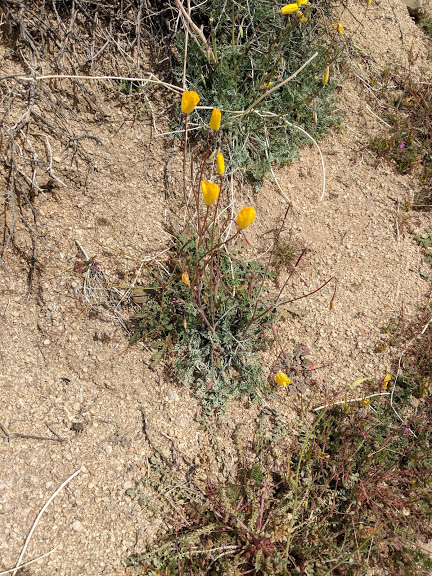
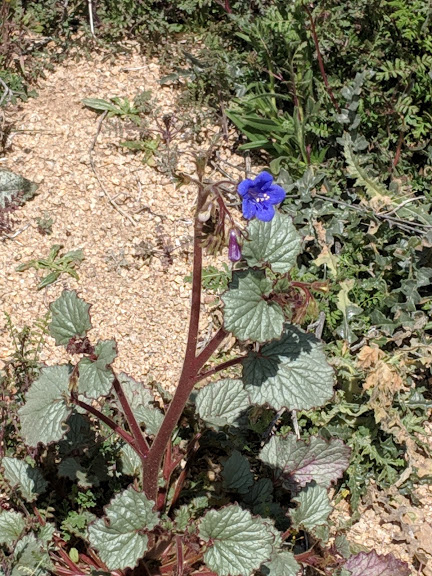
Since I have so many pictures of rocks, this time I focused on flowers.

These pool little golden poppies are too cold to open!

There were a lot of them! Ah, blessed spring.

Isn’t this gorgeous? Anyone know what it is?

But what’s up with those dark clouds?

Ocotillo cactus blossoming

Hmmm. Getting colder by the minute.

Last little blob of sunshine…

By the time the Mate took this, snowflakes had begun to fall.

Hurry up, my legs are freezing.

Let’s get out of here! Dropping back down to I-10, we left the white stuff behind…

…until next morning, driving into Tucson. Seriously?!

Seriously.

I don’t know if this is just Climate Change, or Nature’s way of reminding me I need to include “Snow Falling On Saguaro” in my photo gallery. I saw that, all right, but unfortunately I didn’t capture it…’cause I was too cold and wet to take off my gloves.

Sun’s supposed to come out tomorrow. It would be nice to have something non-extreme to notice for a change.


Road Trip IX: Let’s Get This…Brrrr!…Party Started

If you’ve been following Wing’s World for a while, you know that The Mate and I take a 6 to 7-week pilgrimage this time of year, from our little island in Washington’s Salish Sea, all the way across the country, back to our former lives (and my folks, and Tarheel basketball) in North Carolina.

If you’re new to this blog–well, now you know. Welcome! This is the only time Wing’s World morphs into a travel blog; please join me!

The Mate cleared out our bike garage in order to load up Red Rover without getting snowy.

That is, if we ever get going. When driving across the country in February and March, weather is always in charge of your route. Every year we’ve diverted around something. But we’ve never found ourselves stopped in our own driveway! We were planning to leave on February 12, but now it’s snowing like crazy, so that is NOT gonna happen.

I’m pretty much packed. Cleaned out the fridge. Nothing to do but go for a walk!

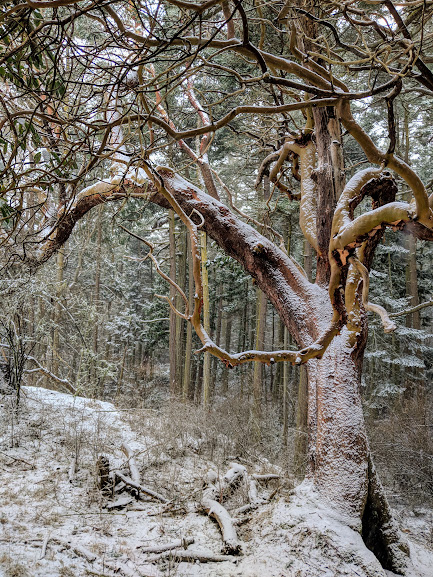
Snow falling on cedars…and salal…and bracken…

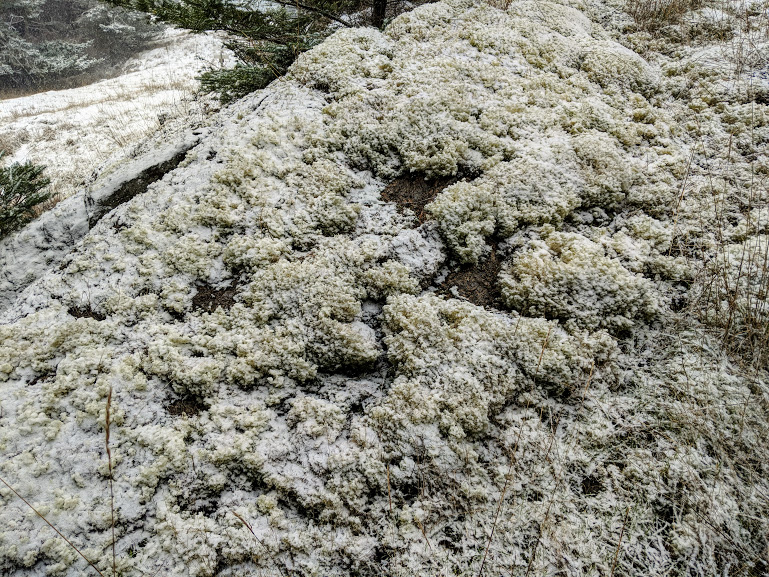
…and moss…

…and reindeer lichen…

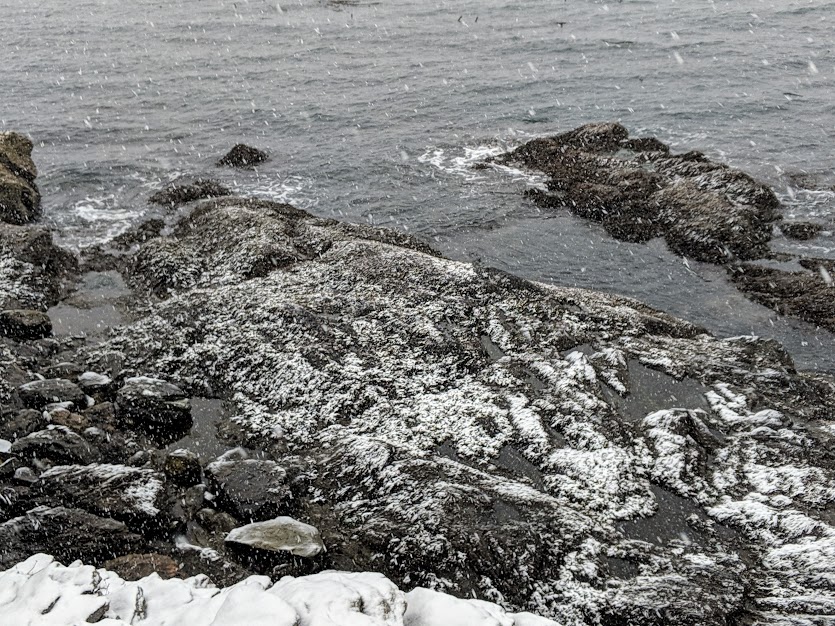
…and even kelp!

You know what, though? This extraneous walk gave me exactly what I needed: the reassurance that, no matter where we go, there is no more special place than where we already live.

G’bye, Gorgeous…see you in the spring!

The rest of y’all? See you on the road…whenever we get there!

“Go on, already…we’ll take care of this place while you’re gone.”

Return To Kiwiland, Take 2: Author’s Cut

A quick catch-up: twenty-two years ago, my family spent an academic year in southern New Zealand.

Two years ago, the Mate and I returned, with two objectives: 1) tramp (hike) the Milford Track (Trail); 2) learn about the Coast to Coast cross-country multisport race for a novel I’m writing.

Objective #2 was mine, not the Mate’s. And this time, the purpose of this trip is ENTIRELY due to the demands of my book. But lucky me, the Mate’s coming along anyway, and so is Wing Son Two, who can keep him company when I’m off learning about sheep farming and Maori culture.

There will always be sheep.

Will this trip feature some adventures? Of COURSE–this is NEW ZEALAND we’re talking about.

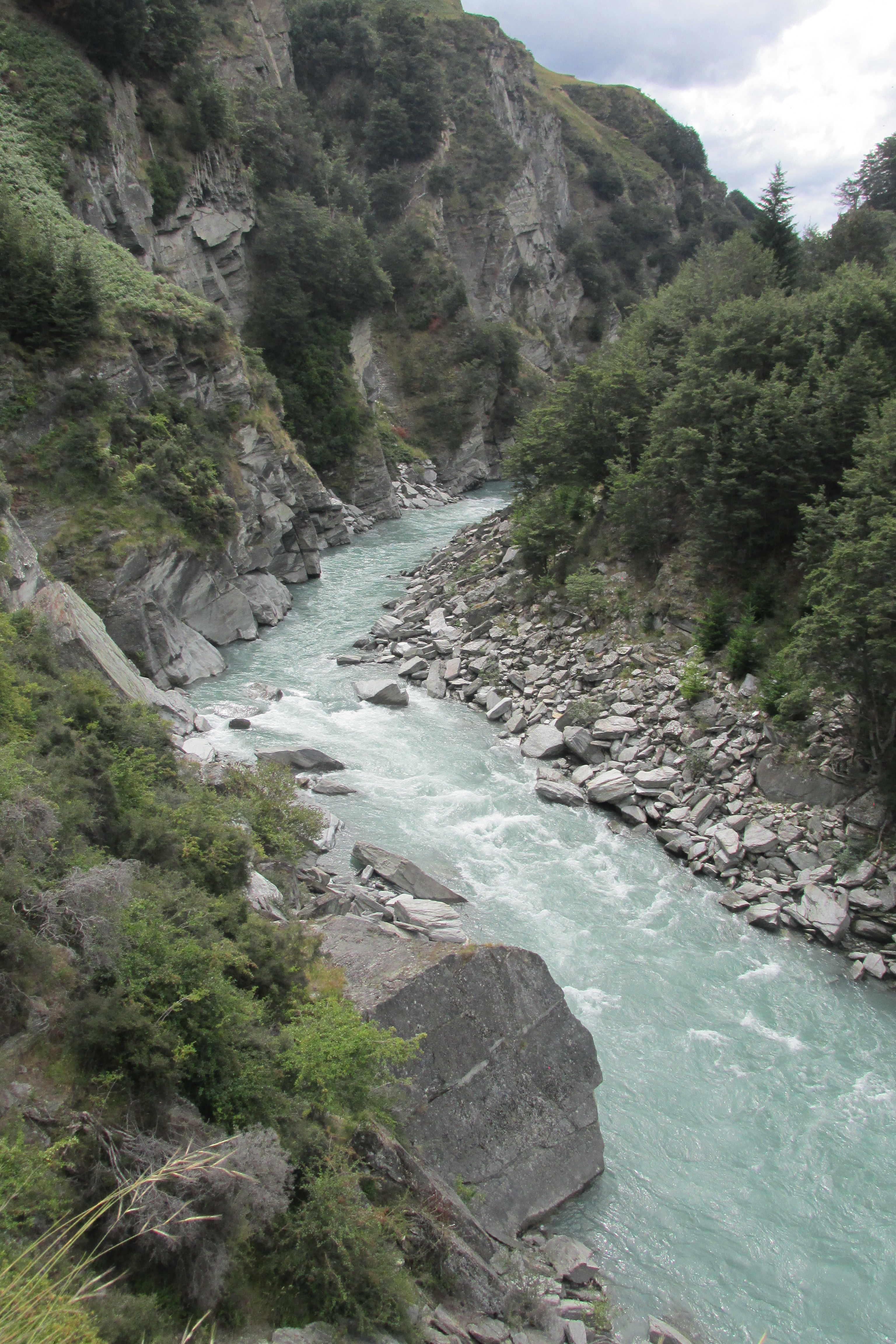
Rugged rivers? High probability.

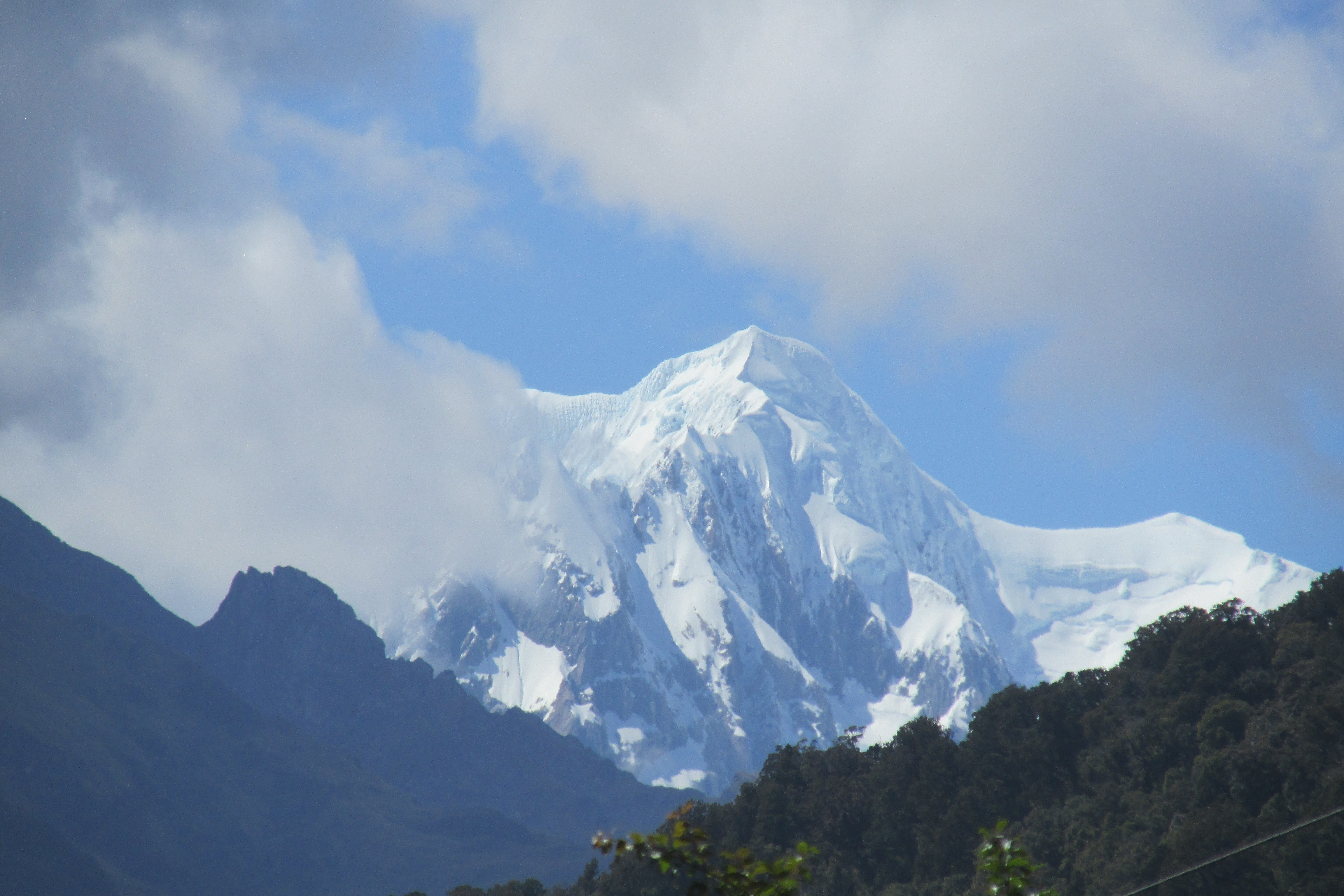
Aoraki (Mt. Cook)? Could be!

Tree ferns there WILL be. (I love me some tree ferns.)

But when I return, will my accounts of New Zealand be travelogue, or Author’s Notes? Stay tuned. Ta for now.

Celebrating Family Piety In The Church Of The Great Outdoors

Since our children are grown and flown, we count any holiday we can spend together as extra specially blessed. This year we have been basking in this blessing (as much as one can bask, in a Pacific Northwest winter), and celebrating by going to church.

Our version of church, that is: the Church of the Great Outdoors.

While I was raised as a Quaker and still attend Meeting, we did not find Quakerism attractive as a family unit when Sons One and Two were growing up. The Mate was not interested, and I was loathe to leave the kids behind after being away from them at work all week. Also, the Meeting I attended in Tacoma was so small that if I did bring them, I usually ended up having to do my own childcare, which felt silly. Might as well stay at home together…or go for a hike.

And so evolved our family religion. We weren’t that hard-core; after our kids reached the age of two we ceased riding them atop our backpacks–too heavy! And once they got into team sports, our weekend forays became fewer. But still, on holidays, the mountains called, or the ocean, and we always came. Hell, that’s why we became Northwesterners to begin with! (You’re welcome, boys.)

And the only place we all actually enjoy shopping? REI. Going there is like a down payment on beauty.

So, two days after Christmas, here we are, in deep worship:

Easiest liturgy in the world.

A little snow just adds to the reverence.

Amen.

Peace be unto you.

Glory be…

…and all praise.

Nothing Gold Can Stay…Including, It Seems, Me.

Continue reading

That Annual Thanksgiving List We All Love to Write

Pretend you’re in third grade. It’s the Wednesday before Thanksgiving, and your teacher just gave you That Assignment.

Now pretend it was your idea all along. With me? Let’s do this. Here’s mine:

This year I am thankful for…

…the good health of my family, myself, and most of my loved ones.

…the communal strength, love and support that continues to go out to those in need of it.

…the power of Nature’s everyday beauty that she keeps surprising me with (Spiderweb! Lichen! Wing of thrush!)

…really DARK chocolate

…the way gardening and eating local food is re-awakening in America

…my amazing amalgam of work, which allows me to get my hands sticky, get paid, interact with lovely people, and still retire to the quiet of my writing bench

…those hard-working folks still teaching and nursing and fixing pipes FULL TIME (y’all know who you are; I am so grateful to you–please let me make you pie!)

…friends who push me to improve my Spanish and my guitar-playing.

…mis hijos. Los dos.

…my Mate. Always. Always. But somehow, after 37 years–increasingly.

So...freakin...grateful!!!!!

So…freakin…grateful!!!!!

Know what? I could do this all day. How ’bout you? What’s at the top of your gratitude list? HAPPY THANKSGIVING!

PS–don’t forget to #optoutside this Black Friday!