First, let me take a moment to welcome my Wing’s World readers who have done me the honor of subscribing, now that I have left the Facebook community. As I posted on FB before deleting, no judgement for those who stay! I have mixed feelings about leaving, and goodness knows, I’m fully invested in Google products, Amazon services, and all kinds of other playgrounds of unsavory billionaires. Aren’t we all just doing our best?
So what was that about bird quilts? Do you mean cute little sparrow-sized comforters? Something to tuck around your favorite hen? Or do you mean…
Ah. THAT’s what you mean. (Quilt by Phyllis Cullen)
This cormorant by Caryl Fallert-Gentry stopped me in my tracks–how is this not a photo??
Because I was at the museum chiefly to see the Red Dress, and because I had a ferry to catch, I had to flit from bird to bird, snapping photos to study later. But thanks to the wonderful technology of “zoom-in,” we really CAN do just that, appreciating the detail, the genius of the work almost as well as in person.
Go ahead: zoom in!
Who, who, who made this quilt? Unfortunately I was so excited to take its picture, I missed the creator’s name. Sorry, O Talented One!
But I am inspired. Not so much to get back to the ol’ sewing machine (got too much else going on right now), but inspired by plain old beauty. Imagination. Discipline. Bird love. All the things you see when you zoom into…
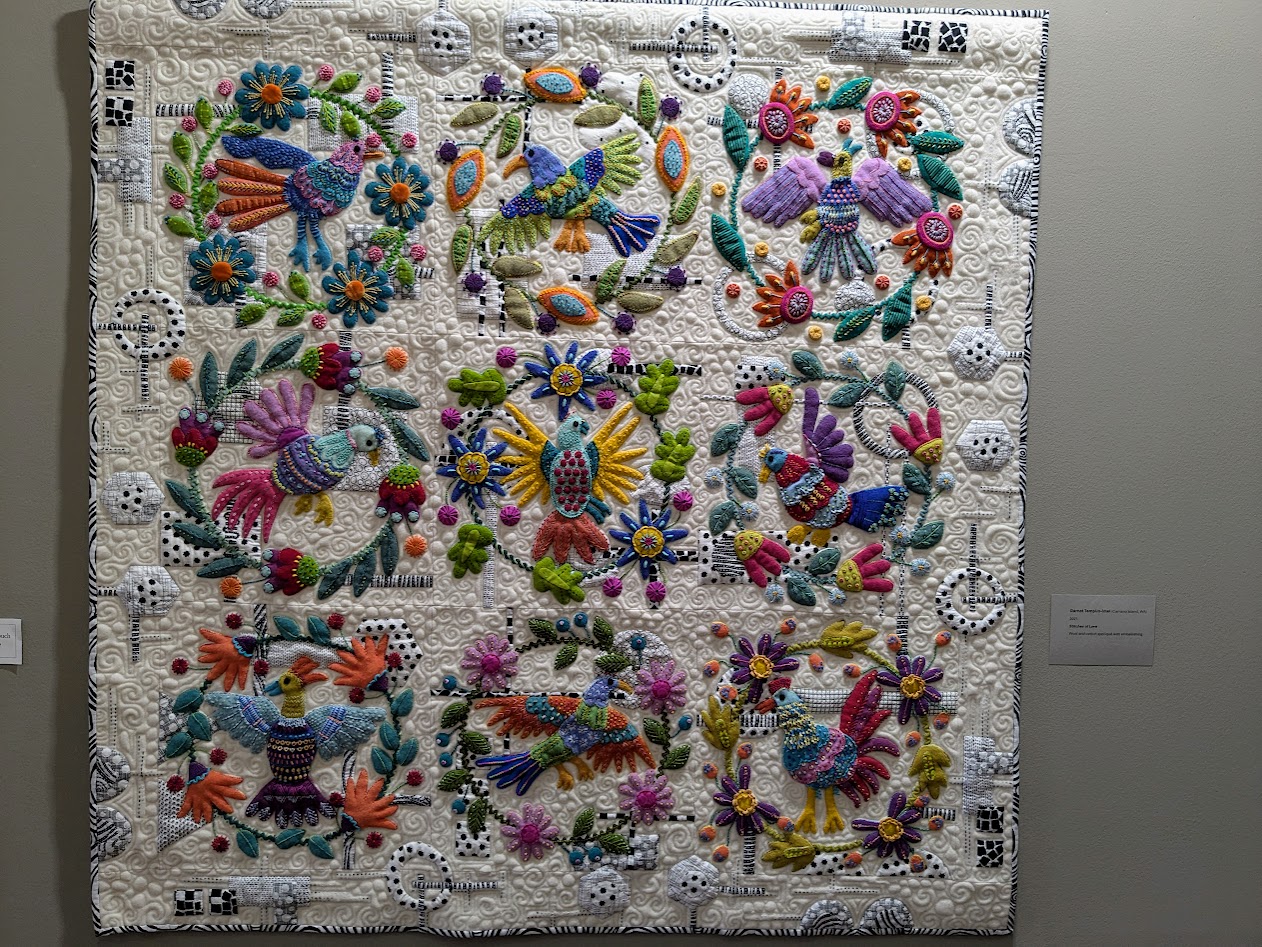
…this folk-art piece by Garnet Templin-Inei, for example.
Or this whimsical, 3D depiction of a swooping eagle, using natural, gathered materials:
Lookout, ducks–DUCK! Perimeter includes mammalian jawbone and some kind of antler. (once again, my apologies for missing the artist’s name)
These are bleak days. You don’t need me to tell you that. But you might need me to show you a gorgeous, cheerful quilt-full of finches. Because ESPECIALLY these days, we all need every last ounce of inspiration, beauty and joy we can absorb.
Once again–apologies to the unnamed artist! I really did get too excited taking photos. Sorry.
I’ll be traveling for the next 3 weeks, WITHOUT my computer. So please, pile on the comments so I can read them before I go, and when I get back, Wing’s World will go back into travel-blog mode.
Till then, be well, zoom in, be inspired! And thank you for visiting Wing’s World.
I read the article (by Ava Ronning, reprinted from The Skagit Valley Herald). And I had to go see it for myself.
Overwhelming. And that’s only at first glance.
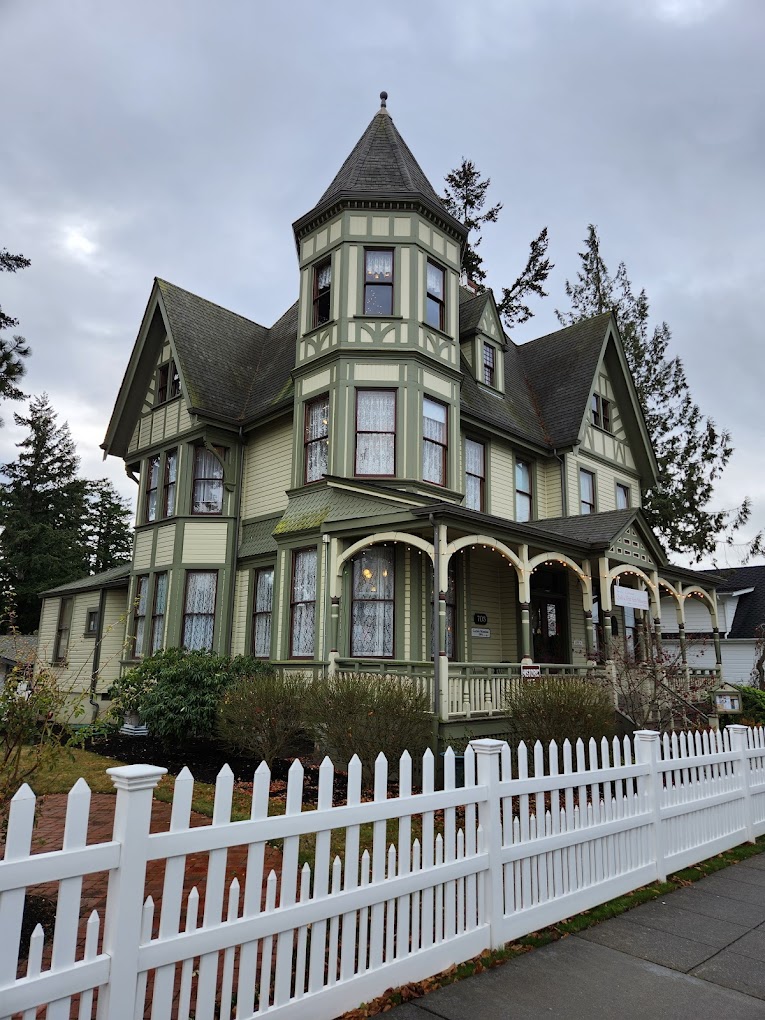
The museum itself is housed in a breathtaking old dwelling on a hill overlooking the Swinomish Channel. I was so excited about the exhibit I forgot to photograph the museum, so here’s a shot I stole from their website:
Photo by Wendell Hendershott
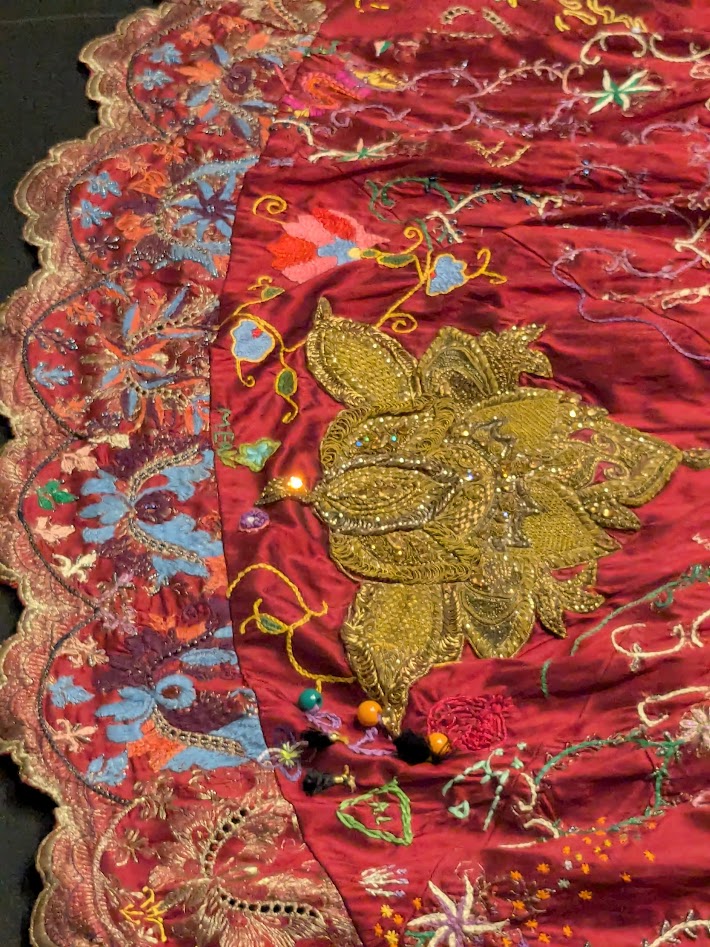
The dress occupies one small room…and I mean occupies. It fills the space, drawing you in to examine every fold, every flounce.
The border is the only part embroidered by machine, commissioned by the dress’s creator
And that’s before you watch the video in the next room, which unpacks the dress’s stories (in part–there are too many for a 12-minute video). That’s where I learned that the white doves on this panel, sewn by survivors of the Kosovo war, represent their longing for peace.
Notice the contrast with the colorful images from (I think) Rwanda. Two communities of survivors, side by side on the dress: white and color; same medium, same message.
The Red Dress Project began with UK artist Kirstie MacLeod, as the website says, “as a sketch on the back of a napkin in 2009.” Since then, it “has grown into a global collaborative project involving and connecting with thousands of people all over the world.”
Through the video, I learned the story of this small piece from an artisan in Colombia. She started with traditional symbols–hibiscus, toucán–but after being shaken by a bombing in Bogotá, she added this word in English:
She could have written “esperanza,” but she preferred to make her message more universal.
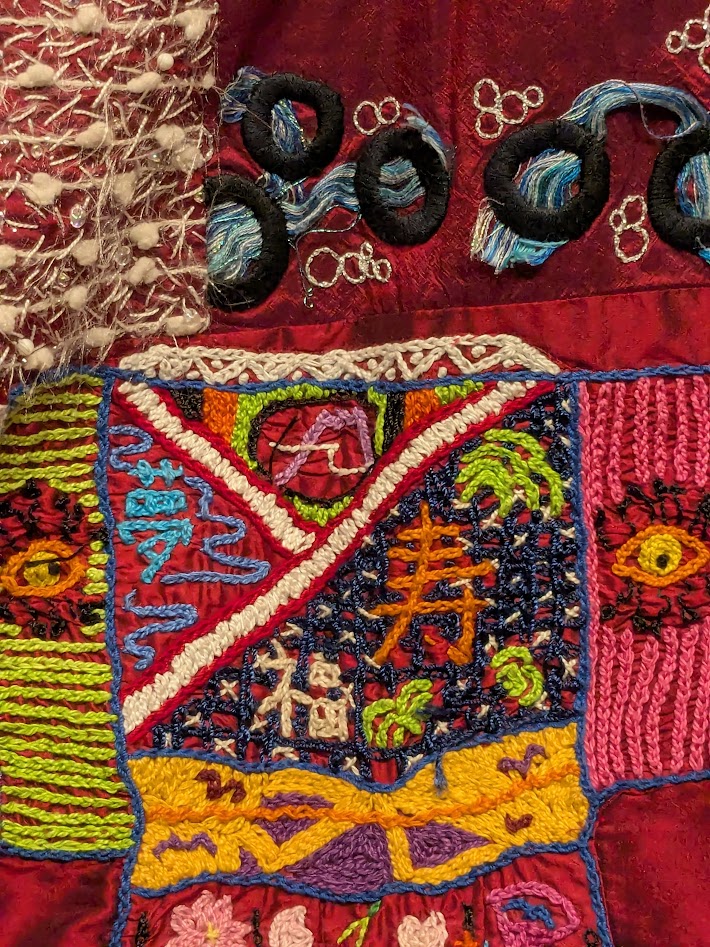
The same word appears in a section from…somewhere else in the world:
The video didn’t say where. But how many places it could be from!
The website tells you right off how many women have been involved in its creation: 380. From 51 countries. If you dig around on the site, you will also learn that the dress weighs 6.8 kilos–that’s just under 15 pounds. (I actually thought it might be heavier–there are beads stitched on there!)
like this bit from India
The website goes on to explain,
Initially the project sought to generate a dialogue of identity through embroidery, uniting people around the world across borders and boundaries. However, over the 14 years it was created, The Red Dress also become a platform for self-expression and an opportunity for, often marginalised, voices to be amplified and heard, initiating vital dialogues on important and frequently uncomfortable issues.
A panel from Chiapas, Mexico. This section of the video was one of the most moving.
The website estimates the number of stitches in the dress from one to 1.5 billion. It reports: “Some of the artisans are rebuilding their lives with the help of embroidery, using their skills or being trained in embroidery to earn a consistent living to support themselves and their communities.”
In other words, these women are paid for their work. From the video, I learned that 50 Bedouin women had been able to achieve financial independence from the embroidery work the Red Dress Project engendered.
This one’s from Japan, not Egypt. I didn’t learn its story.
The most heartening part of the video is where creator Macleod explains, “The importance has shifted from the dress as an art piece to the creators of the dress.” One country at a time, she is traveling with the dress to allow each embroiderer to see (and in some cases wear!) the entire dress, in most cases for the first time. Seeing that wonder on the face of the 19 year-old artisan in Mexico choked me up.
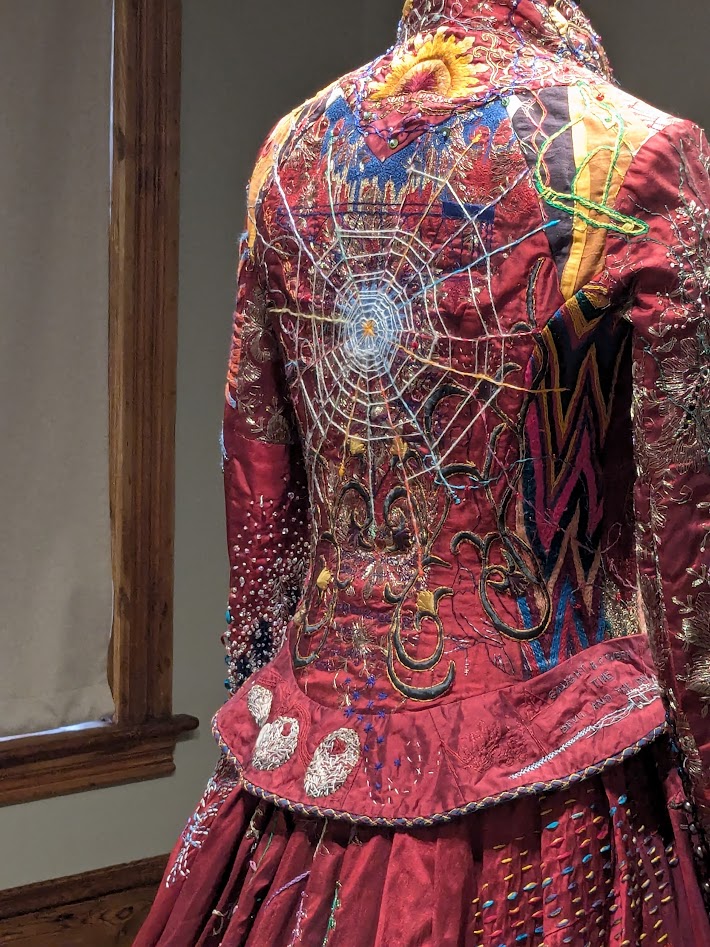
Macleod herself stitched the web on the back of the bodice, representing connection.
Speaking of choking up: this image from Ukraine: their national colors expressed in a flower:
May it be so
Only after leaving the exhibit did it occur to me to consider the word “redress”: it means, “to remedy or set right (an undesirable or unfair situation).” As Kirstie Macleod says, in the video, “The voices of the women are just crying out to be heard.”
And in an era of increasing division, borders, walls, aggression and suspicion, this dress is a community object “without prejudice, without boundaries, without borders…”
So many stories to absorb. So much solidarity to learn from.
So, you want to see the dress yourself? Here’s how.
According to the website, after its La Conner visit (La Conner! Not Los Angeles! That still blows me away), the dress will travel back to the UK, and thence to Asia and Australia.
modest little La Conner, and the Swinomish Reservation on the opposite side of the channel
So unless you can go to those places, here’s what I recommend. Go to the website. Watch the video (under “Media”). Then use their really cool Digital Red Dress tool for a DIY tour: https://reddressembroidery.com/DIGITAL-RED-DRESS
If you’re really bold and/or inspired, Ms. Macleod invites you to reach out to her directly: “Kirstie is able to offer events and presentations with/without the Red Dress tailored to your group/community. Please email her for more info on: reddressembroidery@gmail.com”
That wonderful museum in La Conner is also showing a breathtaking exhibit of bird quilts. I was going to append some of those photos to this post, but you know what? The Dress and the birds deserve their own space. So I’ll save the birds for later.
Go see The Red Dress, in whatever medium you can. And then tell me your favorite part about the experience, eh? It’s all about that web.
WordPress tells me my last post was #500. Not paying much attention to these things, I just happened to notice, but–mazel tov, me! That milestone’s a good enough reason to carry on blah-blah-blahgging, right?
I’ve written in the past about my imperfectionism as it relates to the arts of baking, music, and quilting. This latter trait came to light big time this fall when the Mate actually commissioned me to make a quilt.
More specifically: a window quilt, something to insulate our sliding glass door in the winter months. Since we heat exclusively with firewood, blocking that giant heat sink was going to save us a lot of logs.
His request happened to coincide with a one-day workshop I took from Grace Errea, on a new method of adhesive applique. Grace’s quilts are jaw-droppingly beautiful, so I thought–aha! Here’s an opportunity to use what I’ve just learned.
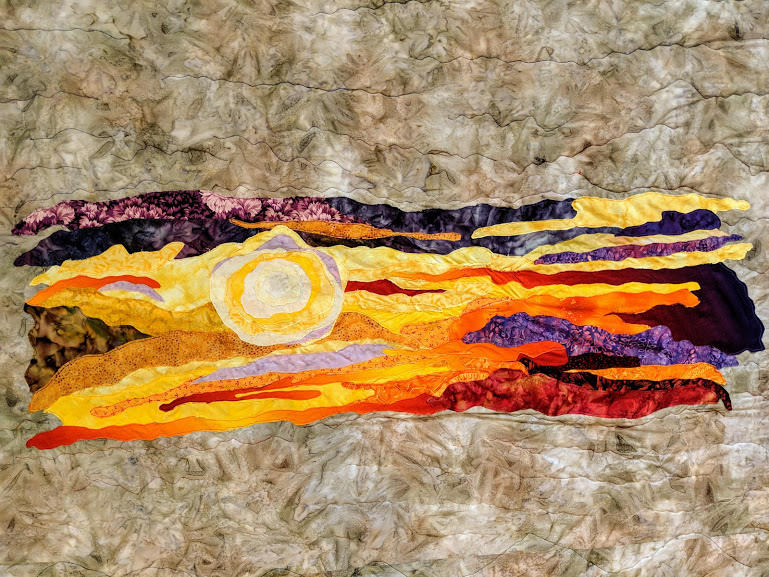
Since this quilt would be blocking our view of the sunset over the water (which, admittedly, we only see between late April and September, before the sun moves south) I adapted one of Grace’s sunset patterns to place just where the sun would be. I chose my fabrics, cut out every tiny, curvy piece, applied the adhesive on the back, ironed the whole thing, and…
Voila? Non. Not quite. See, I had been taught to sandwich my pattern with tin foil before ironing, so’s not to get the adhesive on my iron. But I must have missed the part where Grace specificied which side of the tin foil to place next to the fabric. I chose the dull side. I chose wrong. It stuck.
Since I wasn’t planning on blogging about this topic, I did not take pictures of the resulting disaster. You’ll just have to imagine me peeling miniscule strips of tin foil from the back of my painstakingly-pieced pattern…each pull dislodging the pieces from the adhesive I’d so carefully applied.
When at last all the horrible silver stuff was gone and it came time to sew, of course I found most of the edges of each fabric strip were now misaligned. So not only did I have to try to re-align them while sewing by machine–which I do not recommend if you enjoy all your fingers–I actually had to do quite a bit of hand-sewing to repair gaps the machine could not accommodate.
The result was a wrinkly mess.
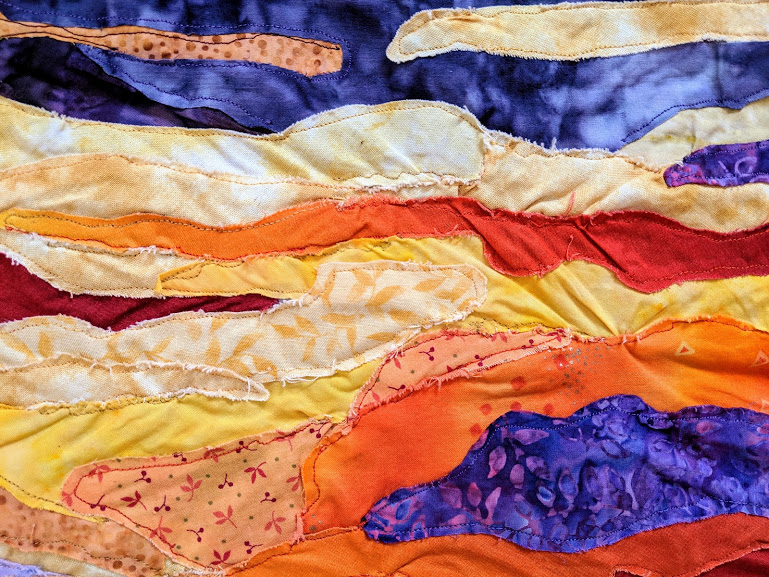
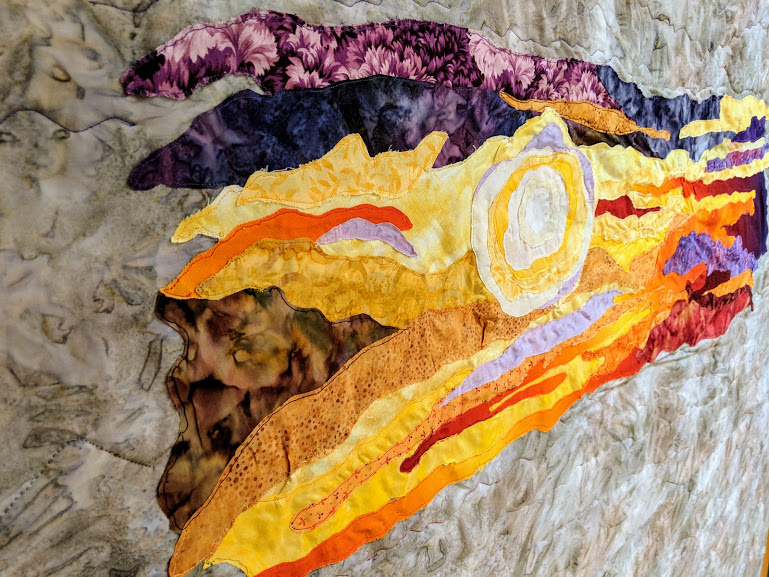
Or was it? Here’s where my Imperfectionism came to the rescue. “Those aren’t wrinkles, those are texture,” it said. “Nature’s not two-dimensional! All those rucks just make your scene look more real.”
Go ahead. Look closely. Sigh.
Thanks, Imperfectionism. You’re the best friend I’ve got.
All those wrinkles? Meant to do that. Yup.
The light wasn’t great when we set up our window-quilt, so I only took close-ups. You’ll have to imagine what the whole thing looks like–and now, of course, it’s partially obscured by our Christmas tree. Probably just as well.
But y’know, when you step back…it’s not so bad.
But I’m still proud of my imperfect sunset–or rather, proud of myself for not tossing the whole thing into the garbage! Besides bringing a huge ray of brightness into our winter lives, it’s a darn good metaphor.
I don’t know what year Stella Moore Jayne was born, but I do know that she died of tuberculosis in 1924…just 16 years after giving birth to my grandmother, Edith Jayne. Her husband, William Jayne, died just a few months later in an auto accident, leaving Edith–or Dede, as she was called–an orphan.
Stella Moore Jayne with baby Edith, 1908.
Dede Jayne Smith, my grandmother, was born in 1908. Unlike her parents, she lived to old age–to an incredible old age, in fact: 103 and a half. She died peacefully in 2012.
Why is this important to anyone but me and my family? It isn’t. And yet I made sure that a young friend of mine, who’s planning a wedding next fall, knew these details, because she will be using parts of both Stella’s and Dede’s wedding dresses to decorate her own.
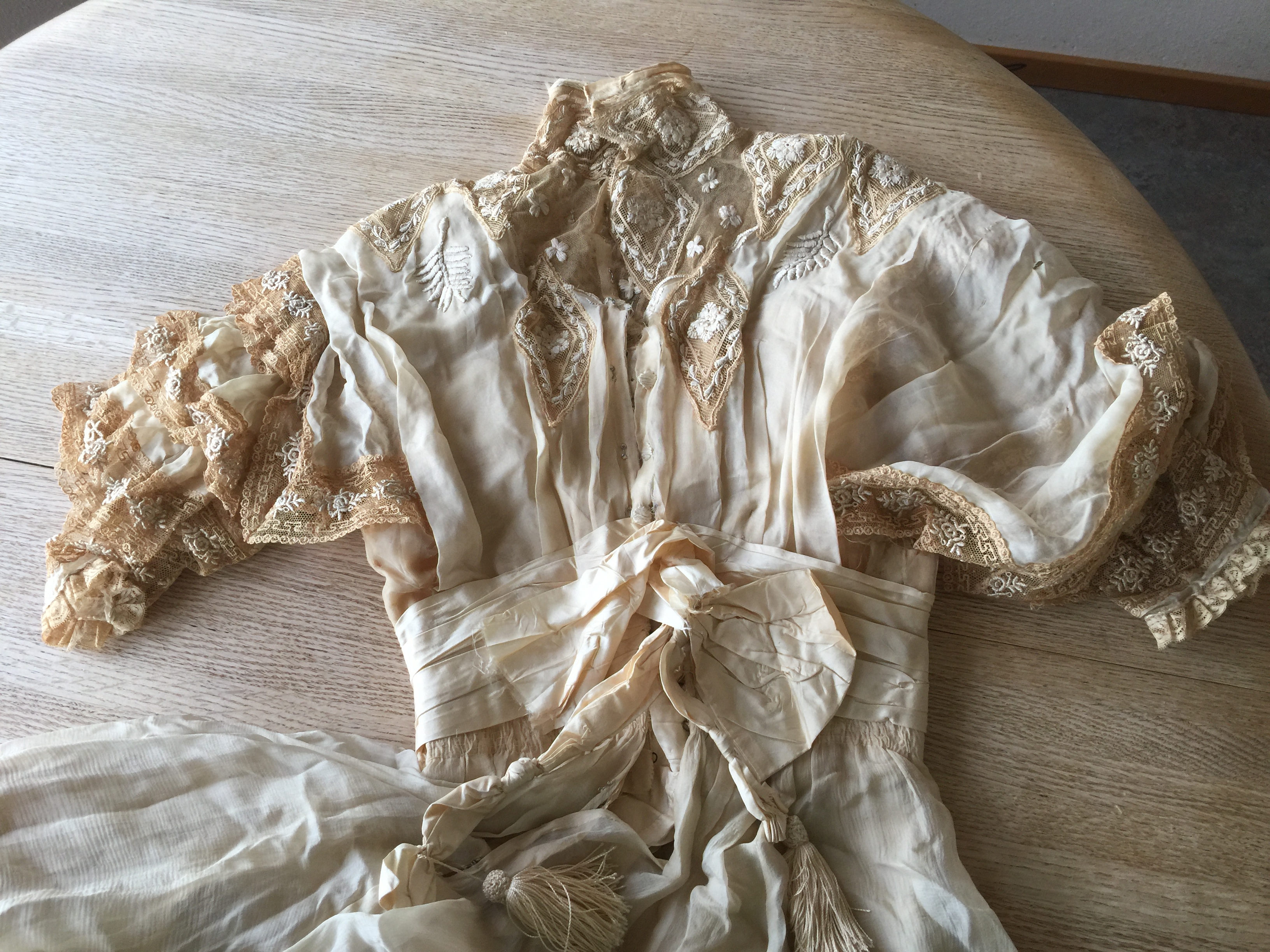
Because I was the granddaughter who most enjoyed playing “dress-up,” Grandma Dede bequeathed these precious dresses, and other antique clothing, to me. But they were already falling apart by then, the delicate silk of bodice and skirt literally dissolving into sparkling flakes and filling the air with fairy dust.
Handle with CARE.
Great-grandma Stella’s dress was probably made around 1904. Grandma Dede’s dates from the late 20s, probably 1929–the year of the Crash. You can definitely see a nod to flapper style.
Somewhere I have a picture of me in this dress, but it would come apart if I tried it now.
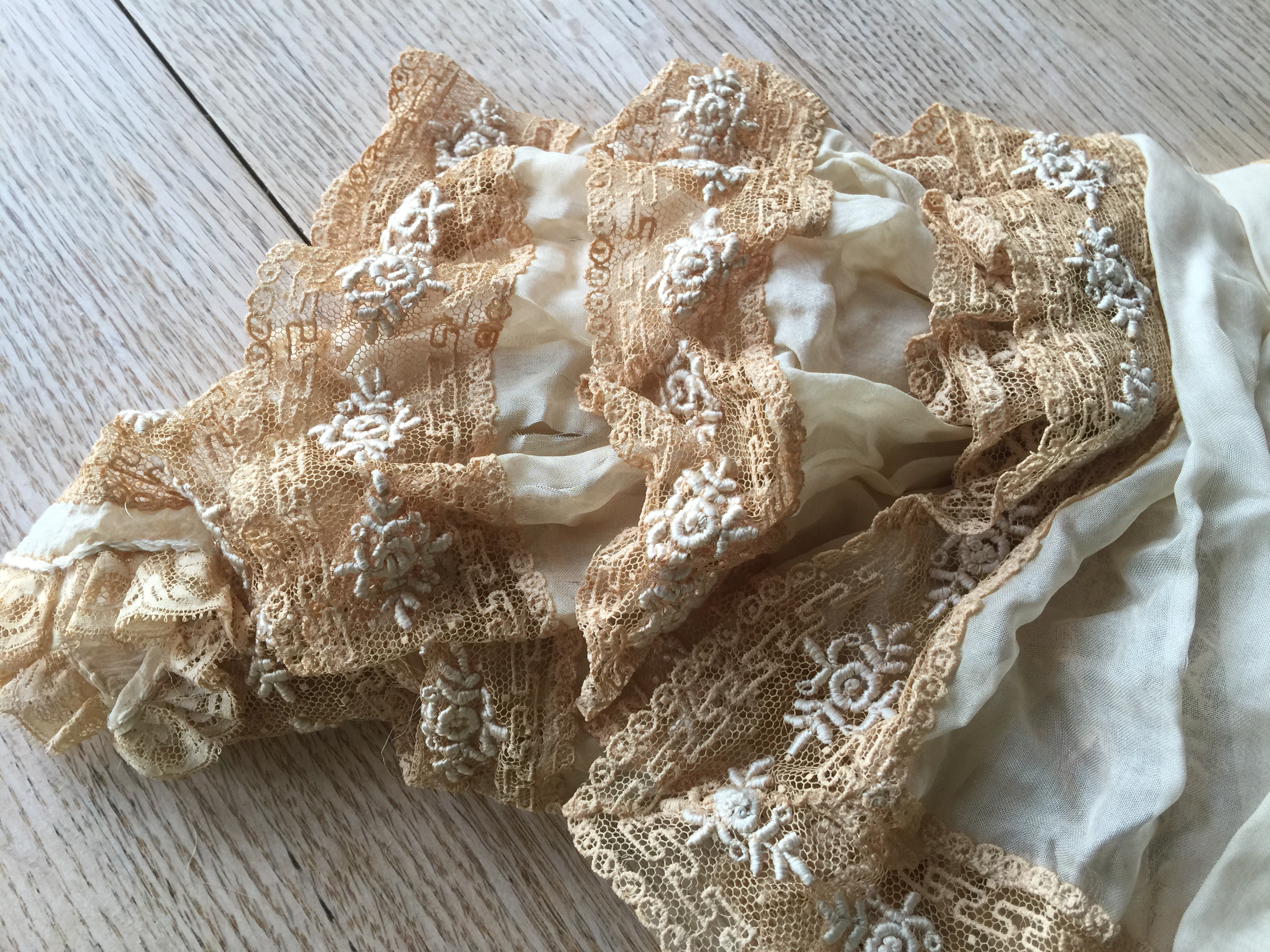
So the dresses are shot. But the lace? It might be more beautiful than ever.
Just look at that detail. Grandma Dede said it was made by French nuns.
Can we get a close-up?
That’s what I’m talking about.
All antiques are special, but some are more special than others. Antique clothing is more intimate than anything I can think of that lasts down the years: not only is it worn next to the skin, it absorbs the body’s sweat and smells. There’s a reason clothes are the hardest thing to part with after a loved one’s death.
Couldn’t resist including this one. The card says “Made in 1890.” The rose on the bodice is carved of ivory. Can you imagine the corset it would have taken to get into this?
And these dresses were worn on what was very likely the most exciting day, to date, of these women’s lives. (Too bad birthing gowns are not treasured in the same way as bridal gowns!)
So, because I can neither preserve nor wear them, I decided to up-cycle these dresses. But NOT anonymously.
I am beyond thrilled that Stella’s and Dede’s lace will live on in another wedding. I like to think of them as a blessing passed down from a century of womanhood. And I hope and trust that the new bride will remember their story as she sews it into her own.













 Wing's World