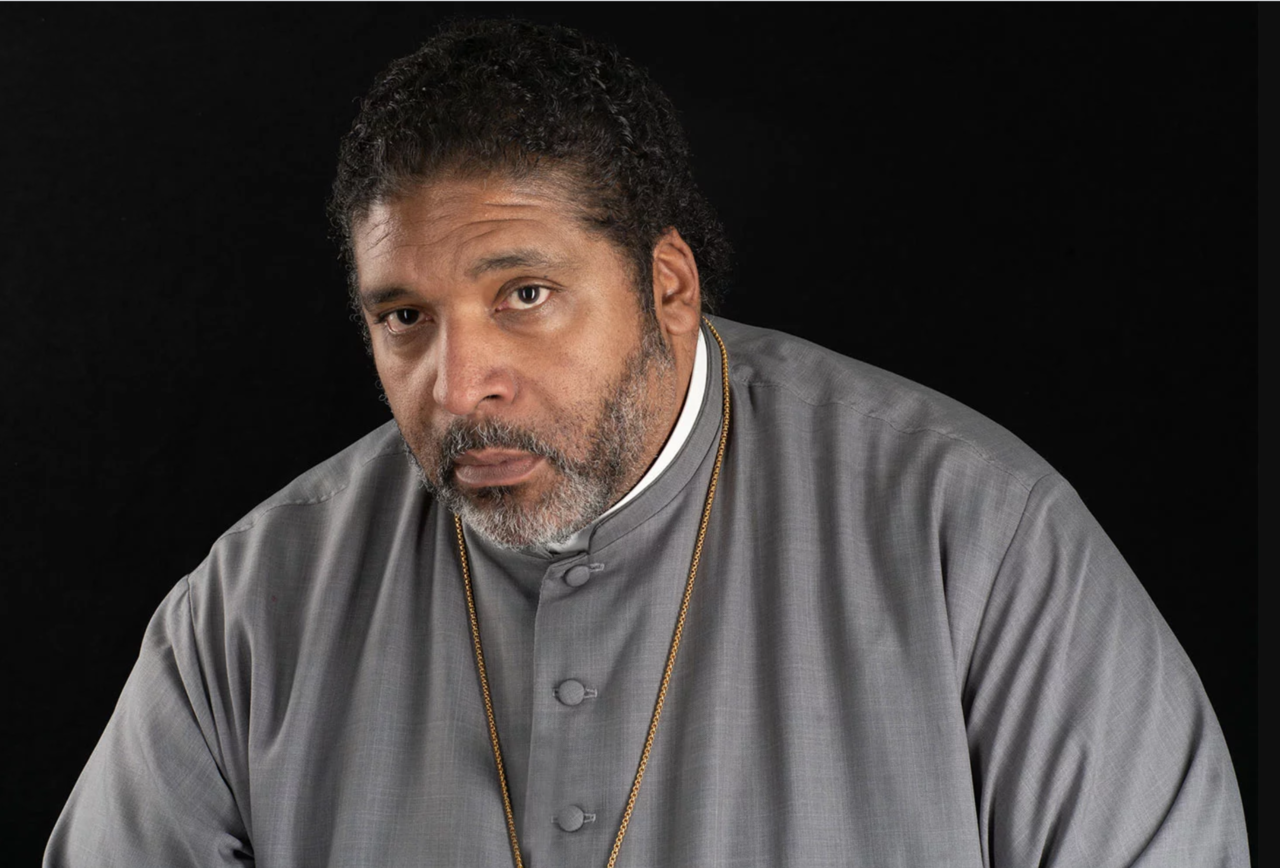
Rev. Dr. William Barber [photo courtesy Wikimedia]
If we were back in my childhood of the 1960s-70s, all watching the same 3 or 4 channels, everyone would know this preacher. Everyone would have seen him preaching, heard him cajoling or roaring from the pulpit. Though his accent is eastern Carolina, not Atlanta, we would have known him the way we knew that other Rev. Dr., the one whose birthday is now a federal holiday.
But we’re all in our separate media silos now; separate channels, separate apps. Rev. Barber is back on the east coast (managing to pastor a congregation at Yale even while doing all this political work), and here on the west, I RARELY meet anyone who’s heard of him.
I’m trying to change that.
One of my very earliest memories is of the civil rights movement in my hometown of Durham, NC: holding hands and swaying in a demonstration, singing “We Shall Overcome.” I learned later that Duke students and faculty–including my dad–came out in support of Duke’s all-Black custodians, probably 1965.
Out here in the Pacific Northwest, all that history feels remote. Or it did until Trump, the Supreme Court and Project 2025 started attacking voting rights again. Now here we are, right back in the mid-60s, fighting to maintain what we thought we’d won.
The only difference? “We” is more than Black Americans now. “We” is we.
If you find yourself thinking, “We sure could use Dr. King now,” then
a) you’re not alone, and
b) meet Rev. Barber.
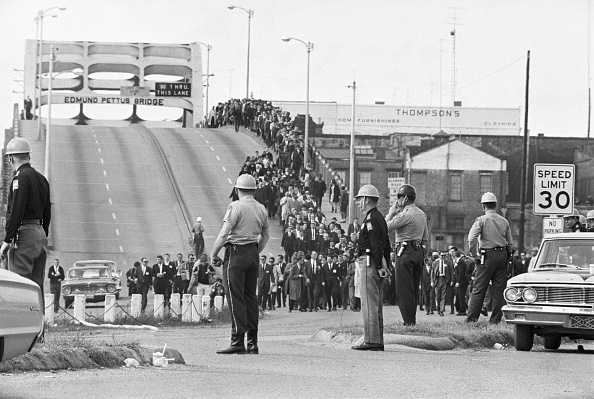
State troopers watch as marchers cross the Edmund Pettus Bridge over the Alabama River in Selma, Alabama as part of a civil rights march on March 9. Two days before troopers used excessive force driving marchers back across the bridge, killing one protester. [Courtesy Legal Defense Fund]
This February, Rev. Barber’s group, Repairers of the Breach, will be leading a march modeled on the famous Selma to Montgomery March of 1965. They’ll start in Wilson, NC on Feb. 11 and walk almost 50 miles (15 miles/day), finishing in Raleigh on Valentines Day. How I wish I could be there! I can’t…but I plan to support the march financially. And I plan to tell everyone I can about it.
Starting here. Because, who knows? Maybe you can be there. Maybe you can be part of that history.
Can you? And if not…can you send this post to someone who might be able to join, or support the marchers?
And if you do that, will you tell me about it?
PS: For more information, or to contact Rev. Barber & the Repairers of the Breach directly, click here.
“I’ve tuned out,” your adult son, your cousin, your sister-in-law tells you. “Politics is too f**cked up for me bother. And there’s nothing I can do anyway.”
I hope the first thing you do is to support your loved one for prioritizing self-care. But then I have a question for you to ask them.
What does the word “harvest” mean to you?
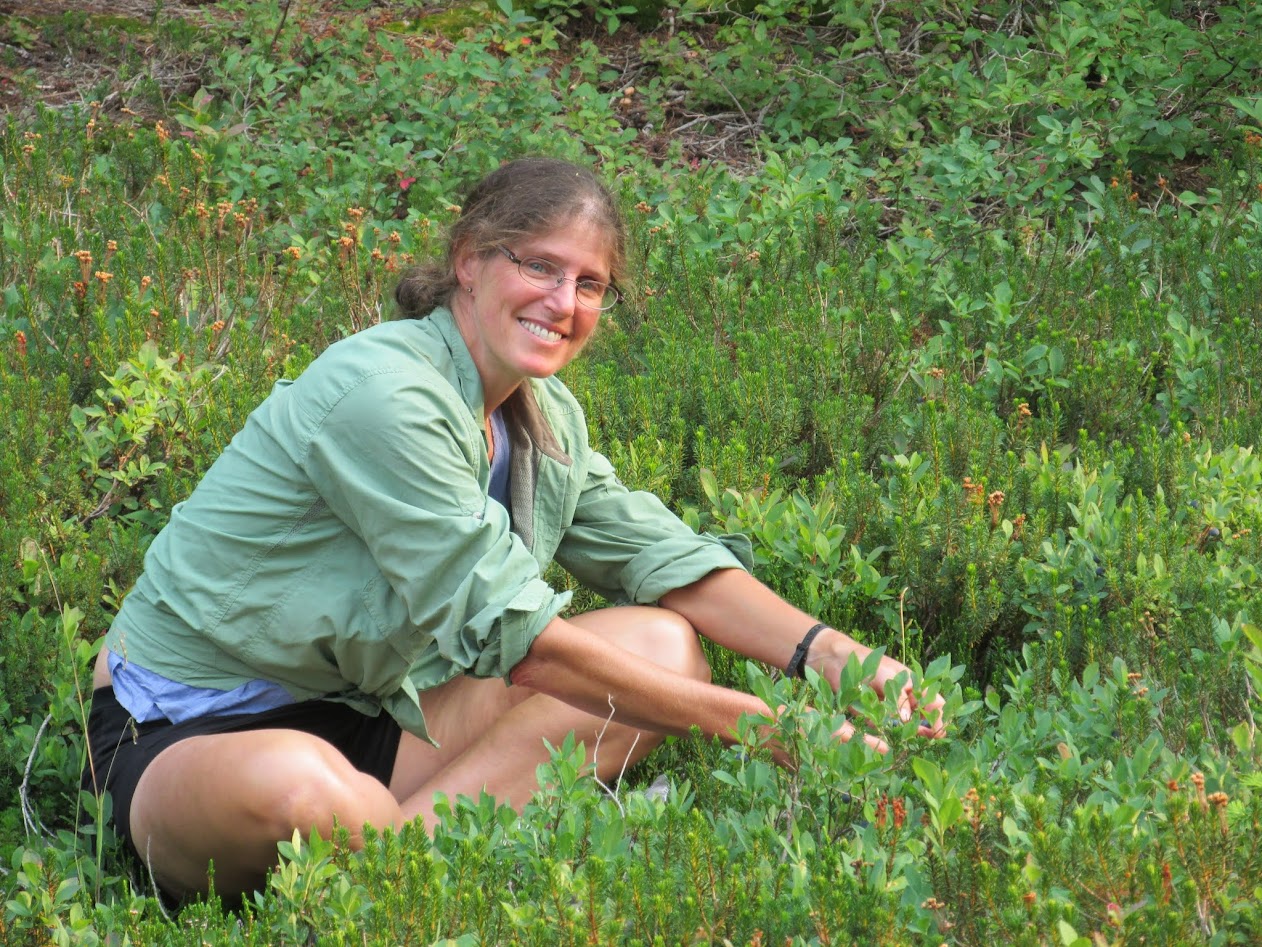
Wild blueberries? (Yes, this photo’s OLD. My knees don’t let me sit that way these days.)
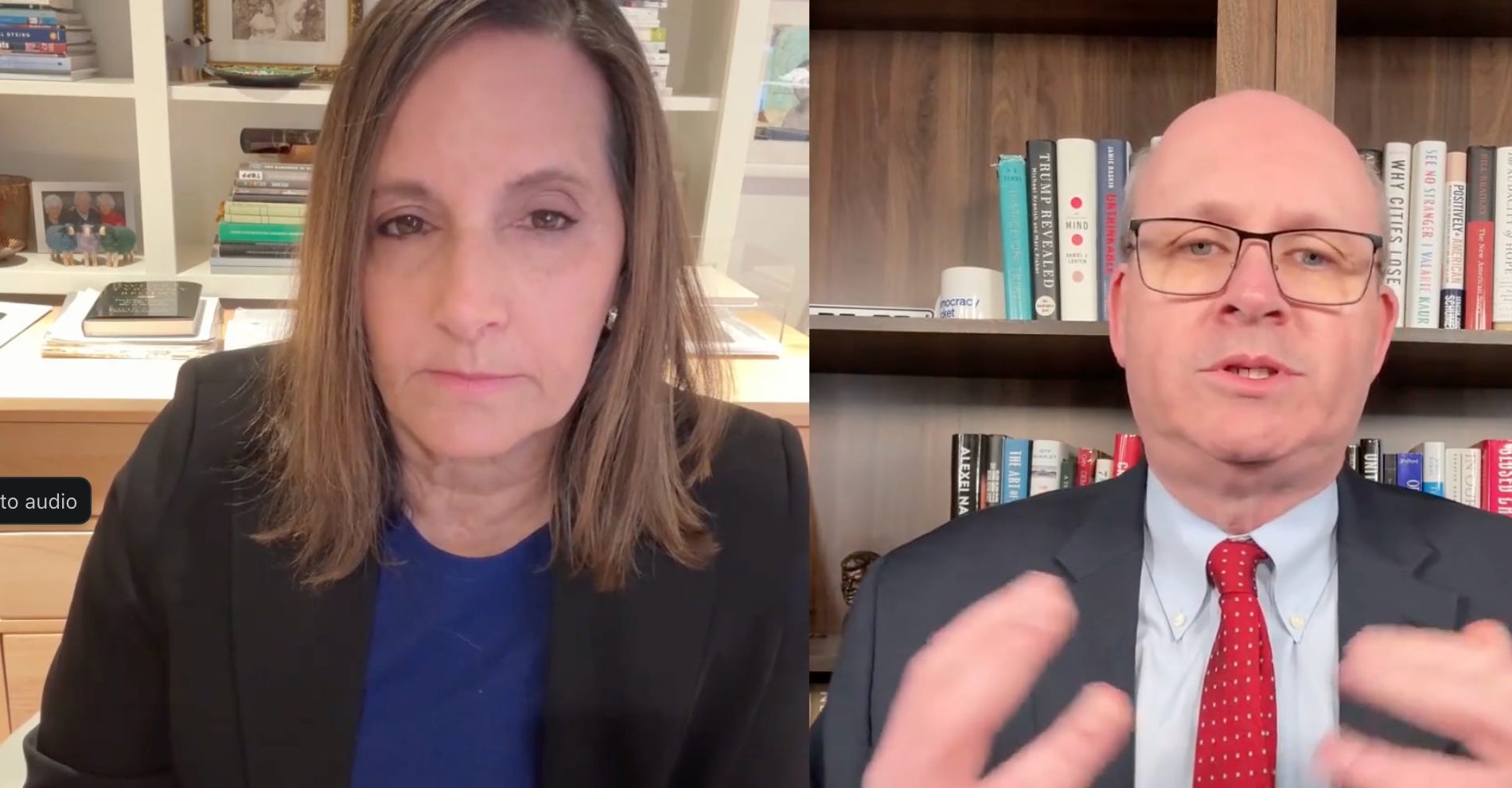
That question popped into my mind last night while reading Joyce Vance’s Civil Discourse on Substack. She was asking legal expert Marc Elias (a lawyer who’s argued before the Supreme Court five times and counting) about what voters should be concerned about in 2026. Marc’s answer jolted me:
“According to Democracy Docket’s case tracker, there are about 170 active voting and election cases nationwide. Unfortunately, the majority of those cases (roughly 55%) are anti-voting cases that seek to make it harder to vote…”
Wait–who are these Bad Guys trying to keep Americans from voting? Will the feds crack down on them?
Nope. The Feds ARE the Bad Guys now. Says Marc:
“…One of the most important new developments this year is the Trump DOJ’s emergence as one of the most prolific sources of anti-voting litigation. In less than a year, the Department of Justice has filed 25 anti-voting lawsuits. While pro-democracy attorneys often found ourselves allied with the DOJ in the past, we are now forced to oppose them to prevent the federal government from trampling on voting rights.”
Joyce and Marc talking [Courtesy Civil Discourse]
“Okay, Gretchen,” you say, “What does this have to do with harvesting?”
Glad you asked. Because here’s the part that made me realize, even someone’s apolitical son, cousin or sister-in-law might want to know this.
When Joyce asked Marc how our federal government is going about the nitty-gritty of voter suppression, here’s what he told her:
“Trump’s Department of Justice is seeking a comprehensive database of sensitive personal information on virtually every person who might vote in 2026 and 2028. This includes names, addresses, Social Security numbers and dates of birth. In some states, it includes a voter’s race. In most places, it includes party registration, which elections a person has voted in, the method of voting they used, and whether they have moved.“
In other words: they’re harvesting our data. ALL of it. Not this kind of harvest…
…but this:
[image courtesy Wikimedia Commons]
Marc Elias goes on:
“Never before has the federal government sought all this information from nearly every state. Never before has the DOJ sued more than 20 states (most of which lean Democratic) to obtain it...We are seeing the weaponization of federal power against American voters, and I think this voter data collection effort by Trump’s DOJ could become the major story of the 2026 election cycle.”
So, ask your disaffected son, your cousin, your sister-in-law: “Is that what ‘harvest’ means to you? Are you comfortable with your own government harvesting your voting data in order to keep themselves in power?”
Harvest kale, not my proclivities.
If their answer is No…maybe suggest they look into Civil Discourse, or any other site that relies on lawyers, teachers and historians.
If YOU want to know more, join Substack and tune in to Joyce’s upcoming conversation with Marc, January 15th @ noon EST, where they will dive further into the questions of what’s going on with the data harvest, and what we can do about it.
They may not appreciate the question. But politics is choosing them, regardless of whether they choose politics. And as Leonard Cohen wrote, “There is a crack, a crack in everything. That’s how the light gets in.“
And as Joyce Vance says, “We’re in this together.” Let’s try to keep the conversation going.
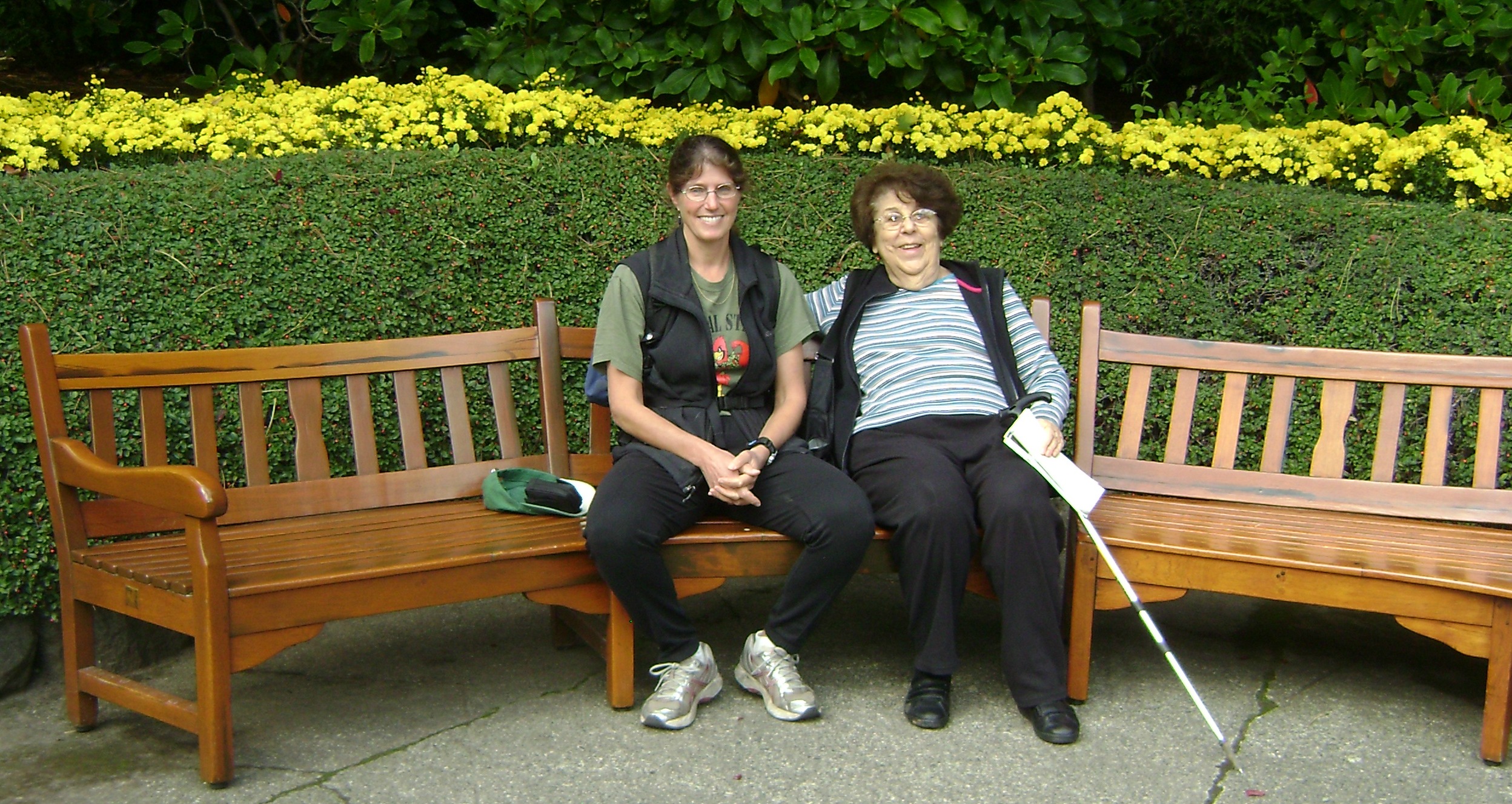
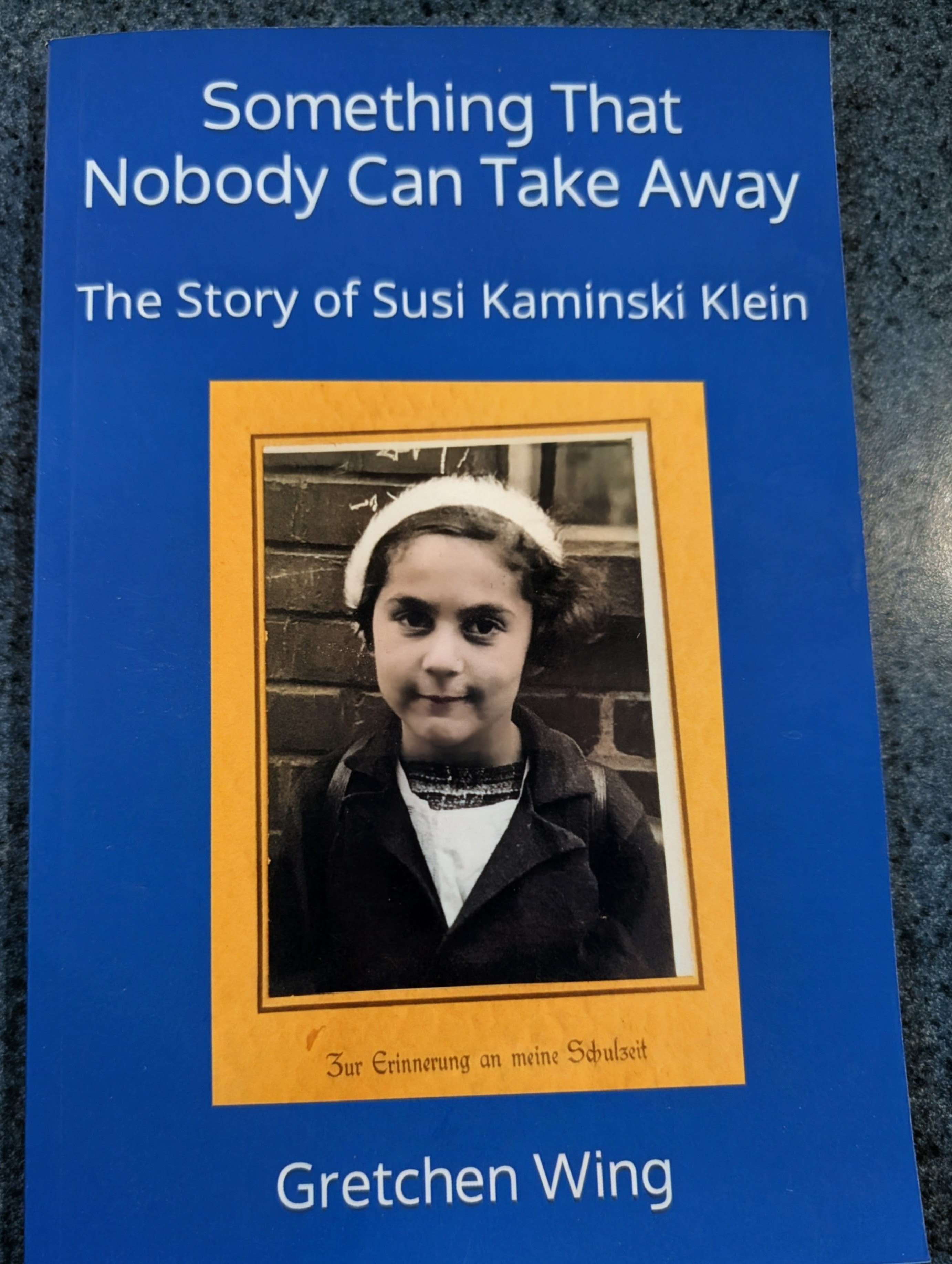
Fifteen years ago, I interviewed my LA-based cousin, Susi Kaminski Klein, about her experiences as a child survivor of the Holocaust. Over the course of four days, hanging out here on Lopez Island and visiting beautiful Victoria, BC, I recorded Susi narrating her story.
Susi & I taking a break from history in Butchart Gardens, 2010
Nine years ago, I blogged about Susi’s story as depicted in Jewish Journal of 2016. You can read that here.
Five years ago, with some urging, and a TON of formatting, research and illustration help from my cousin Helen (Susi’s daughter), we turned those notes into a book.
Helen should’ve gotten co-author billing!
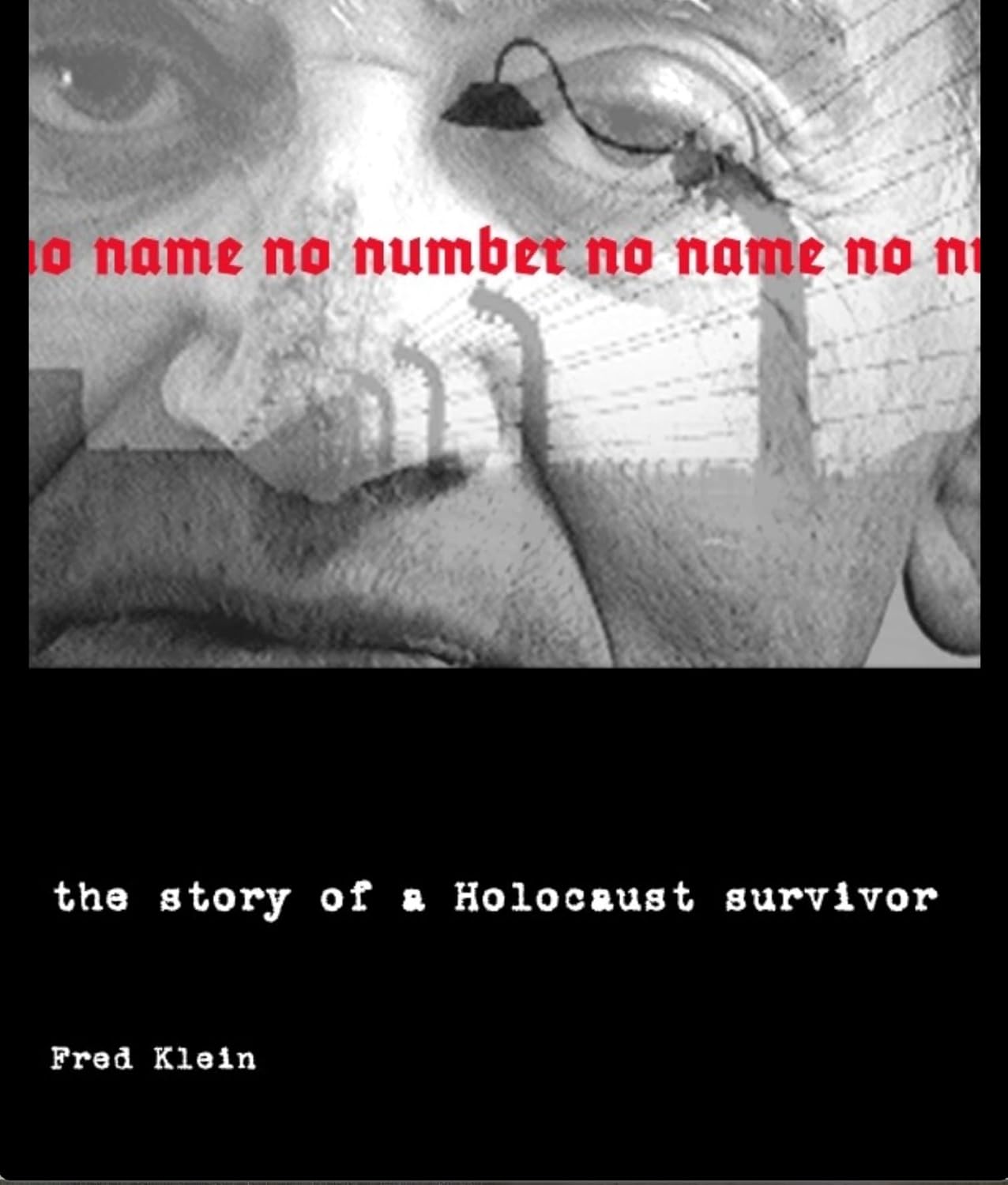
But the lede I’m burying here is this: COUSIN HELEN WAS WAYYYY AHEAD OF ME! In 2011, four years earlier, she had already published the story of her father, Fred Klein. Here it is:
Something you have to understand: back then, self-publishing was HARD WORK. I’ll get to that part in a moment.
What I wanted to know was how Helen’s experience interviewing her father compared to mine, interviewing her mother, and…well, I’ll let Helen tell it. Cuz?
“This will be a short and possibly unexpected answer. I never interviewed my father to capture his story. My father started writing his book, believe it or not in 1997! He went through a number of iterations. During the process he found several people who were willing to edit his work and give him ideas on organization, grammar, etc. I was not involved in that process at all.”
Fred and Helen in 2015
Well, that tracks. Susi had separated and Fred by the time we met, so I never got to meet Fred. From what I’ve learned, I think he must have been an impressive man. Maybe daunting to interview? Not really, Helen said, but…
“I think I would have found it extremely challenging to interview my father. Not because he would not be willing but it is such a vast subject, I would really have had to figure out where to begin, how to organize and structure the questions etc. so honestly I am grateful my father wrote his story on his own and got some guidance from others on organization and structure.”
Keep in mind, my cousin’s working full-time during this entire period. When I interviewed Susi, I had just left my teaching job, so I had the time I needed to organize her story after capturing it on tape.
Helen and Fred in 2006
Also…as Fred Klein’s book cover intimates: he survived Auschwitz. While Susi’s story was horrific and traumatic, including her father being sent to the concentration camp Theresienstadt…it did not involve Auschwitz.
Full disclosure, I’m only partway through No Name, No Number, which is written as a mix of personal account and history lesson. History, I think, is more and more necessary these days when precious little Holocaust history is taught. But personal stories are the most poignant.
Here’s an excerpt from Ch. 7, where, in 1941, still living “freely” in Prague, teenage Fred is forced to labor on a collective farm. I have bolded sentences that especially capture the personal reality of the horror.
“For me, the worst part about the camp was the strenuous physical effort required. I was in extremely bad shape, not accustomed to the job, never having learned to push myself. Sometimes the grueling twelve-hour workday seemed like hell to me. I thought I would never last through them. I had to shovel some three hundred times earth up to a little metal wagon. Sometimes I had to carry very long tree-trunks with a fellow forced laborer. Most of my fellow inmates were in better shape than me and enjoyed teasing me. They had me carry the thick end of the tree-trunks which was so heavy that I almost collapsed, whereas the other fellow had it easy. Had I been in better shape, the work would have been exhausting, but tolerable.”
Fred as a still very young man, after the war, now living in Argentina
Here’s another excerpt, from Ch. 11, where in 1944, 22 year-old Fred is unloaded at the dreaded camp. Notice the detail in the middle of the passage:
“I jumped out of the cattle car. Barracks, barracks, barbed wire, gleaming lights. SS men with police dogs, wielding whips. Pajama-clad figures – kapos – and other prisoners, something I had never seen before. This place was cold, frightening, there was nothing soft to humanize it. I stared briefly at the hellish scene, and then I took off my glasses. Shouting and shoving, the kapos and prisoners herded us into rows five men deep and made us stand still. The dogs of the SS were poised to attack us. Somehow the pajama-clad prisoners got us moving forward in a single file.”
“I took off my glasses.” To me that act says, I will not look at this. I will get through it.
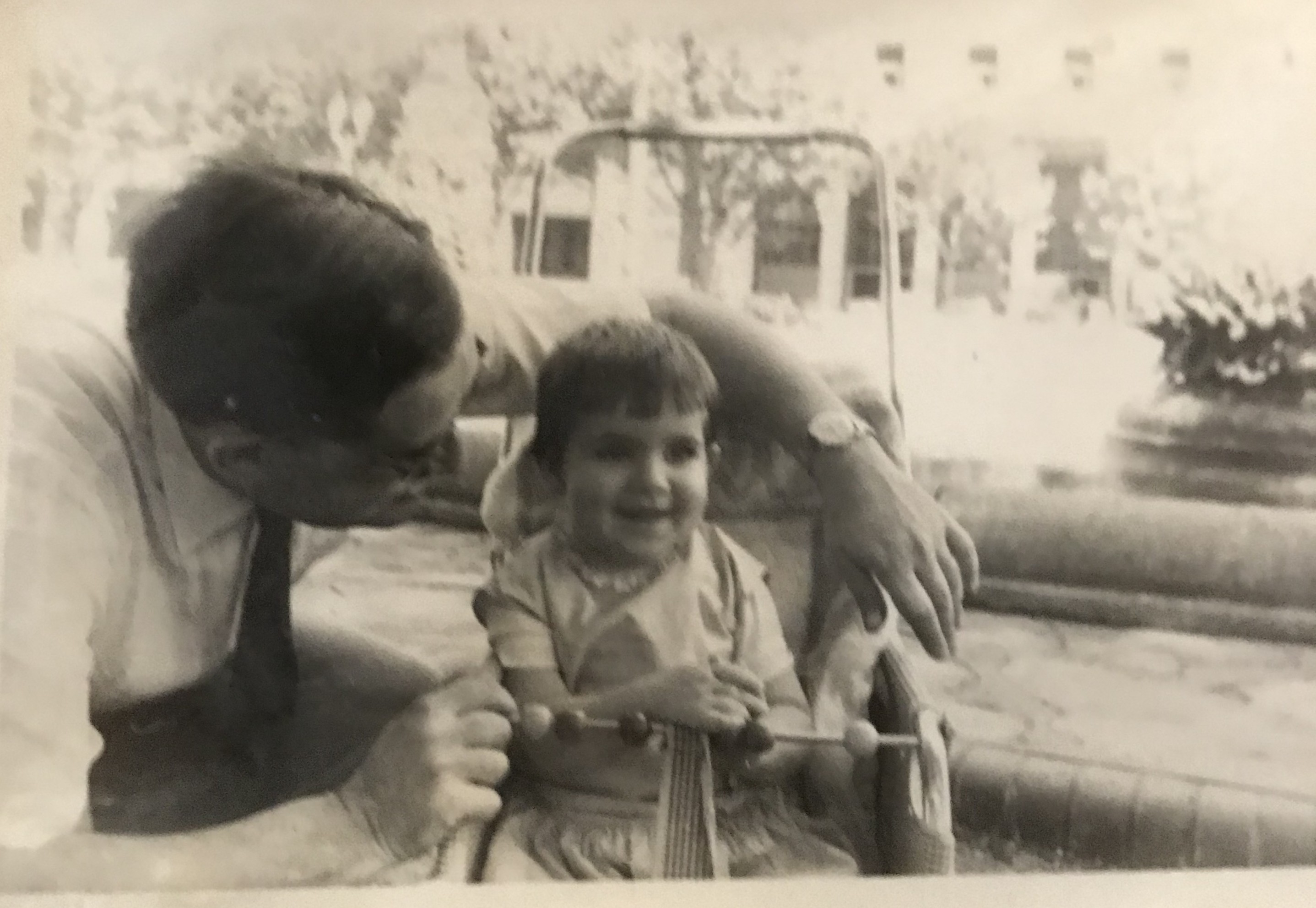
Fred with baby Helen in Buenos Aires, 1958
So, Helen– your dad wrote out his own book. Why was it not published right away?
“What I can tell you is that my father tried very, very hard to get his book published. He wrote lots of letters to a variety of publishers, but none of them seemed interested. I don’t even know if he ever got answers.”
It’s painful to reflect on this answer. There are so many Holocaust stories. The simple truth– that the sheer quantity of such traumatic stories affects their “marketability”–hurts my stomach.
Helen finishes:
“He finally gave up looking for a publisher, and sadly resorted to literally going to Kinkos, making copies of his book, getting the books comb-bound, and then trying to distribute his book that way.”
Ouch. But then here comes my cousin, to ease her father’s pathway:
“Originally, I published my father’s book in 2007 using Blurb.com. That process was long and tedious, but I pushed through it as I really, really wanted to get it done while my father was alive. Little did I know back in 2007, when I completed the publishing on Blurb, that my father would live to 100, something I am ever so grateful for!”
Helen & Fred in 2018
Which brings us back to this moment. Blurb.com no longer exists. Fred Klein passed away in 2022 (at the age of 100, as Helen said). But thanks to his daughter, Fred’s story lives on…easily available on Kindle!Click here to download and read No Name, No Number, for free.
I would like to thank my cousin Helen for her perseverance (not to mention all the photos!)…and my cousin Susi for hers. They are both role models for me.
And, in this season of deepest darkness, please say an extra prayer for the Fred Kleins of the world. May their stories find resonance.
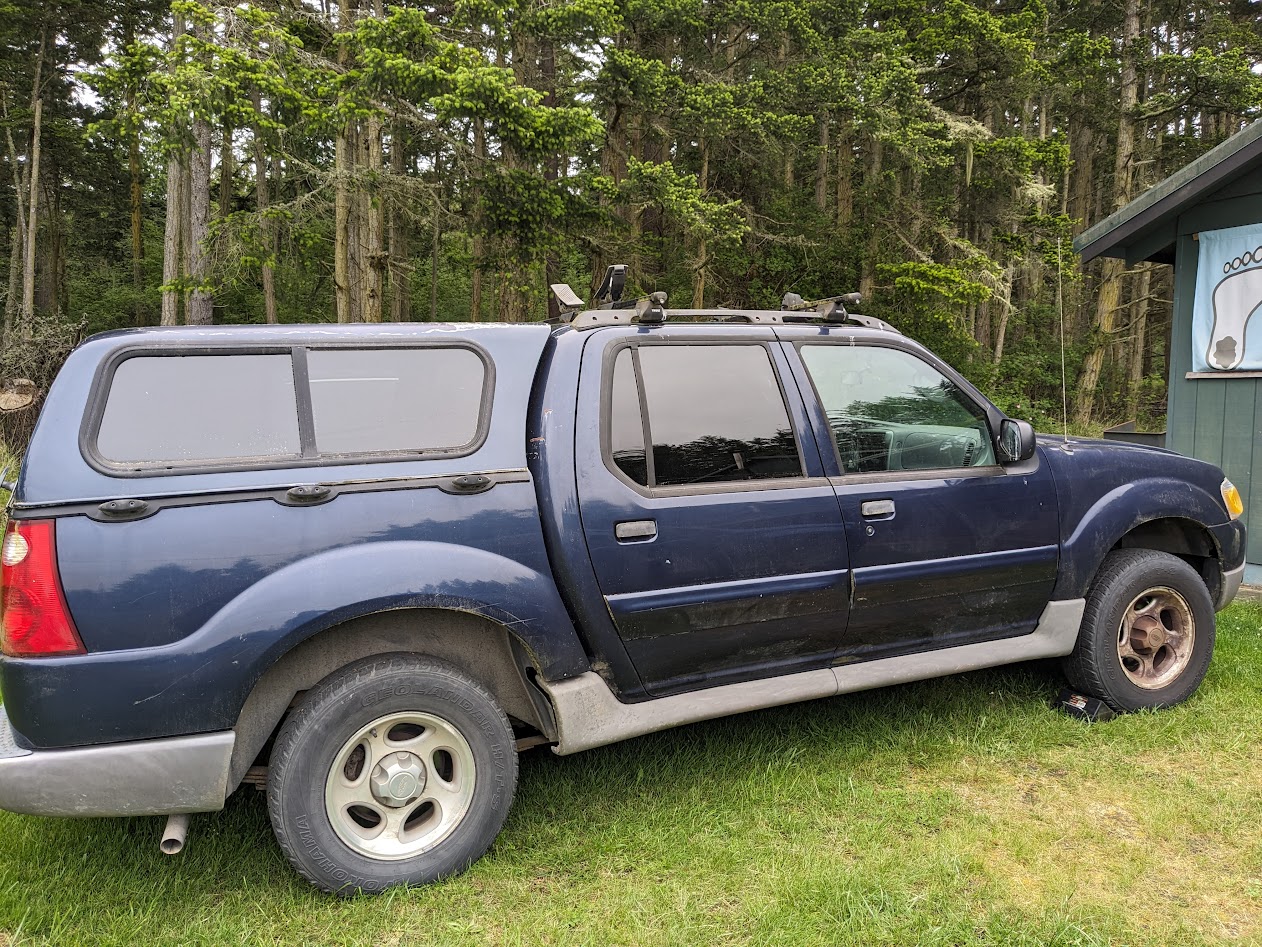
I’ve asked one of my humans to write this letter for me, as writing is a challenge–me being an SUV and all. After what happened in the Oval Office on December 4, my humans wanted me to tell you they’ll “never buy another Ford!” But I just wanted to ask you, CEO Jim Farley…
“The Somalians should be out of here. They have destroyed our country.”
Or this:
“Most of those people” — meaning the Somali immigrants — “have destroyed Minnesota” and made it a “hellhole.”
Or this, about a woman who moved all the way to America from across the sea, got so much education and respect that she was elected by other Americans to represent them in their Congress:
Congresswoman Ilhan Omar “shouldn’t be allowed to be a congresswoman…and she should be thrown the hell out of our country.”
Omar “should not be — and her friends shouldn’t be allowed — frankly, they shouldn’t even be allowed to be congresspeople, okay? They shouldn’t even be allowed to be congresspeople because they don’t represent the interests of our country.”
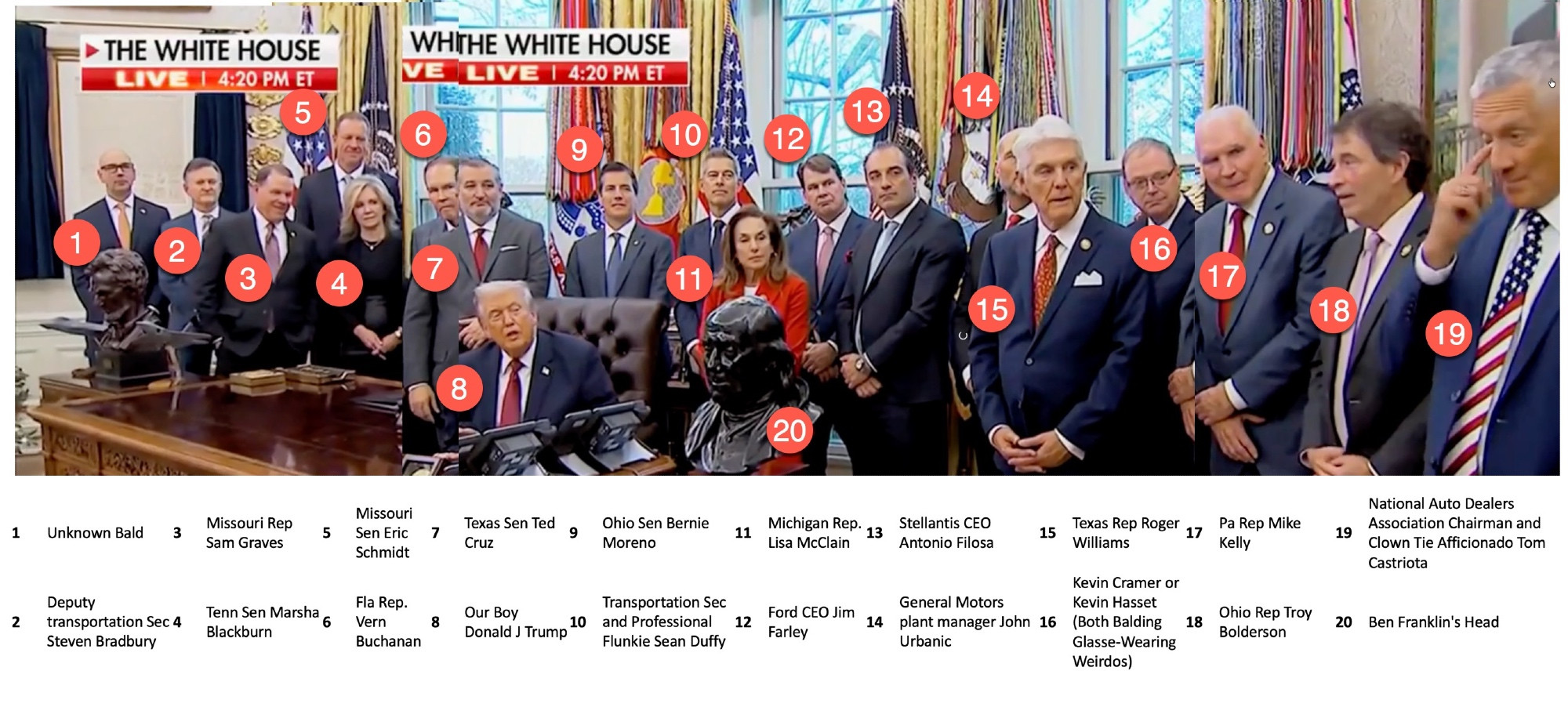
You were right there, CEO Jim Farley of Ford Motor Company, MY company. My humans saw your picture. You are #14–not real visible in this shot, but don’t worry: it’s you.You were all nodding and laughing as the President said horrible, dangerous things about his fellow American humans. Things that could get them attacked–maybe even run into by SUVs like me. You should know that, Mr. Jim Farley.
(Picture ID’s by “Carlg1000” on BlueSky, as shared by Helen Kennedy on BlueSky)
You should have spoken up, Mr. Jim Farley. Said SOMETHING. You’re not an elected official. You’re a guy who makes cars. But you you just laughed and nodded away.
So you agree with the President, Mr. Jim Farley, CEO of Ford? You think Somali immigrants are “garbage”?
Do you have the guts to admit that to all the people who drive Fords like me?
Or do you just hope Ford drivers like my humans don’t notice?
[Note from Ol’ Blue’s human, Gretchen: Please share this photo as widely as possible. And if you have any connection to any of the other humans shown here cheerfully standing by for the President’s evil, racist rant–if they are your representative!–PLEASE call them on it. Literally.]
[As Joyce Vance says, “We’re all in this together.”]
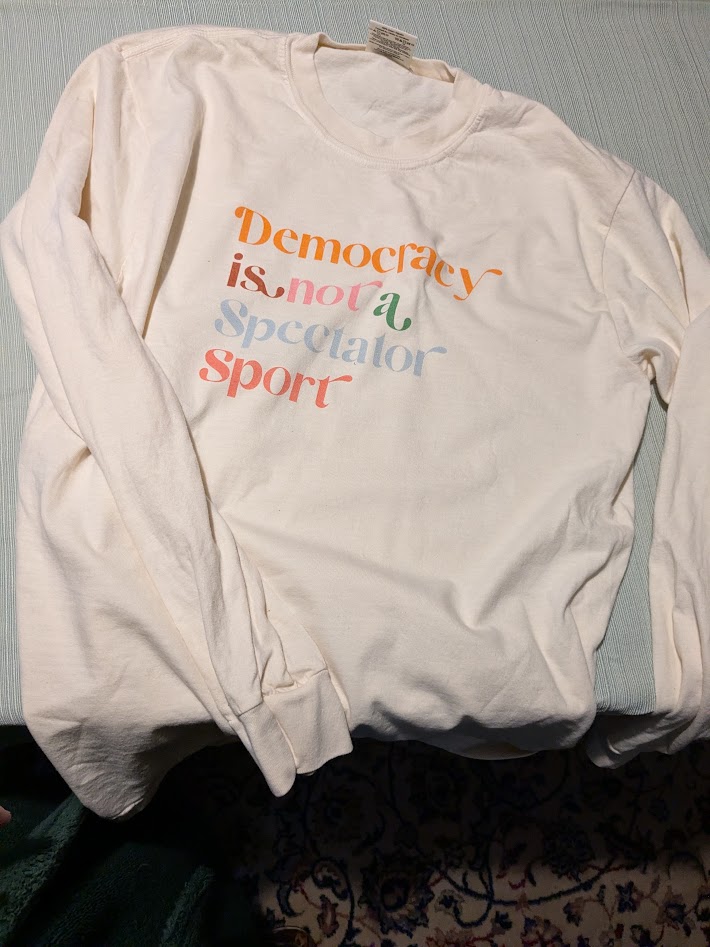
This was my birthday present to myself, fresh from my Virginia-canvassing-and-family trip, and amped up–only a week later–by democracy’s powerful showing in the November 4 elections.
Notice I didn’t say Democrats (though they did well, and I’m glad). Nine months in to this presidency, people on all sides of politics–including no politics at all!–are starting to coalesce around the basic idea that things should work. And democracy, as Churchill famously said in 1947, is “the worst form of Government…except for all those other forms that have been tried from time to time.…” [ellipses added for emphasis]
In other words, for things to work (fairness, food, airplanes–that sorta thing), we need democracy. And when you look at election results more focused on immediate outcome than on party, here are some promising signs:
Maine anti-mail voting measure loses
Progressive DAs in Philly and NYC win
Colorado funds free school meals and SNAP support with taxes on the rich
Detroit elects first woman mayor
Cincinnati rejects JD Vance’s brother after endorsement
GOP Redistricting in Kansas failed
Charlotte approves transit tax
Maine passes gun control
Turnout in blue district US House election in Texas higher than 2024 Pres (thanks to Common Power for this compilation)
See what I mean? I have a lot of company in thinking, the IDEA of democracy is having a moment right now. And for democracy to work, we need all hands on deck.
“Wait a minute,” I can hear you saying. “I loathe phone-banking, and I’m donating all I can to things like food banks and my church. And now you want me to do take on ‘democracy’ too? I am SO not that person.”
Au contraire. I maintain that if you are looking out for vulnerable people; if you are protecting green spaces or animals; if you are reading to kids, or making art to share, or donating to organizations that multiply those values, you ARE a democracy standard-bearer.
I mean–don’t forget (or underestimate!) voting! Do all you can to keep your loved ones from feeling that voting’s not worth it. Point them to this book if they need a little inspiration…
I’m giving this book to everyone who’ll take it!
On my walk today I stopped to make a roadside bouquet. November in Washington State = pretty limited wildflowers. But the low-rent, multicolor assemblage I collected reminded me, there’s so many ways to be a flower!
You can be bright, demure, prickly, robust, delicate, complex or simple–and you can still call it democracy. Just do SOMETHING, keep doing it, and keep talking about it.
As Joyce Vance says, we’re in this together. And as Gretchen Wing says, “For things to work, we need democracy.”
What are some of your ways of participating? Anything new, anything especially challenging or rewarding, or both? Please share as many as you feel like.
Not that Joyce. Nothing against Dubliners or Ulysses; I just don’t think they’ll help get you through another week of our current presidency. I mean Joyce Vance, author of this book that was waiting for me, hot off its October 21st release, when I got home from my canvassing trip this week:
Mine’s autographed! 🙂
To judge a book by its cover, this one looks boring. To me, though, it looks like mental health. I thought I’d take a minute to explain why.
In 2022 and 2024, I canvassed in my home State of North Carolina, where my folks still live. This year Virginia has some important elections, so I went there (visits to sister & niece a bonus).
Part of Team Fredericksburg on the canvass trail
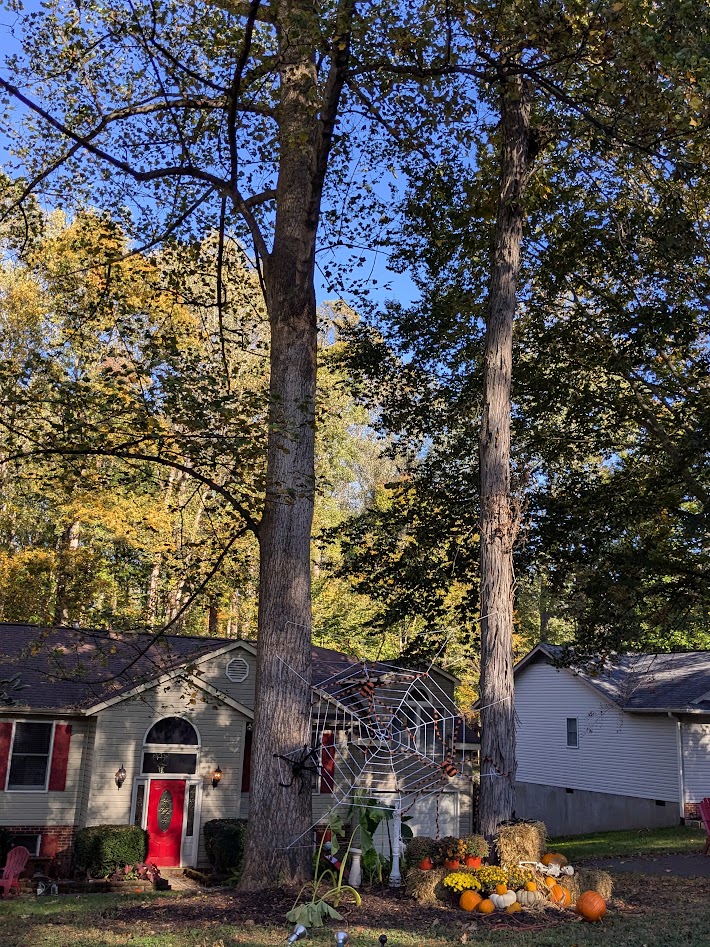
Between doors (we knocked on about 2,000 during the days I participated in Fredericksburg, then Richmond), I split my awe between the lovely big deciduous trees of the east…
O oaks, how do I miss thee!
…and creative Halloween decorations.
(sometimes both!)
But the best part of CP work, to me, isn’t actually the conversations on voters’ doorsteps (though those can be quite moving). It’s the TEAMWORK, the FELLOWSHIP.
especially at a dumpling restaurant at the end of a long day
Which brings me back to Joyce’s book, whose opening line is, “Could I have picked a worse time to write a book about saving democracy?”
My answer is: no, this is EXACTLY the right time. Because now more than ever, we need to know we “have friends everywhere” (as they say on Andor), and we need to get our hands on some how-to.
However, if podcasts are what your life has room for, Joyce is all over that landscape. I first discovered her via Substack, where her Civil Discourse unpacks the week’s latest legal WTF?!! as only a former U.S. Attorney (and current law professor) can. Each post ends with, “We’re all in this together.”
Or you might just as easily find her on the brilliant panel-pod, Sisters in Law…
While I’m only halfway through Vance’s book, I’m happy to report that the final chapter–titled We Are the Cavalry–is chock-full of options for resistance, participation, finding community, pointing yourself towards hope…or, as one heading puts it, “Understand That Protecting Democracy Comes in a Lot of Flavors.” (146)
This is Fredericksburg’s Rappahannock River at sunset. Not a flavor; it just looks like one, eh?
In this moment when the bad guys want us to despair and give up, Vance offers this uplifting reminder:
“Although we may be on our own, we are not all alone. We truly are in this together. We have one another, a community of like-minded people across the country who care about democracy. That may seem to be a slender thread, but it’s how we, like others who have faced similar challenges in the past, are going to get through this.
So, gather your resources and take courage.” (138)
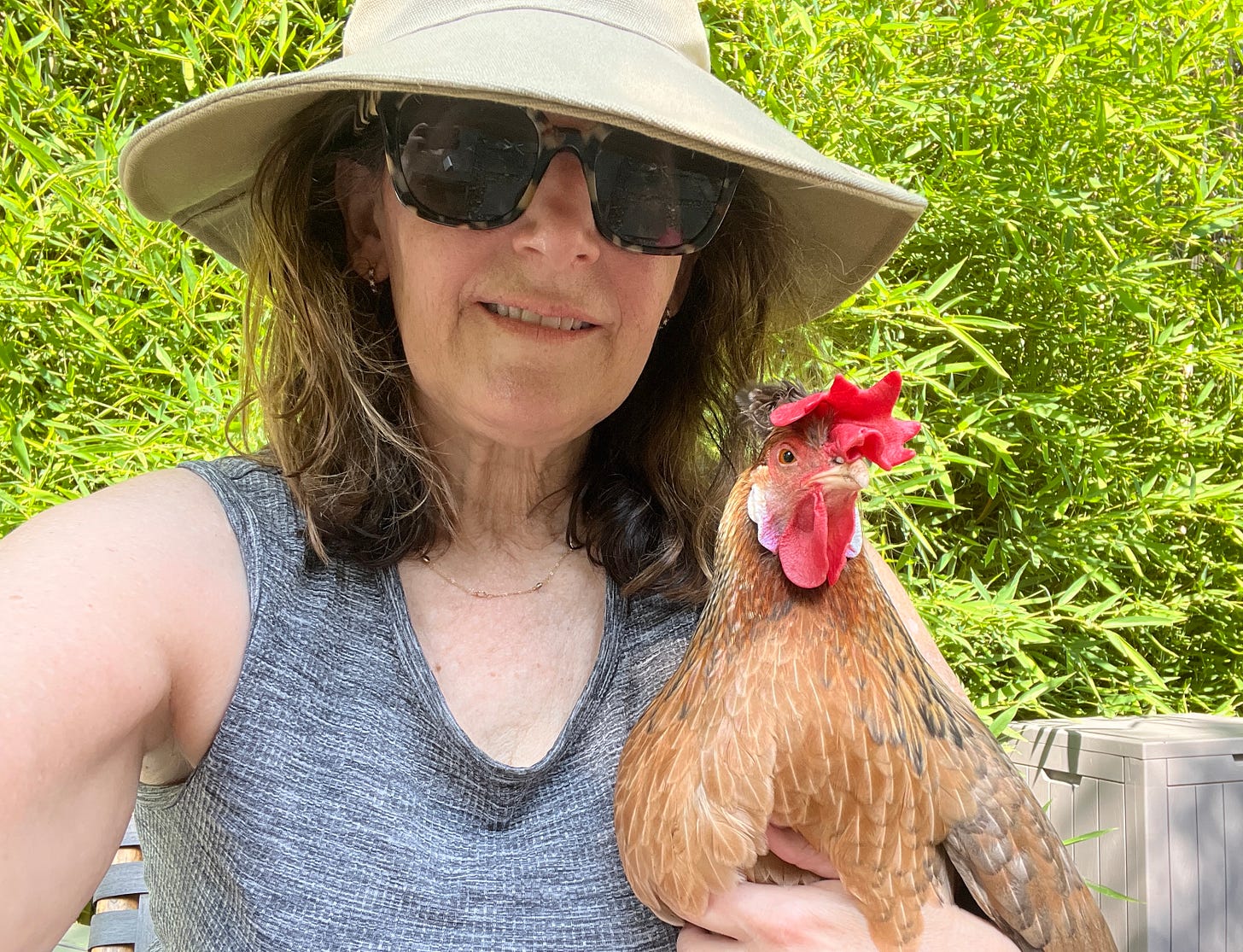
Joyce’s chickens also make appearances on her Substack, so I’ll close with this:
[photo by Joyce Vance]
Do yourself a favor: Read Joyce. [Support her by clicking here to buy her book!] You will feel empowered–because, as she says, we’re all in this together.
“Throwing shade” on someone is bad. So is calling something “shady.”
But in July in Alabama, the shade is where you want to be.
Once my Amazing Mom had finished her track meet and we’d all gone out to brunch (at Waffle House, where else?), the five of us–me, parents, sister, brother-in-law–found ourselves with several hours of free time before their flight back to North Carolina, and nowhere in Huntsville’s 95-degree humidity that we wanted to be.
We’d already gone to see the big rockets. The local botanical garden looked pretty online, but most of its pathways were out in full sun. No thanks.
Then my sister found us Monte Sano State Park–a little mountain just outside downtown Huntsville.
complete with Japanese tea house!
There’s nothing like a mature hardwood forest for real shade, and this one was up a thousand feet or so–easily 10 degrees cooler than town. The park even boasted those wonderful New Deal-era CCC cabins The Mate and I always loved to discover on our Road Trips.
Not pictured: all the birdsong in these woods
We strolled; we lingered. We sweated a LOT less than we would have, anywhere else in Alabama that day…
…some of us stretched our hamstrings…
…thanks to the shade.
Mid-afternoon, well satisfied, I dropped my fam off at the Huntsville airport and continued on an errand of my own. Yes, I could have booked my flight from there, but the connection via Birmingham worked better for me. And Birmingham carries a weight of history that I wanted to feel again.
Except it was Sunday: all museums closed. So I made another plan. I decided to take a 90-minute detour through the small town of Anniston, where I knew the Freedom Riders Memorial would still be accessible, Sunday or no.
Not pictured: the beautiful, green, rolling lushness of the Alabama hills I drove through alone, wishing I could take photos with my eyes.
Also not pictured: the Sisters in Law podcast I was listening to, in honor of Professor Joyce Vance, my favorite legal explainer, who lives and teaches in Birmingham. (Click her name to follow her “Civil Discourse” Substack!)
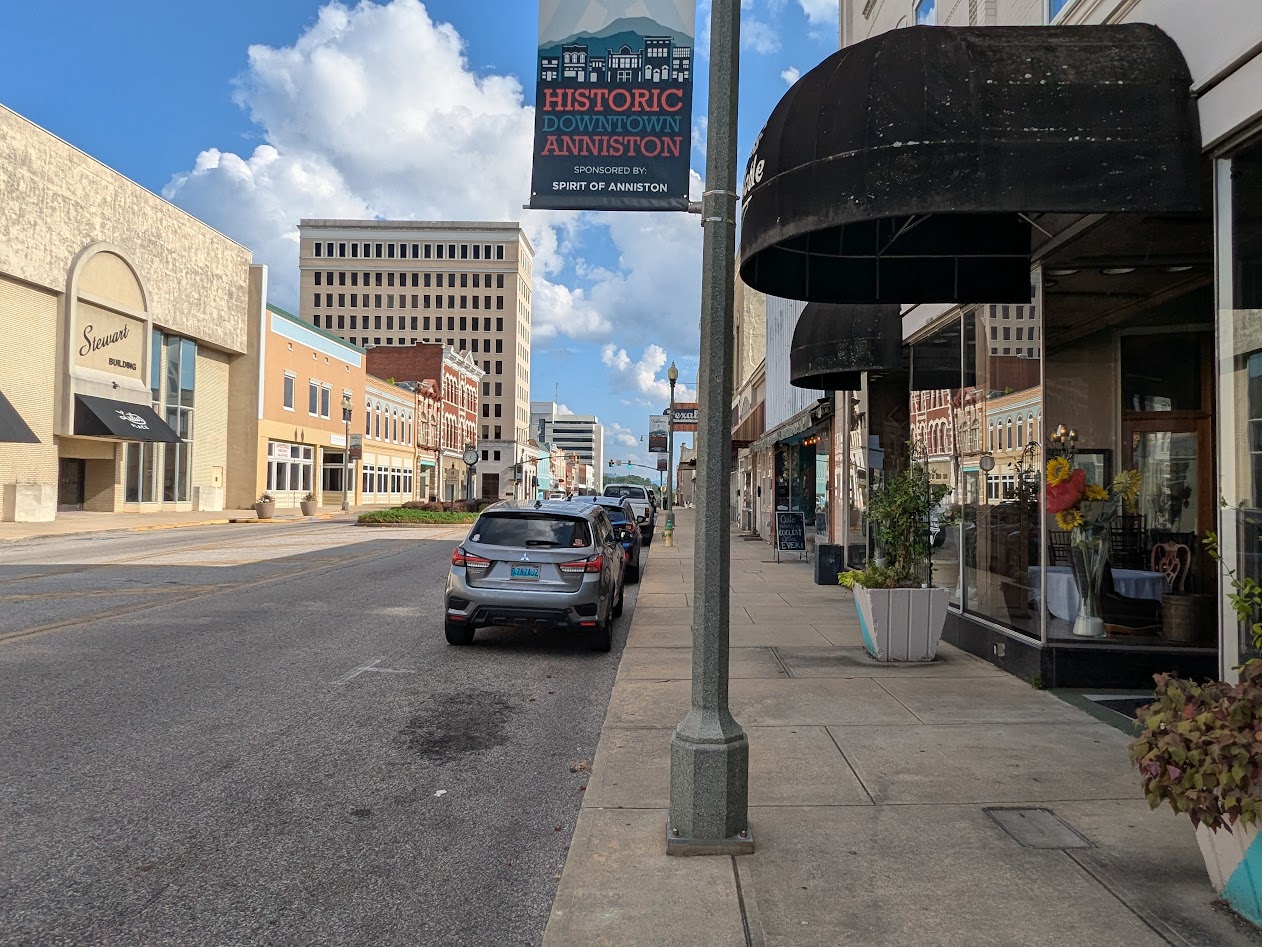
My first view of Anniston reminded me of the narration in To Kill a Mockingbird: “an old town…a tired old town.”
Hopefully the emptiness was mostly due to it being Sunday…but I wasn’t so sure.
The memorial was tucked into an inconsequential alley, next to what had once been the bus station.
Note my giant rental car parked across the street.
Inside the alley, the exhibit came to life.
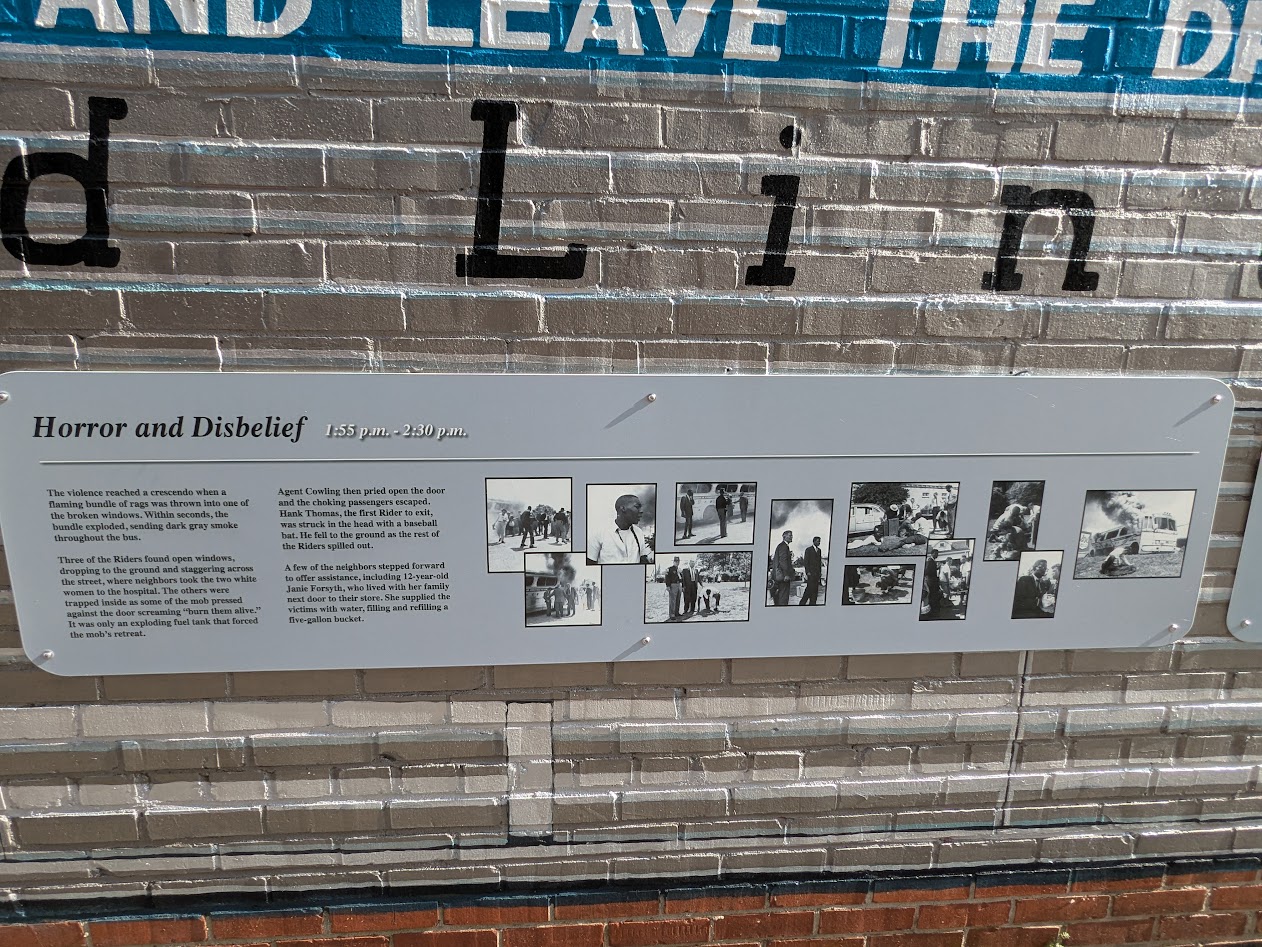
Each panel of the bus explained the events leading up to that spring day in 1961. I read them all, but for purposes of brevity, didn’t include the whole background to the event, which you can read about here.
I’ll let the panels speak for themselves, assuming you can expand them on your device.
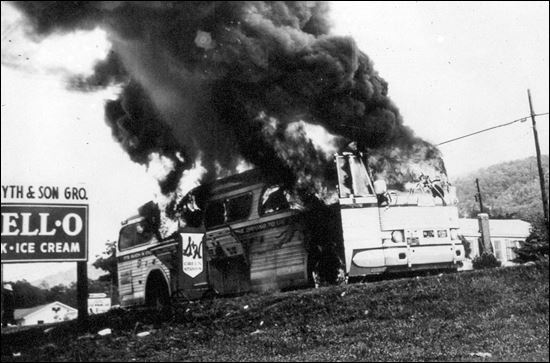
Did I learn anything new from this exhibit? Only the small fact that the actual firebombing of the bus had occurred a few miles outside of town–after the local cops made the KKK mob let the bus leave, only to abandon driver and passengers to their fate as the KKK followed.
They had already slashed the bus’s tires. They knew it wouldn’t get far.
I still can’t comprehend how no one died that day.
But what I DID get from standing in that (shady) alley: chills. Thinking of the bravery of those young volunteers, Black and white, sitting in that Greyhound as the mob surrounded them. Yes, they were all well trained. Yes, they knew what they were signing up for, what they were up against.
(Photo courtesy Wikimedia)
But who, in the moment, is really ready to die by violence?
I drove off into the Alabama evening, shaken by its past…and by the shade that past still casts on our present.
I needed a walk in the woods.
Such beauty. Such peace. Such irony in these Iron Hills.
I want to thank the foot soldiers of the Movement, and the people who keep their story alive. We’re going to need all your grit in the shady days ahead.
“This little light of mine, I’m gonna let it shine…”
I know–Quakely isn’t a word, but it fits the Paul Simon reference better than the actual word, which is Quakerly. Which is what My Sister The School is.
I can’t possibly capture the entire, joyous 3-day anniversary celebration in one blog post, and I won’t try. What I do want to capture, briefly: how true that rag-tag ol’ Quaker school, started 60 years ago by 6 people (two of them my parents) in order to prove to the State of North Carolina that yes, people of all colors and backgrounds could learn and grow together with more happiness and grace than those who were separated by race…
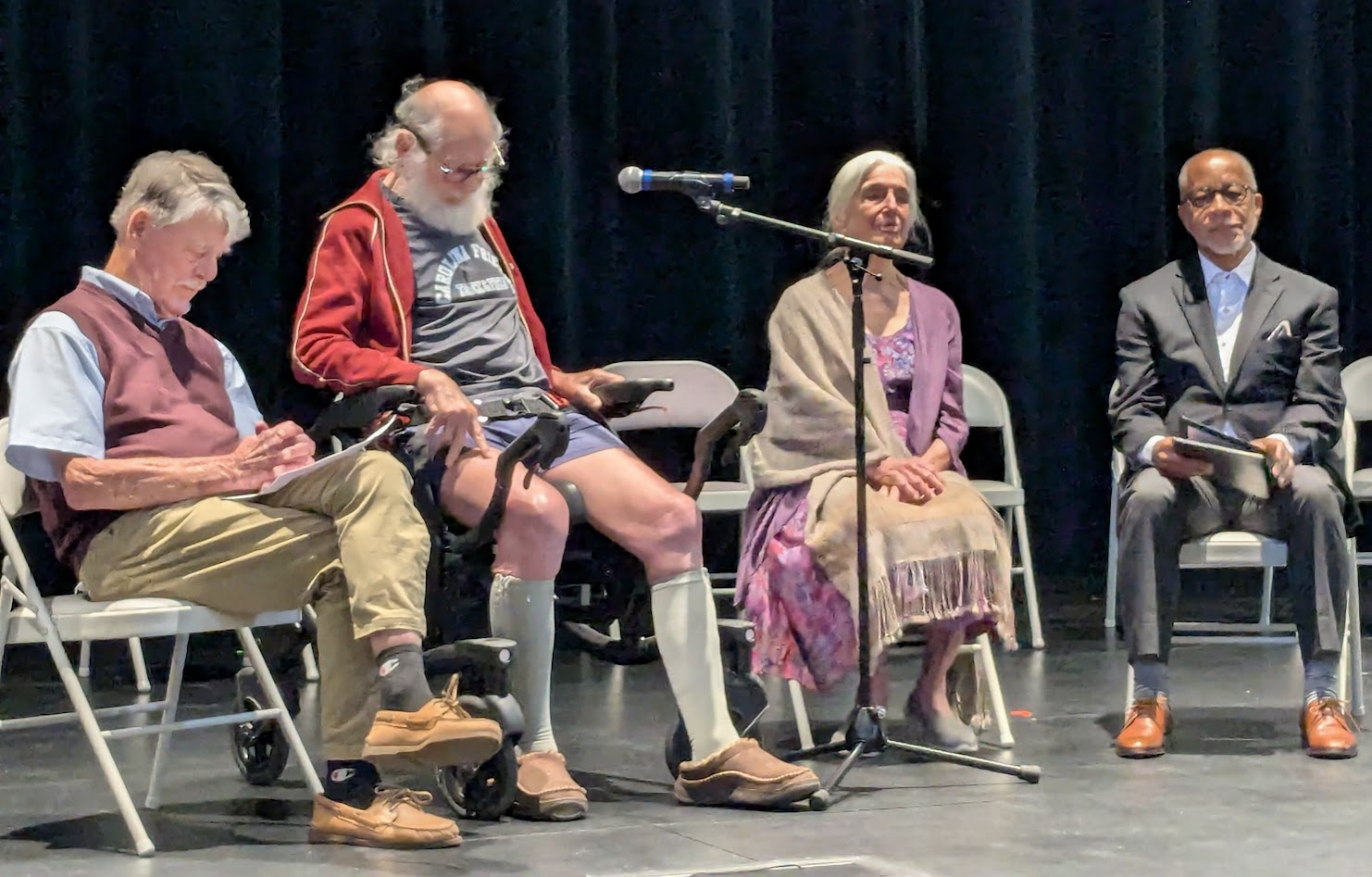
My folks–Peter & Martha Klopfer, in the middle–kicking off a Founders’ Panel with some quiet “settling in”
…that school abides, true to its roots.If you don’t know what I mean by “roots,” take another look at that panel of 4 folks up there. Longtime influential Principal Don Wells (left) and longtime influential teacher Thomas Patterson (right) are dressed as one might expect from panelists, as is my mom. But Dad? He’s dressed for a track workout. Because that’s just who he is. And the school is what it is.
This creek separates Middle School from Upper. And I was overjoyed to see it still hold balls and frisbees, just as it did back in the early 1970s.
Like a number of my fellow “oldies,” I’d worried, in recent years, that CFS was getting too big for its britches. It has sports teams now–with uniforms and everything! And tennis courts. And a performing arts center. At our humble old school?
But throughout my weekend, spending days with decades-old friends and going back to my folks’ farm across the pond every night, I rejoiced in the hanging-in-there-ness of the whole place.
Like Raj, the Last Equine Standing at my folks’ Tierreich Farm…(which will one day go to the school)…
Age 37! And he can still canter!!
…and my dad, who uses the golf cart to get to his walking workout at the new CFS track, but makes his dog get her workout on the way there (just as me & my sisters used to get ours–OK, minus the leash!)…
Good girl. Good boy.
…and Mom, still getting hers by running, at age ALMOST-90!
You’ve outrun me, Mom. I had to give up running for my knees 6 years ago!
Quakers don’t tend to live by tenets, but if they did, #1 would be Simplicity. What you see is what you get. But keep striving for truth, which is constantly revealed. Don’t rest on your laurels. Don’t assume you have it all sewn up because you’ve operated successfully for 60 year. Sit down, be quiet, listen…
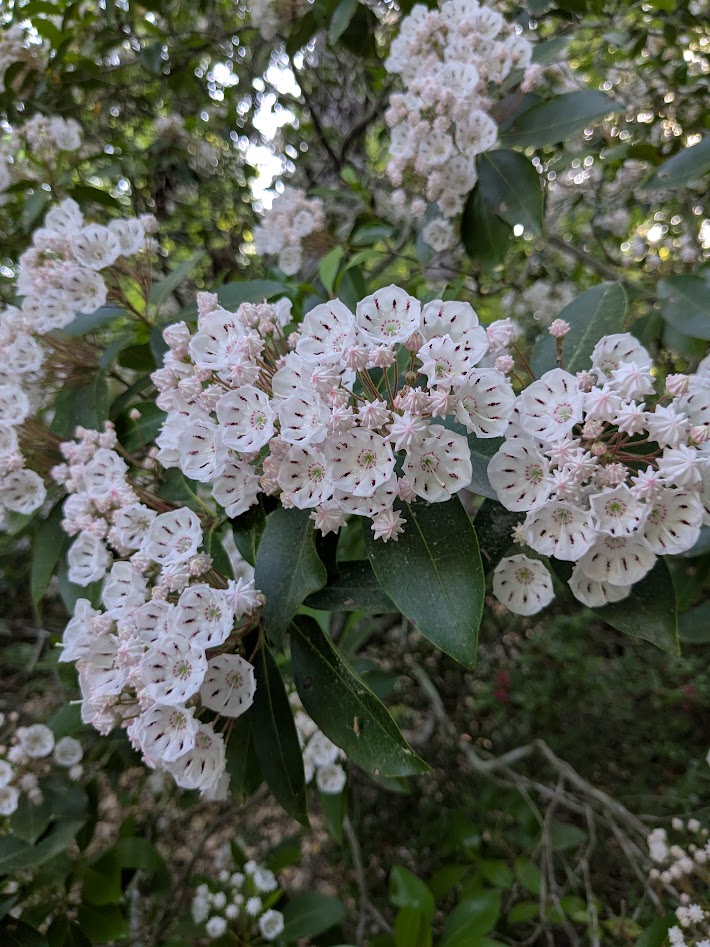
These are (mountain) laurels. Don’t rest on them. But do smell them & take their picture!
…and who knows? You might age as gracefully and thoughtfully as my sister the school. That’s what I’m aiming for!
Next up on Wing’s World: New England and New Scotland (Nova Scotia)!Thanks for ridin’ along.
I read the article (by Ava Ronning, reprinted from The Skagit Valley Herald). And I had to go see it for myself.
Overwhelming. And that’s only at first glance.
The museum itself is housed in a breathtaking old dwelling on a hill overlooking the Swinomish Channel. I was so excited about the exhibit I forgot to photograph the museum, so here’s a shot I stole from their website:
Photo by Wendell Hendershott
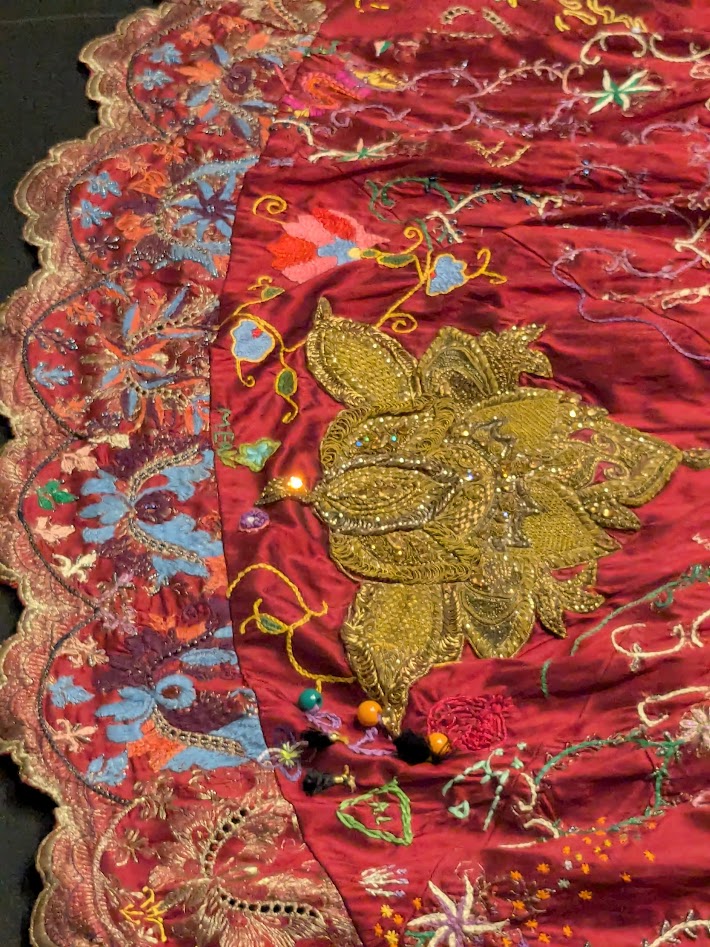
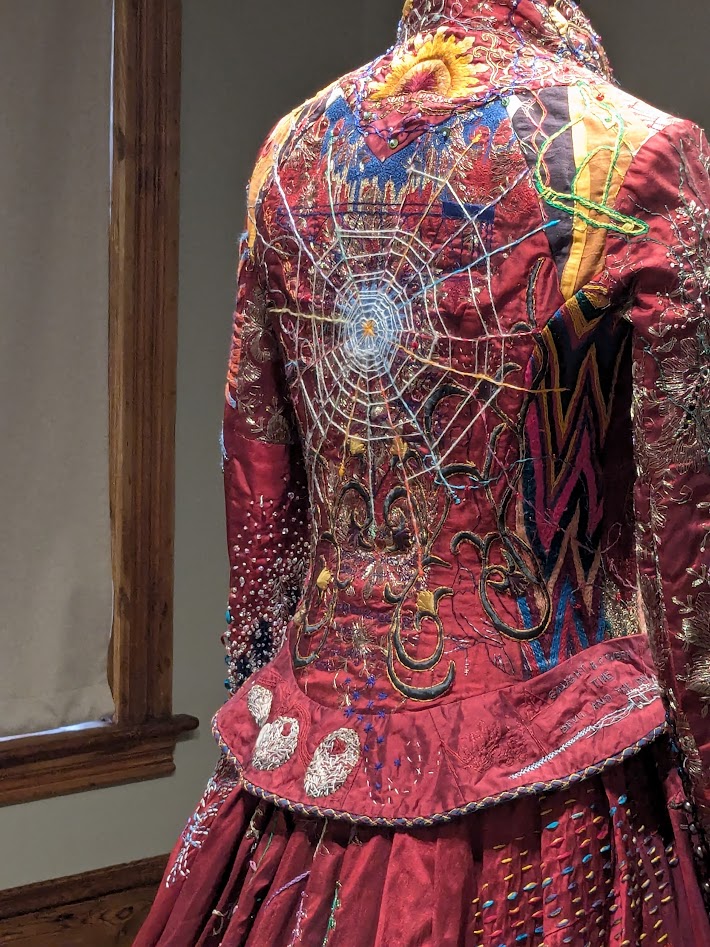
The dress occupies one small room…and I mean occupies. It fills the space, drawing you in to examine every fold, every flounce.
The border is the only part embroidered by machine, commissioned by the dress’s creator
And that’s before you watch the video in the next room, which unpacks the dress’s stories (in part–there are too many for a 12-minute video). That’s where I learned that the white doves on this panel, sewn by survivors of the Kosovo war, represent their longing for peace.
Notice the contrast with the colorful images from (I think) Rwanda. Two communities of survivors, side by side on the dress: white and color; same medium, same message.
The Red Dress Project began with UK artist Kirstie MacLeod, as the website says, “as a sketch on the back of a napkin in 2009.” Since then, it “has grown into a global collaborative project involving and connecting with thousands of people all over the world.”
Through the video, I learned the story of this small piece from an artisan in Colombia. She started with traditional symbols–hibiscus, toucán–but after being shaken by a bombing in Bogotá, she added this word in English:
She could have written “esperanza,” but she preferred to make her message more universal.
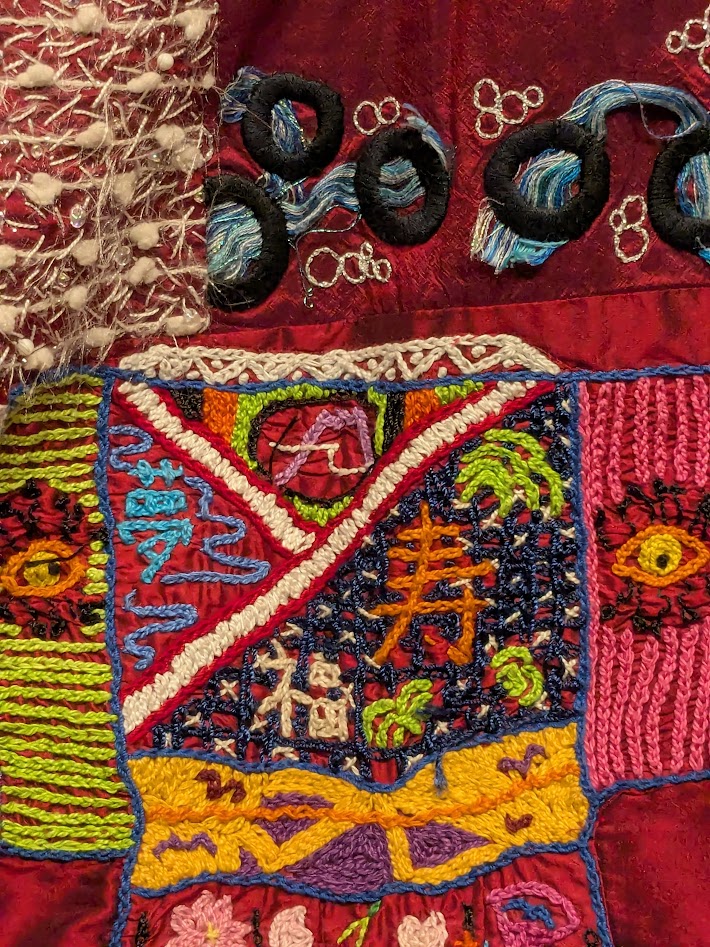
The same word appears in a section from…somewhere else in the world:
The video didn’t say where. But how many places it could be from!
The website tells you right off how many women have been involved in its creation: 380. From 51 countries. If you dig around on the site, you will also learn that the dress weighs 6.8 kilos–that’s just under 15 pounds. (I actually thought it might be heavier–there are beads stitched on there!)
like this bit from India
The website goes on to explain,
Initially the project sought to generate a dialogue of identity through embroidery, uniting people around the world across borders and boundaries. However, over the 14 years it was created, The Red Dress also become a platform for self-expression and an opportunity for, often marginalised, voices to be amplified and heard, initiating vital dialogues on important and frequently uncomfortable issues.
A panel from Chiapas, Mexico. This section of the video was one of the most moving.
The website estimates the number of stitches in the dress from one to 1.5 billion. It reports: “Some of the artisans are rebuilding their lives with the help of embroidery, using their skills or being trained in embroidery to earn a consistent living to support themselves and their communities.”
In other words, these women are paid for their work. From the video, I learned that 50 Bedouin women had been able to achieve financial independence from the embroidery work the Red Dress Project engendered.
This one’s from Japan, not Egypt. I didn’t learn its story.
The most heartening part of the video is where creator Macleod explains, “The importance has shifted from the dress as an art piece to the creators of the dress.” One country at a time, she is traveling with the dress to allow each embroiderer to see (and in some cases wear!) the entire dress, in most cases for the first time. Seeing that wonder on the face of the 19 year-old artisan in Mexico choked me up.
Macleod herself stitched the web on the back of the bodice, representing connection.
Speaking of choking up: this image from Ukraine: their national colors expressed in a flower:
May it be so
Only after leaving the exhibit did it occur to me to consider the word “redress”: it means, “to remedy or set right (an undesirable or unfair situation).” As Kirstie Macleod says, in the video, “The voices of the women are just crying out to be heard.”
And in an era of increasing division, borders, walls, aggression and suspicion, this dress is a community object “without prejudice, without boundaries, without borders…”
So many stories to absorb. So much solidarity to learn from.
So, you want to see the dress yourself? Here’s how.
According to the website, after its La Conner visit (La Conner! Not Los Angeles! That still blows me away), the dress will travel back to the UK, and thence to Asia and Australia.
modest little La Conner, and the Swinomish Reservation on the opposite side of the channel
So unless you can go to those places, here’s what I recommend. Go to the website. Watch the video (under “Media”). Then use their really cool Digital Red Dress tool for a DIY tour: https://reddressembroidery.com/DIGITAL-RED-DRESS
If you’re really bold and/or inspired, Ms. Macleod invites you to reach out to her directly: “Kirstie is able to offer events and presentations with/without the Red Dress tailored to your group/community. Please email her for more info on: reddressembroidery@gmail.com”
That wonderful museum in La Conner is also showing a breathtaking exhibit of bird quilts. I was going to append some of those photos to this post, but you know what? The Dress and the birds deserve their own space. So I’ll save the birds for later.
Go see The Red Dress, in whatever medium you can. And then tell me your favorite part about the experience, eh? It’s all about that web.
My Quaker Meeting meets in the best space ever: a goat dairy.
…where, in the spring, after Meeting, you sometimes get to do this
A dairy is a farm, so of course Sunnyfield has barn cats. One of them, Basil, decided to join us this morning in our nice, warm yurt, for an hour of silence. (Or, for Basil: cuddles.)
Let me repeat: Basil is a barn cat. He’s supposed to be out in the barn catching mice, not sitting on nice, warm, indoor Quaker laps.
And Basil knows this. Oh, he knows! Just look how firmly he’s anchored to this lap–even with his tail!
Since when do cats have prehensile tails? (photo by Kirm Taylor)
For the first 10 minutes, as Basil’s contended purring dominated our silence, I found myself meditating on the power of comfort, the lure of bliss.
What, I asked myself, are my own versions of purring? Me slipping into a hot tub. Me lying down on the couch with a fat novel in an empty house. Me fitting an entire chunk of sushi into my mouth.Me on a mountain, contemplating more mountains.
prrrrrrrr….. (photo by Allison Snow)
But 10 minutes in, one of our group, who happens to also co-own that goat dairy, came in and spotted Basil. Quick as a wink, she deported him back to mousing duty, outdoors.
So I spent a good portion of the rest of that quiet hour thinking about it means to choose comfort over cold, hard service. I know myself well enough to know that I need BOTH. Around this time, I probably lean a bit more toward the purring-on-laps parts of my life.
But I also welcome the fresh air of personal, artistic, and political challenge when it comes. I’m not ASKING to be sent out to the barn, understand. But when someone sends me, I’ll get back out there with my tail high.























 Wing's World