Aventuras Mexicanas con El Esposo y Hijo Dos: Tamasopo de Nuevo, y…Adiós

As I described last entry, we survived 40 degrees Celcius–that’s 102 for us!–in Jalpan by hiding out in its clear blue oases. But there weren’t enough of these within a reasonable drive (on unreasonable roads).

So we decided to spend out last 2 days (1 night) where we started, in Tamasopo.
Aquí

1,000 year old tree? Sí, por favor.

We were not disappointed.

If this thing looks big, please know the picture doesn’t come close to showing how MASSIVE this ancient goddess is. And since cypresses are deciduous, we got to enjoy the sight of this building-sized tree sporting tiny, fresh baby leaves. Circle of life!
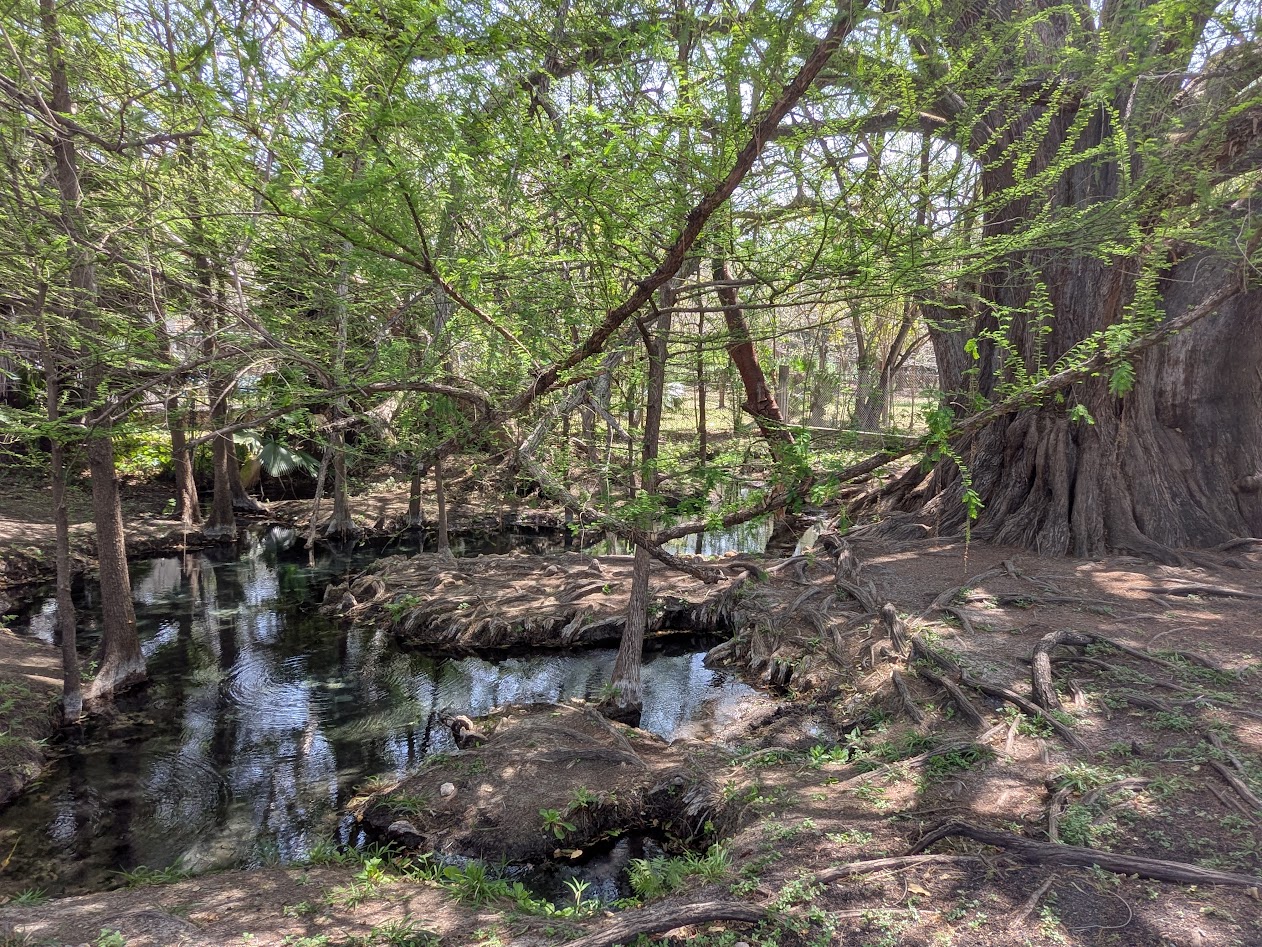
El Arbol Milennario’s secret, I think, is this spring, right at its base. This part was fenced off (luckily), but I was able to sit in the clear water just downstream.

Adventure #2 was Google’s fault. Well, maybe it was ours…for taking the route as Google directed, even though the road appeared not to have a name. It started nice and paved, but when it abruptly turned to rutted dirt, it was too late to turn around.

At a maximum of 15 mph, I had plenty of opportunity to take cactus photos out the window.

Luckily we got through 45 minutes of potholes without damage to the car, and after regaining pavement, we were back in Tamasopo in no time, and back in that incredible river.

Miss you already

Early next morning, Hijo Dos y yo paid one last visit to the Puente de Diós we’d first met the week before. But there was a guide nearby, so no illegal swimming this time…plus it was a little chilly anyway.

Miss you too
…honestly, who cares? This photo is now my computer’s wallpaper.

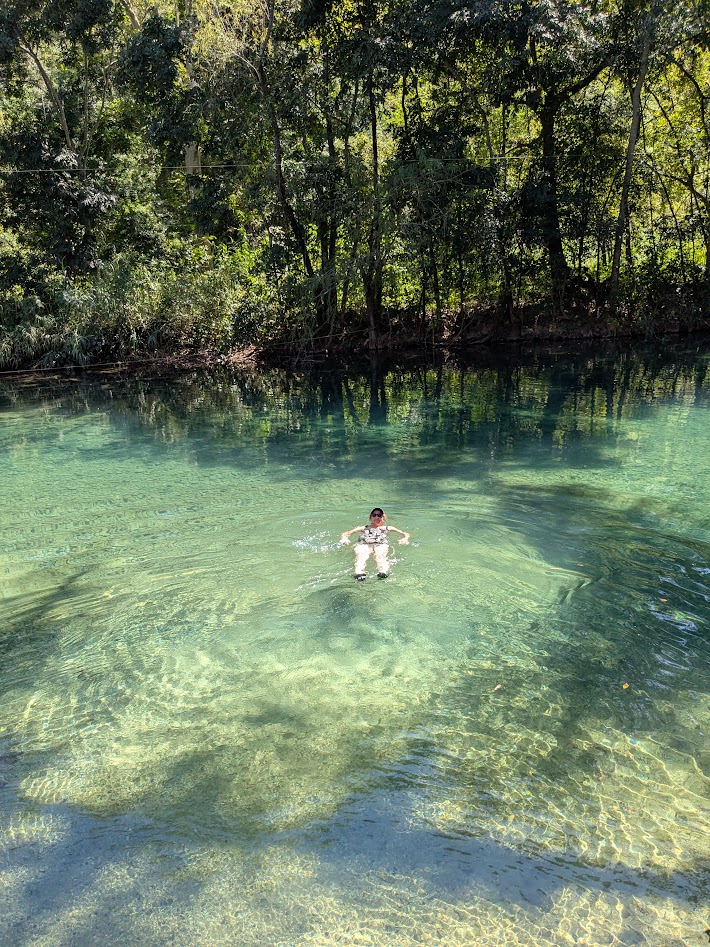
A lazy part of the same blue river that starts at the Puente de Dios, El Trampolín has the added feature of being PUBLIC. No entrance fee, no guides, no nothing…just hop on in and float!

And look up at the Spanish moss while doing so.

The only disadvantage to the public part of this gorgeous oasis was…garbage. Not a ton, but enough to be noticeable. And disappointing. Sometimes people suck.

Back in the city of San Luis (or the outskirts; after all our beautiful blue-green experiences, we weren’t in the mood for touring a hot city), we took ourselves out to dinner at a place close by our airport hotel. Hijo Dos picked it out. “It’s famous for grilled meat,” he said.

If you’re thinking, “Wait–is The Mate eating a cheeseburger??” you are not wrong. What a gringo! (But he said it was one of the best cheeseburgers he ever had. The he helped me and Hijo Dos eat the big meatpile)
Here’s a hint.

Tree Guru, Part II: Let Me Learn From Yew Too

Here’s one of those “discovering” something that was always in plain sight stories. And of course it has a moral.

A few weeks ago I was walking my favorite woodsy path on our beautiful isle and my eyes came to rest on the trunk of a tree I must have passed literally HUNDREDS of times. “Funny,” I thought, “that looks like a juniper. But they don’t have junipers here.”

It’s true. Here in Ecotopia we have Western Red Cedar and we have Douglas Fir, but juniper’s an eastern thing. I knew right away this was something special. And that’s when I remembered hearing about a handful of ancient Pacific Yews still surviving on the south end of Lopez Island. I stepped in for a closer look.

Much closer look.

Thirty+ feet in height. Flat needles. Red bark. But the width–whoa! I couldn’t get my arms around the trunk, not by a long shot. My wing span’s a good 5 feet, so this trunk’s circumference could be 80 inches. And yet it looked SO modest, tucked into the larger forest, that I had ignored it for a good six years of walks.

Not much to yew, is there?

A botanist friend tells me a yew this size is “hundreds of years” old. Impossible to tell how MANY hundreds, of course, but who cares? This unassuming tree, much smaller than the firs around it, could be their great-great-great grandma (overlooking the whole different genus thing, of course).

The obvious moral to this story is, PAY ATTENTION. Who knows what you may be walking past? The more subtle moral…well, several come to mind.

Perseverance and strength–the qualities of heroes–may come in drab packages.

Flashiness often distracts us from our best, truest role models. And of course…

Yew are who yew are.

Do you have your own story of an unobtrusive hero or role model you came to notice after much time? Do share, won’t yew?

My Guru The Tree

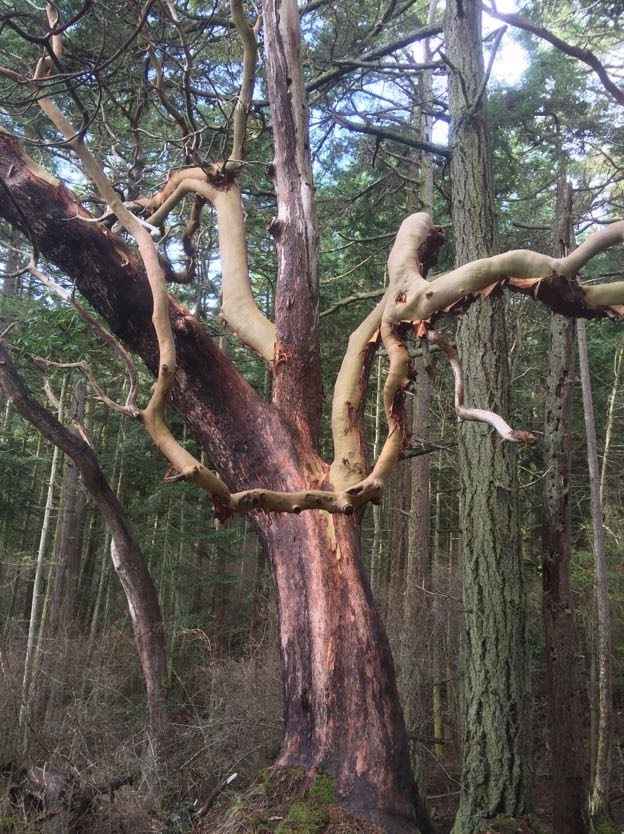
If you look at my books you’ll see my publisher is Madrona Branch Press.

That’s me. All us Indie authors are our own presses. But Madrona Branch, the name? There’s a story there, which I’ve told before.

Don’t have time for the previous blog post? Just look closely at that loopy branch.

Here’s an update.

The other day I was out for a walk and stopped to hug “my” tree as I usually do.

Hello, Beautiful.

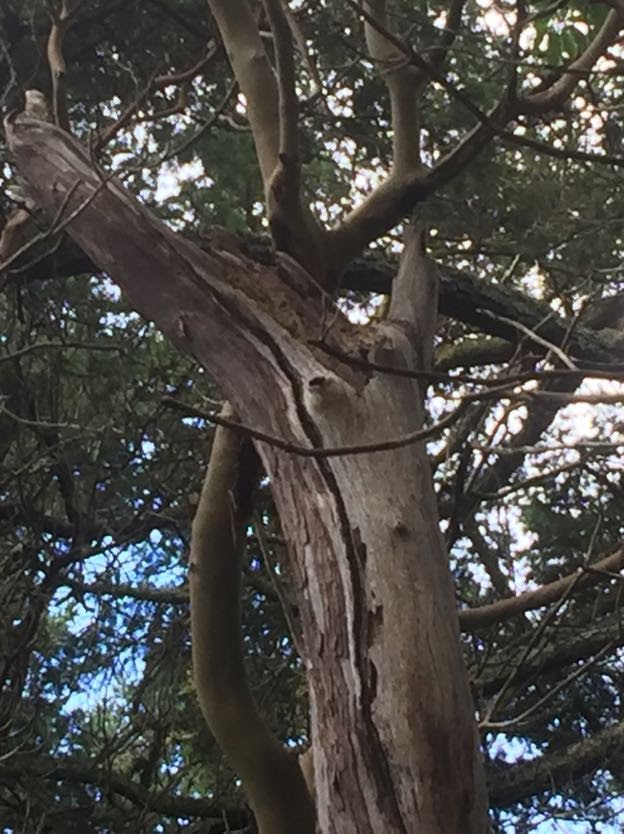
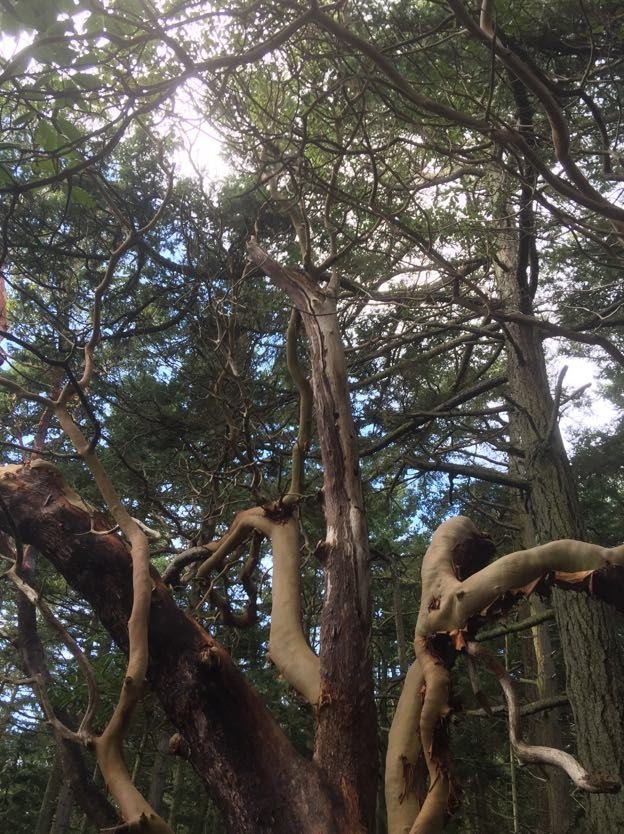
Then I stepped back and looked into its upper branches. My eyes found that astounding curl of branch which has become my personal emblem. Then, for the first time, they noticed something new that had always been there:

“I’ve been here all along, y’know.”

See it? Look closer.

“Lean on me…when you’re not strong…”

Not only is that never-say-die branch supporting itself with its own loop, it’s also leaning against an older part of the original tree trunk. A dead part. But not so dead that it can’t lend its bulk to keep “my” branch climbing toward the sunlight.

Excelsior!

So I’ve extended my metaphor. Yes, I accepted the “failure” of not being traditionally published, and supported myself to keep growing upward, into independent publication. But I was never alone in that endeavor. I leaned heavily on my writing group, on my editor, on my book designer, and on countless friends I knew only via internet, who helped me with technology or marketing questions.

Not to say any of those folks are “dead wood.” They are all solidly growing themselves. The “dead” part of that solid trunk is all the authors over time whose work inspired me and taught me. Shakespeare. Zora Neale Hurston. William Carlos Williams. Wallace Stegner. Barbara Kingsolver. Michael Chabon. And on and on and on, a trunk of growth so powerful it will never stop nourishing growth, even when it’s finally broken down into soil.

There’s also something to be learned from a tree which uses its own dead parts as scaffolding, rather than shedding them. That’s US, guys–the community of writers! We are the whole damn tree.

A little further on my walk, I ran into another new favorite tree of mine. But that’s a whole other story, so I’ll save it for my next post.

Any other metaphors strike you from these pictures? Or do you have a Nature metaphor for your own experience? I would love to hear.

Factoid #15

THIS JUST IN! Shocking news for us Northwesterners: The Douglas Fir is not–I repeat NOT–an actual fir tree.

I know. We’ve been living a lie.

For those of you not privileged to live anywhere west of the Cascade Mountains and north of the Bay Area, these trees are EVERYWHERE. Tall, dark and handsome. And everyone calls ’em fir trees (unless we’re like, “oh, look at that eagle in that pine tree–” but that’s a whole other issue).

courtesy Wikipedia

courtesy Wikipedia

Turns out the good ol’ Doug Fir isn’t even in the genus Abies. Nope, it’s a Pseudotsuga. All I can make of that name is that it’s a “kinda-sorta tsuga”–whatever a tsuga is.  The species is menziesii (so says Dr. Wikipedia), named after naturalist Archibald Menzies. Dr. Wiki says he was a “rival” to naturalist David Douglas, so I bet ol’ Archie felt pretty smug when he got that species name. Joke’s on him, though–no one calls ’em Menzie-firs!