I read the article (by Ava Ronning, reprinted from The Skagit Valley Herald). And I had to go see it for myself.
Overwhelming. And that’s only at first glance.
The museum itself is housed in a breathtaking old dwelling on a hill overlooking the Swinomish Channel. I was so excited about the exhibit I forgot to photograph the museum, so here’s a shot I stole from their website:
Photo by Wendell Hendershott
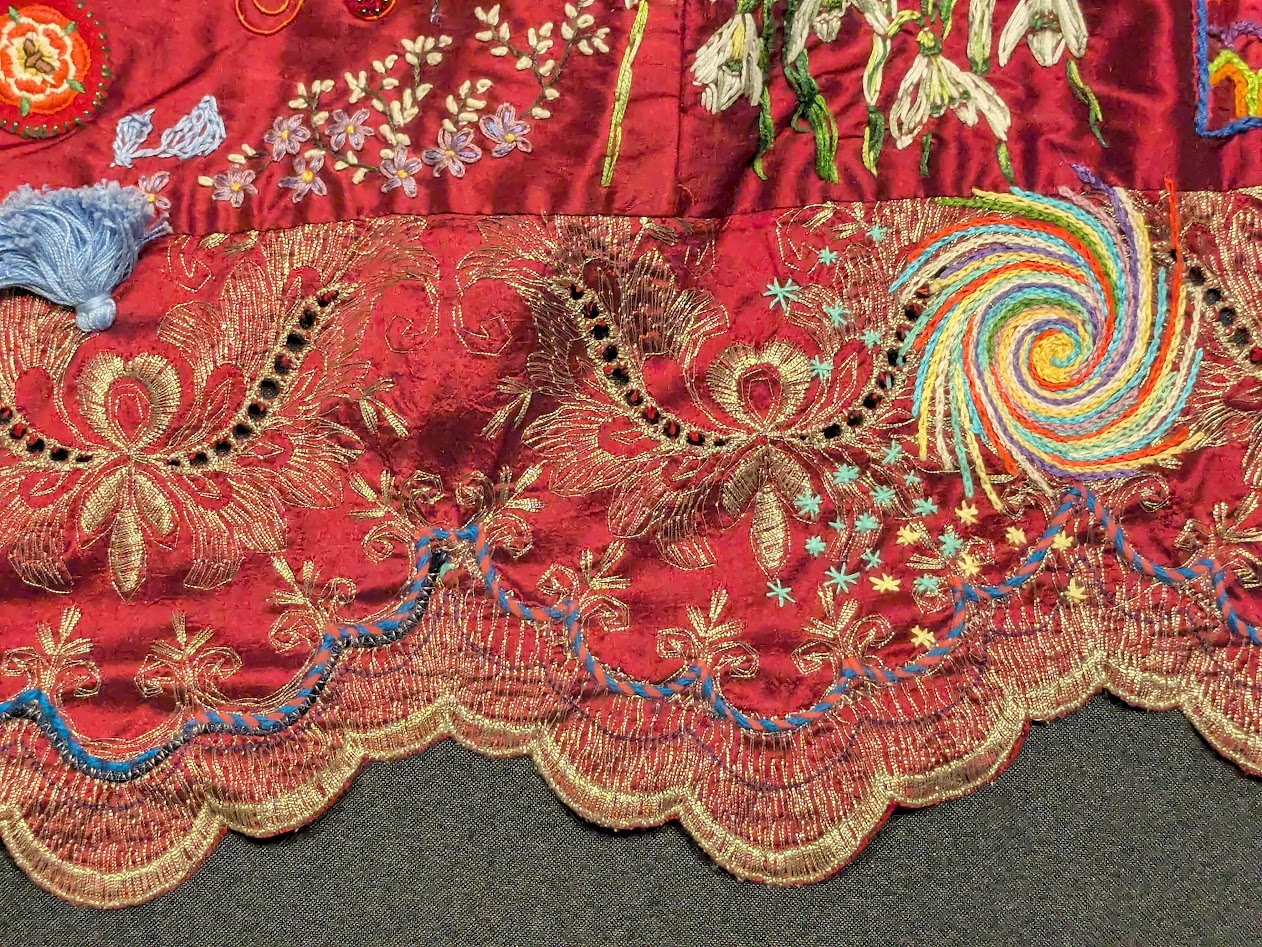
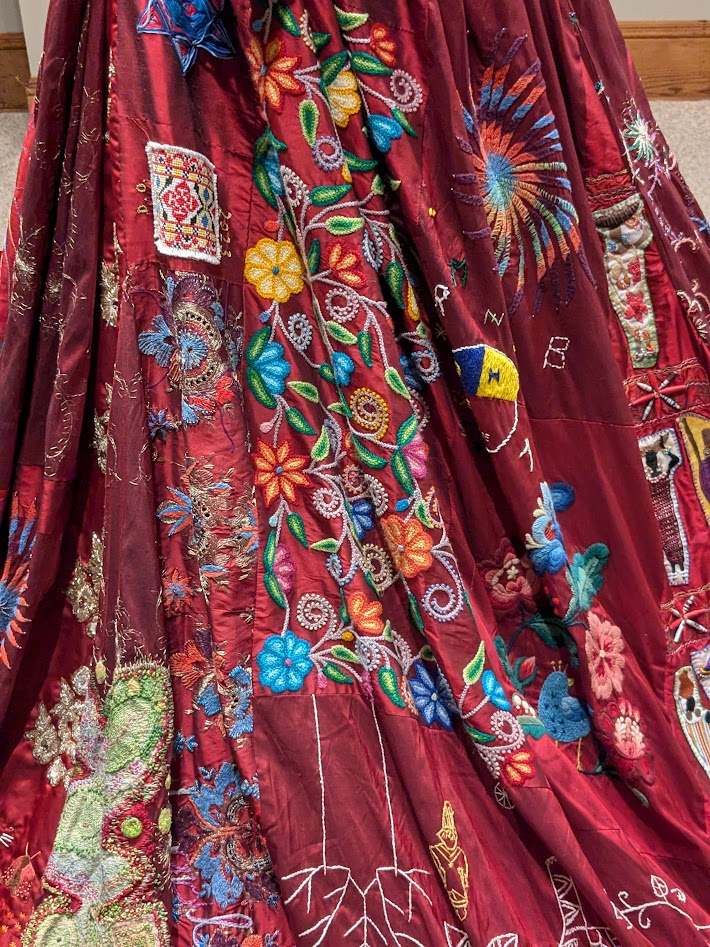
The dress occupies one small room…and I mean occupies. It fills the space, drawing you in to examine every fold, every flounce.
The border is the only part embroidered by machine, commissioned by the dress’s creator
And that’s before you watch the video in the next room, which unpacks the dress’s stories (in part–there are too many for a 12-minute video). That’s where I learned that the white doves on this panel, sewn by survivors of the Kosovo war, represent their longing for peace.
Notice the contrast with the colorful images from (I think) Rwanda. Two communities of survivors, side by side on the dress: white and color; same medium, same message.
The Red Dress Project began with UK artist Kirstie MacLeod, as the website says, “as a sketch on the back of a napkin in 2009.” Since then, it “has grown into a global collaborative project involving and connecting with thousands of people all over the world.”
Through the video, I learned the story of this small piece from an artisan in Colombia. She started with traditional symbols–hibiscus, toucán–but after being shaken by a bombing in Bogotá, she added this word in English:
She could have written “esperanza,” but she preferred to make her message more universal.
The same word appears in a section from…somewhere else in the world:
The video didn’t say where. But how many places it could be from!
The website tells you right off how many women have been involved in its creation: 380. From 51 countries. If you dig around on the site, you will also learn that the dress weighs 6.8 kilos–that’s just under 15 pounds. (I actually thought it might be heavier–there are beads stitched on there!)
like this bit from India
The website goes on to explain,
Initially the project sought to generate a dialogue of identity through embroidery, uniting people around the world across borders and boundaries. However, over the 14 years it was created, The Red Dress also become a platform for self-expression and an opportunity for, often marginalised, voices to be amplified and heard, initiating vital dialogues on important and frequently uncomfortable issues.
A panel from Chiapas, Mexico. This section of the video was one of the most moving.
The website estimates the number of stitches in the dress from one to 1.5 billion. It reports: “Some of the artisans are rebuilding their lives with the help of embroidery, using their skills or being trained in embroidery to earn a consistent living to support themselves and their communities.”
In other words, these women are paid for their work. From the video, I learned that 50 Bedouin women had been able to achieve financial independence from the embroidery work the Red Dress Project engendered.
This one’s from Japan, not Egypt. I didn’t learn its story.
The most heartening part of the video is where creator Macleod explains, “The importance has shifted from the dress as an art piece to the creators of the dress.” One country at a time, she is traveling with the dress to allow each embroiderer to see (and in some cases wear!) the entire dress, in most cases for the first time. Seeing that wonder on the face of the 19 year-old artisan in Mexico choked me up.
Macleod herself stitched the web on the back of the bodice, representing connection.
Speaking of choking up: this image from Ukraine: their national colors expressed in a flower:
May it be so
Only after leaving the exhibit did it occur to me to consider the word “redress”: it means, “to remedy or set right (an undesirable or unfair situation).” As Kirstie Macleod says, in the video, “The voices of the women are just crying out to be heard.”
And in an era of increasing division, borders, walls, aggression and suspicion, this dress is a community object “without prejudice, without boundaries, without borders…”
So many stories to absorb. So much solidarity to learn from.
So, you want to see the dress yourself? Here’s how.
According to the website, after its La Conner visit (La Conner! Not Los Angeles! That still blows me away), the dress will travel back to the UK, and thence to Asia and Australia.
modest little La Conner, and the Swinomish Reservation on the opposite side of the channel
So unless you can go to those places, here’s what I recommend. Go to the website. Watch the video (under “Media”). Then use their really cool Digital Red Dress tool for a DIY tour: https://reddressembroidery.com/DIGITAL-RED-DRESS
If you’re really bold and/or inspired, Ms. Macleod invites you to reach out to her directly: “Kirstie is able to offer events and presentations with/without the Red Dress tailored to your group/community. Please email her for more info on: reddressembroidery@gmail.com”
That wonderful museum in La Conner is also showing a breathtaking exhibit of bird quilts. I was going to append some of those photos to this post, but you know what? The Dress and the birds deserve their own space. So I’ll save the birds for later.
Go see The Red Dress, in whatever medium you can. And then tell me your favorite part about the experience, eh? It’s all about that web.
My Quaker Meeting meets in the best space ever: a goat dairy.
…where, in the spring, after Meeting, you sometimes get to do this
A dairy is a farm, so of course Sunnyfield has barn cats. One of them, Basil, decided to join us this morning in our nice, warm yurt, for an hour of silence. (Or, for Basil: cuddles.)
Let me repeat: Basil is a barn cat. He’s supposed to be out in the barn catching mice, not sitting on nice, warm, indoor Quaker laps.
And Basil knows this. Oh, he knows! Just look how firmly he’s anchored to this lap–even with his tail!
Since when do cats have prehensile tails? (photo by Kirm Taylor)
For the first 10 minutes, as Basil’s contended purring dominated our silence, I found myself meditating on the power of comfort, the lure of bliss.
What, I asked myself, are my own versions of purring? Me slipping into a hot tub. Me lying down on the couch with a fat novel in an empty house. Me fitting an entire chunk of sushi into my mouth.Me on a mountain, contemplating more mountains.
prrrrrrrr….. (photo by Allison Snow)
But 10 minutes in, one of our group, who happens to also co-own that goat dairy, came in and spotted Basil. Quick as a wink, she deported him back to mousing duty, outdoors.
So I spent a good portion of the rest of that quiet hour thinking about it means to choose comfort over cold, hard service. I know myself well enough to know that I need BOTH. Around this time, I probably lean a bit more toward the purring-on-laps parts of my life.
But I also welcome the fresh air of personal, artistic, and political challenge when it comes. I’m not ASKING to be sent out to the barn, understand. But when someone sends me, I’ll get back out there with my tail high.
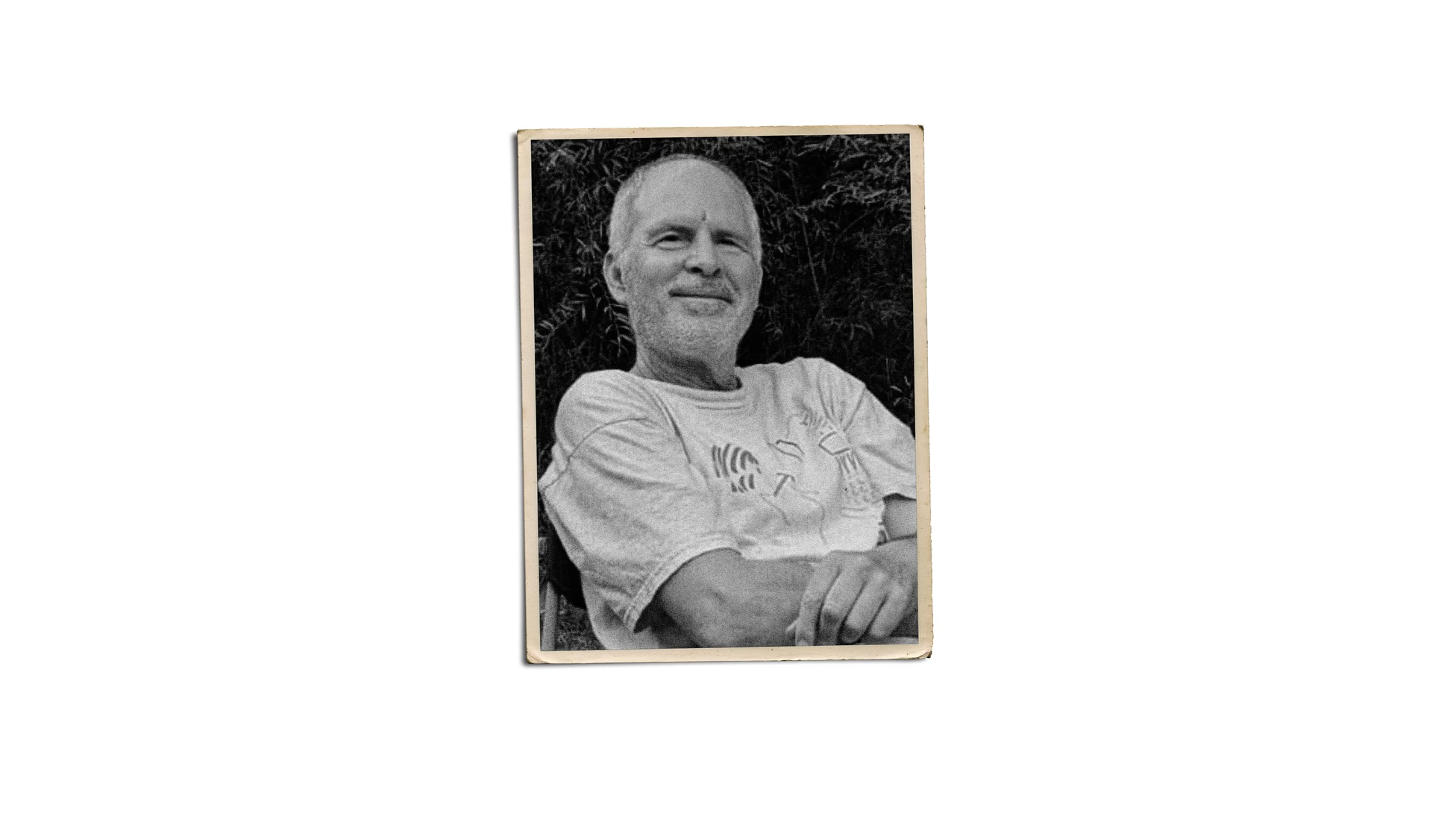
The other night I woke from a vivid dream about Keith Siegel.
Keith graduated two years ahead of me from Carolina Friends School, in Durham, NC–my sister’s class, 1977. Even at such a tiny school, we didn’t hang out. Except for the occasional fragment of nostalgia, I hadn’t heard his name since then.
Shocked into action by this connection, I immediately wrote the White House and my Senators, begging them to keep the pressure on Israel to negotiate a cease-fire in Gaza that would bring the hostages home AND stop the wholesale slaughter of Palestinian innocents.
Then I forgot about the hostages again, for long stretches. I certainly wasn’t dreaming about them.
Photo from The Atlantic, submitted by Aviva Siegel
Then, a few days ago, my sister (the one in Keith’s CFS class) sent me an article from The Atlantic. THAT’s what inspired the dream.
In “I Survived Hamas Captivity, but I’m Not Yet Free,” Keith’s wife Aviva Siegel writes:
The last time I saw my husband, Keith, was on November 26. He was lying on a filthy mattress on the floor of a darkened room and could barely look at me. We had spent 51 days together as Hamas’s hostages after being violently abducted from our home on October 7. I had been told earlier that day that my name was on the list; I was to be released and sent back home to Israel. Keith was to be left behind.
Keith, Aviva reminds us, “is an American citizen…born and raised in Chapel Hill, North Carolina—also the hometown of James Taylor, his favorite singer.” (I remember him liking Jackson Browne too.) He’s a gentle man, she writes, someone who learned Arabic in order to communicate with Palestinians living across the nearby border. A vegetarian so committed he wouldn’t even eat a morsel of chicken in the little food provided by his captors. A peacemaker.
Yes, I thought. Sounds like a 1970s CFS grad, all right.
As I forced myself to read Aviva’s horrific descriptions of captivity–on a lovely, sunny day, heading to a farmstand to buy some flowers–I felt more and more surreal. “I think about Keith all the time,” Aviva writes,
…but I feel a particular pang whenever I drink water, when I take a shower, when I eat something delicious. As a hostage in Gaza, these are not things I could do. The most frustrating part is that I don’t know anything about Keith’s condition: Is he alone? (I’d love for someone to tell me that he’s not.) Is he sad, or crying? Is he in a tunnel with no oxygen? Is he sick or being tortured? Has he eaten any food at all today? Is he alive?
In my dream the other night, I think Keith was trying to answer his wife’s desperate questions. He was still captive, sad and weary, wearing a white T-shirt, but he was philosophical. Reassuring.
I woke up feeling I wasn’t doing enough. I read Aviva’s article again.
“Keeping the hostage issue at the top of people’s minds,” she writes, “is the only thing I can do.”
I’m asking the United States government not to give up on them. I’m asking Israel’s leaders to bring our hostages home. Don’t abandon them. Don’t let our loved ones be killed.
I wrote the White House again, and my two Senators. I don’t know what else to do, to stop this terrible war. Except not forget, not give up.Maybe we can all try not to give up on peace.
If I dream of Keith again, I want to be able to tell him we’re trying.
When it comes to July 4th celebrations, our little island goes all out.
Ooh…
Since over the years I have a) successfully conquered my fireworks phonophobia (i.e. fear of loud bang-bangs) and b) made friends with someone who lives directly across from where our incredible, community-supported show is lit, I am now all-in on this once-a-year explosion of beauty.
Ahh…
But even as I’m making up for decades of fireworks avoidance, oohing and ahhing, I can’t help thinking about…you know. The flip side of this tradition.
What about the pollution? Doesn’t a bunch of crud rain down into our beloved Salish Sea?
Is blowing stuff up really the best way to show our joy? Could all that money be raised for something more peaceful?
What about people who suffer from PTSD? What about the poor animals?
The hour before the show…see how peaceful! Isn’t this a show in itself?
Hey, I GET it. I’m not a killjoy. It’s taken me six decades to experience the joy of fireworks–I’m not about to smother it with a wet blanket. I just can’t help thinking…
In the summer of 2024, what exactly are we celebrating?
I HOPE it’s our common love for our land and our social contract. But right now that love feels more like a tender flame to be guarded than a big, happy explosion.
Boom.
Riding my bike home after a bakery shift on July 5, I looked up to see this Great Horned Owl staring down at me from a fir tree.
Whoooo goes there?
It was 2 pm. Not owl time. And yet there it was, huge golden eyes fastened on me like an interrogation. Like, Were you the one asking what should be celebrated?
Soon I’ll be leaving Lopez again for another foray into the land of interstates–a.k.a., California Roadtrip. But as this small island community slips behind me, I’ll be looking for the equivalent of daytime owls all along our way.
No explosions–just a quiet celebration of what is available to us if we have enough sense not to mess it up.
This is a person and a book I thought many of y’all would appreciate knowing about.
As David’s blurb puts it,
“At the heart of Hall’s approach is the empowerment of readers, encouraging them to embody greater tenacity and compassion in their interactions. By addressing family conflicts with a fresh perspective, readers can transform their dynamics and pave the way for a more fulfilling family life. Hall’s emphasis on recognizing the unique viewpoint of each family member is a pivotal cornerstone of his methodology. Through this lens, the book offers practical and actionable steps that lead to genuine understanding and resolution.”
Full disclosure: My own family has never sought counseling, nor have I ever purchased such a book. But as I found myself thinking, “David’s is a book I would buy,” I also felt like digging deeper: why is that? Which led me to this brief interview.
Me: How did you get into this business, anyway?
DH: I was a Goldwater Republican when I entered Harvard as a freshman in 1964. I’d been my high school’s student leader of an all-school mock political convention for which Bill Miller, Goldwater’s Vice presidential nominee, helicoptered into our school for the keynote.
As I came out of a lecture hall, a SDS [Students for a Democrative Society] leaflet asked if I knew who was the personal hero of Nguyen Kao Ky, South Vietnam’s then Vice President. The answer? Adolf Hitler. That leaflet set me on a new course of understanding the war in Vietnam. As I approached graduation, I studied the selective service laws and eventually applied and was granted a Conscientious Objector deferment based on the Gospel of Matthew.
That led to my being drafted halfway through the Master of Arts in Teaching program at the Harvard Graduate School of Education. I ended up working for the next 3 years in the Treatment Program for Habitual Sexual Offenders at Western State Hospital south of Tacoma. Deciding on a future after that led me to medicine and child psychiatry, wanting to get to kids BEFORE they offended.
Me: Can you describe a typical day of work with children in the past decade or so?
DH: My last decade of full-time work was at Island Hospital in Anacortes three days a week. I had a full schedule from 9am to 5pm working an hour at a time with kids and families ranging in age from 2-1/2 to 80. We’d sit facing each other while I listened carefully to their concerns and hopes for change. The process built on collaborative creative problem-solving exercises looking at new strategies that might replace interactive patterns of communication that continually led to conflict. The challenge was often finding ways to address longstanding histories of family conflict and sometimes significant trauma for parents and their parents, so we focused on breaking the grip of this cascade of intergenerational distress. A key was maintaining a no-fault, no blame approach to any of the emotional or physical trauma, establishing a trustworthy and nurturing environment in which the work could take place, and helping participants to be honest, articulate, and hopeful about healing their soul wounds.
Me: Your book focuses on family conflict. Have you played the role of family therapist in your career, or have you simply found that, with your individual clients, family communication (or its lack) lay at the root of, or exacerbated other problems?
DH: Several years into private practice of child psychiatry, I spent a year with Dr. Tom Roesler’s Montlake Family Therapy Institute learning strategies for dealing with family systems, which became the foundation over the next three decades for engaging conflicted families in healing conversations. I knew from my work with habitual sexual offenders that almost always family trauma lay behind their fractured personalities, often with parents whose fractured personalities continued what I came to call the cascade of intergenerational violence.
Me: I know you and your wife Anne have made international travel a staple of your political and moral lives, including many trips to Gaza. Do you feel a connection between your work with kids and families and your work between nations, or did those two strands of your life arise separately?
DH: My travels grew directly out of my awareness that how children are treated makes a huge difference in how they behave as adults and as participants in governing politics. My first international trip was to Tashkent, Seattle’s sister city in the 1980s. I went as the trip physician with a group of 15 teenagers who spent three weeks with 15 Russian teenagers putting together a “Peace Child” musical, which we performed in the local park at the end of the trip. Subsequently Anne and I took our church youth group on separate trips to Haiti and Tanzania.
Also in 1993 we began a series of medical visits to Israel, the West Bank, and Gaza, where we eventually focused on bringing outside medical training and accompaniment to physicians isolated by the Israeli occupation in the open air prison that is Gaza. I have come to see the way Israeli politics plays out with their immediate enemies in the Palestinian territories directly parallels the way the United States deals with its enemies halfway around the world.
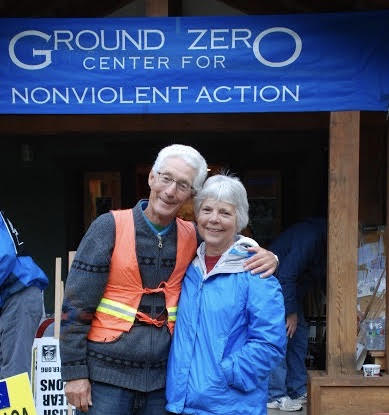
David and Anne Hall in 2016
Me: How many times have you and Anne been to Gaza?
DH: I think 8 trips to Gaza beginning in Oct 1993. Our latest was just as COVID was breaking. We arrived in Gaza in late February 2021 then on March 5th we learned that COVID was likely to close the Ben Gurion Airport, so we got together and decided to leave the next day.
DH: This award is in recognition of my core leadership on the WPSR board for 38 of the last 40 years. I served 2-year terms as chapter president in 1991-2 and 2003-4.
When I retired briefly during our move to Lopez in 2011, the WPSR chapter president died, and the chapter collapsed. I was one of three who put it back together in 2013.
I also served on the national PSR board in the 1990s and was president of that board in 1997. I describe PSR/WPSR as my home community, the third leg of my personal grounding along with family and child psychiatry.
Working for justice in 2019
Me: How did you come up with the Nine Steps described in your book?
DH: My early child psychiatry family therapy experiences nudged me to summarize what I learned from the families I was working with.
The core lesson was learning to listen deeply and patiently, understanding that I didn’t really know these people until I could guide them toward more honest and open disclosure of their true feelings and experiences.
From my several years leading a peer-confrontation therapy group of convicted sexual offenders in the Washington State Treatment Program for Habitual Sex Offenders at Western State Hospital, I’d learned to listen empathically to their childhood stories of maltreatment, ostracism, and humiliation.
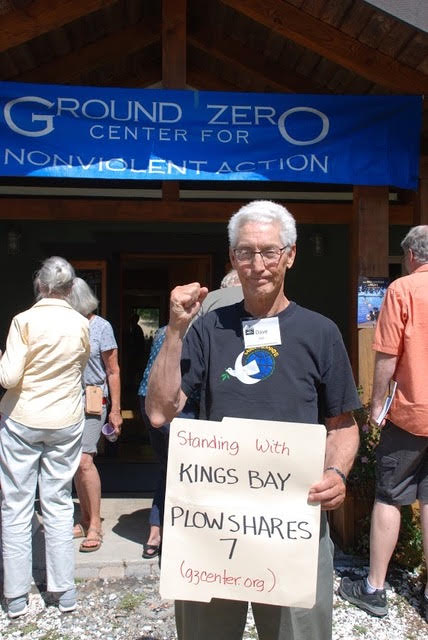
Dave and Anne recently on Lopez
Me: What would you say to someone (maybe a parent like I was, or my parents) who says, “Oh, my family’s fine–we just fight it out, we don’t need a book like this!”
DH: The choice to recognize conflict and deal with it is personal and belongs to every parent and family member. It’s when someone in the family says things need to change that I have a window of opportunity to be helpful.
Me: Thank you so much, David! I feel grateful for the opportunity to shine a little more light on some of the healing work you’ve spent your life on.
Yes. Hi. Me too. There’s a bunch of us in this…boat, this space, this era.
I want to share two things I’ve been leaning on a bit when the pressure of words and feelings builds up.
Number One: I try to capture magic sensory moments in my day. This morning it was the unexpected scent of wild roses on my walk. Yesterday it was the gentle breath of the air when the wind finally dropped. And a couple of days ago, at the Dump, it was this stunning image inside the glass dumpster:
good thing I had my camera, ’cause I’m not sure I could capture this in words
Someone–maybe one of our community’s glass artists?–had dumped a large pile of crushed glass on top of the usual bottles, and then, in a fit of artistry I guess, added a small glass sea star on top.
I took that photo, then got everyone else at the dump to take a look themselves. Voila–instant joy, in a dumpster.
Number Two: You know the game Bananagrams? It’s lovely, and I recommend it. But my sons and I play a variation on the game that we call Scramble. I won’t describe Scramble here, because it’s as fast & furious as it sounds–lots of fun, but not at all restful or comfortable. But SOLITARY Scramble is both. Here’s how it works.
Dump all 144 Bananagrams tiles out and turn them blank-side-up. 2. Turn 4 letters over and try to make a word. If you can’t, keep turning over tiles until you can. 3. Once you have a word, continue turning tiles, one at a time. But (HERE’S THE FUN PART) 4. Try to fit each new letter into an EXISTING word before creating a new one.
A few rules, of course. Adding letters to existing words requires re-arranging the word. You can’t just make something plural, change “bask” to “basking”, or “world” to “worldly”. You CAN change “bask” to “basket,” or “world” to “whorled.” Or even “latrine” to “relating.”
Get it?
Unlike regular Scramble, where you’re trying to use letters before your fellow players do, Solitaire Scramble is deliciously slow. Deliberate. No backsies–whenever you’ve used a letter, you can’t later move it to another word! So take your time.
Hint: pay attention to “ING” and “ED” and “TION” possibilities. If you find the 4-letter-word minimum too challenging, start with three.
And if you’re both careful and lucky, you might just end up with a PERFECT ROUND, using up all 144 letters:
Ahhhhhh…
Now THAT is comfort: a good 45 minutes spent on nothing but language.
Anyone else? Comforting little moments to share? My spirits will thank you.
Anyone else getting tired of hearing about the end of the tunnel? Tunnels are concrete structures, figuratively and literally. They have beginnings, middles, and very distinct ends. Are we seriously trying to compare COVID times with a tunnel?
(Image courtesy BY-NC-ND 2.0, Wikimedia Commons)
Right now, just as the graphs seem to be trending in the right direction, there suddenly seem to be even more unknowns. Can I get on an airplane now? Am I part of the problem for even wanting to? If everything’s getting better, why do I still feel dread? Why does optimism still get stuck somewhere between my throat and my stomach?
The other day I happened upon an “On Being” podcast about this EXACT frustration with the interminability of this time, and the effects of all that who-knows?ness on our mental state. I immediately thought about a bunch of different friends to send the link to.
But I don’t love it when people tell me I “should” listen to something nearly an hour long, even if I know I’d probably benefit. So instead, I’m excerpting that podcast for you here. I hope you can get something valuable from it, without having to spend a whole hour.
For starters, see if you can recognize something in this intro by host Krista Tippett:
“The light at the end of the COVID tunnel is tenuously appearing, yet we feel as exhausted as at any time in the past year. Memory problems, short fuses, sudden drops into what feels frighteningly to me like depression, and fractured productivity that alternately puzzles and shames us.”
Any of that sound familiar?
EXHAUSTED.
Krista then introduces her guest. Christine Runyan is a clinical psychologist and professor at the University of Massachusetts Medical School. She also runs a clinical consulting practice, Tend Health, to support the mental well-being of health care providers.
Runyan, Krista says,
“explains how the very first news of the threat of a new virus in the world instantaneously activated our stress responses, sent our nervous systems into an overdrive from which they’ve never retreated. To use other words, the pandemic has disrupted our mind-body connection, which is always as sensitive to what is imagined as to what is real.”
Don’t know about you, but my own mind and body don’t need much reality to go galloping off in different directions. And this is a GLOBAL PANDEMIC.
As Runyan dives in, describing the classic fight-or-flight response, I note the metaphor she chooses:
“And that’s a very predictable response. It’s our source code as humans…And when that goes off, it does a number of things. It releases glucose, so we have some energy. It increases our heart rate. It increases our blood pressure. It diverts blood to our major muscle groups. It temporarily gives our immune system a little boost. It stops our digestion. It does all these things specifically…so that we can fight or that we can flight, and that we have all the reserve necessary to be able to do that.”
“Source code”? So it’s built in. So it’s not just me? So it’s not my fault if I can’t shake this gut-level dread?
Describing us in our balanced state, Runyan notes,
“And this window of tolerance, which does get quite disrupted…for people who’ve had prior trauma, that window really shrinks, and so you can activate this nervous system at lower levels. And that’s one of the things that I think has been happening throughout this whole year, for various reasons, both related to the virus and related to our social circumstances in this country.”
Uh-huh. Yeah. Go on.
Then Krista really captures the point:
“…here we are, a year on, and we never got to — the threat never went away. But what I’ve also experienced as I look back on the year and its many chapters, including the death of George Floyd, the racial reckoning and rupture, the drama of the election — it feels to me…like there was a lot of adrenalin that got generated at different points in the last year…and that’s just quite apart, again, from people having incredible losses and stresses in their lives and losing people and illness and jobs and all of that. But just — you kept going. There was this energy source.
And then it has felt like winter set in, the election was over — I feel like all of the energy flowed out of my body. [laughs] …it’s not just that I have felt low in energy, I’ve felt disembodied and like I’ll never be the same again.”
And Runyan is on it, reassuring Krista (and the rest of us!):
“I think that’s also part of the nervous system, both assault and response. We talk about fight or flight, but there’s also a state of freeze, which can look very much like you’re describing — this state of apathy, of detachment, of even disembodied or dissociative, and numbing, a lot of numbing.”
Numbing. Yes. Think back to all those terms we used to describe our days: “Shelter in place.” “Blursday.” “Quarantini.” Day after week after month. Even when we spoke of “silver linings” (telecommuting! wildlife roaming streets!) we still knew they involved a big ol’ cloud.
Krista really speaks my mind when she focuses on the physicality of our restrictions:
“You talk about, also, symptoms of this stress on our nervous system that I think I recognize in myself, and we all recognize, as being more impulsive, moody, rigid in our thinking, irritable, lashing out, our frustration tolerance — and you could almost see that play itself out in our political life. And so, collectively, we were faced with this impossible choice — that the very thing that makes us human, which is our physical connection to other people, was the cost of keeping each other safe.“
Hugs! She’s talking about hugs! And smiles! Hell, even shaking hands has been taboo.
And she goes on,
“…naming this feels relieving, even though what we’re naming is a really just impossible and terrible situation we’ve all been placed in. So what do we know about…the effects on us as humans, as creatures, of what we’ve called social distancing…the lack of touch, the lack of seeing and being seen, in a world of masks?“
Ooh, ooh, me! I know that one! We feel CRAPPY.
Runyan responds with pretty much my favorite response to any problem: naming it.
“So this process of naming and “allowing,” I think is the term that I would say — seeing it as a human response to the conditions that are, rather than something wrong with me — so many of us humans are prone to even ask that question, “What’s wrong with me?”
Yes. Sigh.
She goes on to remind us that the naming is just the first step in a process of self-gentleness:
“…I think the self-awareness piece, even before the allowing — we have to have someinternal vision…and know that how it shows up for you is gonna be different than how it shows up for me; how it shows up for you, today, is gonna be different than how it may show up for you next week. So that awareness and the allowing…being curious. If we can be curious, just what’s going on inside of our own bodies — the neurotransmitter of curiosity is dopamine, so if we can be curious, we can give ourselves a little hit of dopamine. And then compassion, if I had to say the one thing that probably supersedes all of those, is compassion, including compassion for oneself.“
I LOVE that bit about the dopamine! Did you know that? I didn’t. The compassion part? That I already knew, but sometimes compassion is hard to get to. But…drumroll…curiosity is the gateway to compassion! And you get dopamine as a choice of sides!
In the latter part of the podcast, after naming the stressors, Runyan moves on to dealing with them. She mentions well-known techniques, like listening to music, or surrounding yourself with your favorite calming scent.
She mentions breath–not, to my surprise, deep in-breaths so much as–well, this.
“…There’s various techniques you can do with the breath, but if you’re gonna do one thing, a long exhale, because that’s part of our sympathetic nervous system, that dorsal part of our sympathetic nervous system that activates our calming — so, a long exhale.“
(Which I suppose involves in-breaths by necessity, right?) And then comes one of my favorite parts:
“…And then, one of my common go-to’s is…“tend-and-befriend,” and particularly if I don’t have people around me, is to just make contact with myself. I put my hand on my heart, on my chest —
Tippett: Oh, you mean literally.
Runyan: Literally. [laughs]
Yes! A little self-caress. (I actually don’t even care if others are around. Self-care is self-care.)
My last big takeaway from this fascinating conversation was the reminder of how our pesky imagination, which likes to occupy itself by creating extra worries, can also summon its own comfort. Runyan asks Krista to imagine cutting open a lemon and tasting it. Krista does. So do I. (So, now, perhaps, do you.)
(Image courtesy Tim-Hoggarth, Wikimedia Commons)
Runyan:We can create a physiological response through our imagination, which is…a double edge. [laughs] It’s a gift and a curse, because that is worry.
Tippett: Right, but you’re saying we can also activate that to comfort ourselves, if we take it seriously enough.
Bingo. Although I’d really prefer imagining these.
Ahhhhh…the scent of summer.
Runyan then reminds us that part of healing that mind-body connection in times of stress is simply being kind to one’s body.
“I’ve had a lifelong struggle with my own body, and probably up until maybe about five years ago. And this reverence — now it is just a wonder and a source of curiosity, and I can appreciate it for all the ways it’s working on my behalf, even when I meet it with frustration.“
Have I thanked my knees lately?
“And this is why, when I think about what are the superpowers that we all hold in us that is also part of our source code, it’s that self-awareness — is there a pause point to be able to step out of that automatic pilot and then be able to make an intentional choice?”
I sure would like there to be.
“There’s a quote that’s attributed to Viktor Frankl, and he says, “Between stimulus and response, there is a space. And in that space lies our power to choose. And in our choice lies our growth and our freedom.” And it’s such a beautiful encapsulation, I think, of that self-awareness and that pause, which is so hard to do at this time, because we’re so activated. And so it’s just recognizing when we can pause and say, oh, that’s what that is.”
I think that’s going to be my new mantra–at least until the world is vaccinated. “Oh, so that’s what that is.”
But lest Dr. Runyan seem too saintly, she ends on a good reminder of why that self-gentleness comes in so handy:
“It’s really that power of the pause. It’s imperfect — there’s plenty of times where I have done that, paused, and then just went right back down the rabbit hole.” [laughs]
Yep. “Oh, so that’s what that is.”
In case you were wondering, the Non-Road Trip series will return next time, at least for one more installment. But I think I heard that end-of-the-tunnel phrase just once too often this week. So that’s what this is.
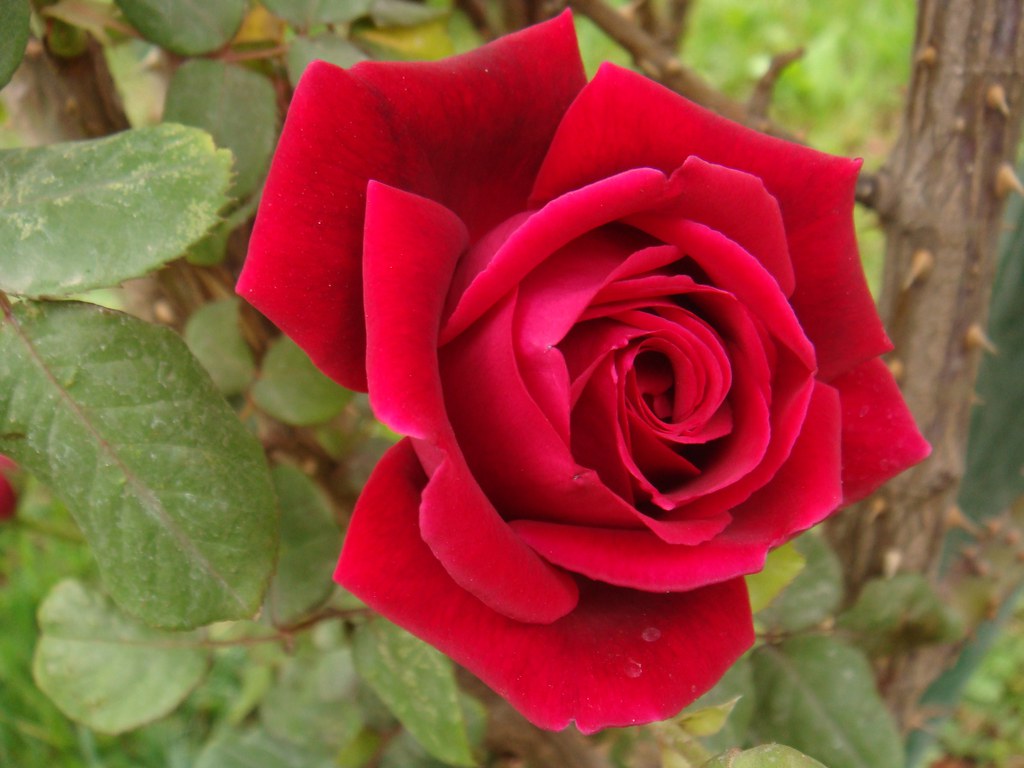
burr and thorn as much a part of us as any fragrant rose.
(Photo by Tico, courtesy Wikimedia Commons)
I started the habit of reciting a Morning Poem right after the election of 2016. I found I needed to fill my mind with something beautiful and deep at the start of the day , before exposing it to the news or even email.
I’ve had other poems–longer ones, more intense–but something about the brevity and purity of this one has stuck it with me now for a year. Only problem is, I’ve forgotten the poet! And as I tend to treat my books of poetry like library books, sending them on instead of keeping them, I can’t look it up.
I’ve tried Googling the first line; it yielded mostly suggestions for growing corn.
Not quite what I had in mind. (photo by doc(q)man, courtesy Wikimedia Commons)
What I love about this poem is the way it reminds me of those dark/light, yin/yang pairing: imperfection yet striving, pride yet humility. Both, and. Yes. Onward we go.
Thorns are part of the deal. (Photo by Parvin, courtesy Wikimedia Commons)
I’m not giving this poem up until another suggests taking its place. But I really want to credit the poet! So I’m hoping someone can step forward and help me here.
Still, while we’re on the topic: I’d also love to hear other suggestions for a poem with which to begin the day. Hit me!
(Image by Tyler Merbler, courtesy Wikimedia Commons)
…I was scheduled to testify at a hearing on a bill in the legislature of my state, The Other Washington.
THIS place: Olympia, WA. (Image by MathTeacherGuy, courtesy Creative Commons)
Of course, what with COVID, the hearing wasn’t in Olympia, but on Zoom, along with gazillion other meetings. (Just curious: what do we do when Zoom fills up? A good koan for medition.)
The NWDC. (photo by Eldan, courtesy Creative Commons)
When I Zoomed in at 1:30, House Public Safety Committee Chair Roger Goodman was announcing the lineup for the 2-hour session. It sounded ambitious. First up: amendments on two different bills: one restricting police car chases, one banning no-knock warrants. Then came public comment on two other bills: one refining the definition of hate crime, the other allowing survivors of sexual assault improved access to the progress of their cases and better overall care. Finally, at the end: “my” bill, 1090.
Oooookay, I thought. Maybe I’ll go make a cup of tea and check back in an hour.
But before I wandered away, something caught my attention. The same something that has probably caught all of America’s attention beginning this past Wednesday, Inauguration Day. That something was…civility.
A minority Republican on the committee–a beefy White guy in a Statue of Liberty necktie–was making an argument about an amendment on the car-chase bill. Talking about the Democratic sponsor of the bill, I heard him say, “…though I love and respect him as a person…” Then the Democratic Chair was allaying the Republican’s fears. And then they thanked each other.
Wait. Wait. No snark, no snarling? I barely recognize this tone…like a Golden Oldie playing softly in the background. Mesmerizing.
So I stayed right where I was. I watched that same burly Republican Representative have another of his amendments voted down–he wanted to allow the police broader scope to continue with no-knock warrants (like the one that killed Breonna Taylor in 2020). Still: no rancor, no posturing. Just–“just!”–courtesy.
I watched prosecutors and brave victims of hate crimes testify in favor of HB 1071, which refines the definition of a hate crime to reflect the reality of what people are facing. I watched legislators from both parties thank the participants with zero grandstanding or finger-pointing.
I watched the Republican and Democratic co-sponsors of the Sexual Assault Rights Bill (HB 1109–described as a model for the nation!) sing each other’s praises for the hard road they’ve traveled together since, apparently, 2015. I watched Rep. Burly Republican tear up as he articulated his concerns about sexual assault victims.
They’re all so respectful! So pleasant! I wanted to run into that Zoom room and hug the entire committee.
By the time they got to the private prisons bill, of course, they were out of time. Only a couple of the dozens of folks signed up to speak got to do so.
Did I mind? Not one bit. That two hours of civil civic discourse was as encouraging as a COVID shot. I felt unexpectedly innoculated against political cynicism.
“Well, sure,” my Mate said when I told him about it, “that’s Washington State for you.” I think he meant, y’know, we’re practically Canadians. But no: our governor’s mansion was also attacked on January 6. We’re every bit as vulnerable to the political virus as any other state.
So…feeling pessimistic about political polarization? Depressed at the divide? Take two of these and call me in the morning–“these” being a couple of the most rivetingly boring hours ever, listening to politicians act like grownups together.
The day after Joe Biden and Kamala Harris were declared President- and Vice President-elect, I sat down to express my thoughts in this blog…and quickly realized someone had already expressed them for me. “Raven and Chickadee” is the blog of my friends Laurel and Eric, who left their home in Ashland, OR several years ago for a life on the road as full-time RV-ers. Until COVID, which…well, I’ll let Chickadee (Laurel) tell it. The photos are by Raven (Eric).
Bridging The Divide
Wow. Is it really over? I hope so. I am deeply relieved to step off of this insane election roller coaster.
It probably comes as no surprise to anyone who knows us that we did not vote for the incumbent. But this election has made me think long and hard about the state of our country.
Strangers In A Strange Land
Our hometown—Ashland, Oregon—is about as liberal a town as you’ll find anywhere. That’s one of the things that drew both Eric and me to live there many years ago. For decades, we lived in a town of like-minded folks, where the biggest controversy was how to humanely manage the deer mowing down people’s gardens.
We now find ourselves in Eastpoint, Florida—a stronghold of conservatives, where we are liberal outliers in a community rife with Trump flags and signs.
When we took to the road for our fulltime travels seven-and-a-half years ago, one of my fears was that we wouldn’t find people with whom we had anything in common. That has not turned out to be true. Our network of friends has expanded to a rich and satisfying tribe that extends from coast to coast.
In our travels, we’ve also discovered that people, by a vast majority, are decent. Even if we aren’t destined to become close friends, we’ve been touched time and again by the kindness of strangers, no matter what their political or religious beliefs. That includes our neighbors here in Eastpoint, who have been unfailingly kind and generous as we’ve navigated these difficult months of dealing with my parents’ home, my father’s death, and the pandemic.
The piney woods in North Florida
The Long Road Ahead
This election was certainly not the Blue Wave that we anticipated. While we are thrilled to have Joe Biden and Kamala Harris as our new president and vice-president, it is painfully clear that we have a long road of healing ahead. And it’s up to us, the people, to heal our nation.
I hope we will be kind to one another, that we will approach each other in a spirit of generosity, that we will listen to each other’s concerns, that we will try to understand, and that we won’t fall into the seductive trap of labeling and dismissing anyone who votes or thinks differently. (I am excluding anyone who voted for Trump for racist reasons. That includes anyone flying a Confederate flag or wearing a MAGA hat. The time of white supremacy is long over, so get over it. )
We do not have an easy task ahead. Personally, I’ve had a field day with the absurdities of Trump over the past four years (along with feeling terrified and outraged). But along with the vast majority of our neighbors here in Eastpoint who voted for Trump, Eric and I both have family members and friends who voted for him. These are not racist, unkind, ungenerous people. They had their reasons for voting for Trump, just as we had our reasons for voting for Biden. Somehow, we need to find compromises.
The chasm is wide. But we have to bridge it, for the sake of one another, our country, and our world.