Still Quake(r)ly After All These Years

I know–Quakely isn’t a word, but it fits the Paul Simon reference better than the actual word, which is Quakerly. Which is what My Sister The School is.

My lil’ sis, Carolina Friends School, turned 60 this year!

Happy Birthday! (Photo by Taki Scoville)

I can’t possibly capture the entire, joyous 3-day anniversary celebration in one blog post, and I won’t try. What I do want to capture, briefly: how true that rag-tag ol’ Quaker school, started 60 years ago by 6 people (two of them my parents) in order to prove to the State of North Carolina that yes, people of all colors and backgrounds could learn and grow together with more happiness and grace than those who were separated by race…
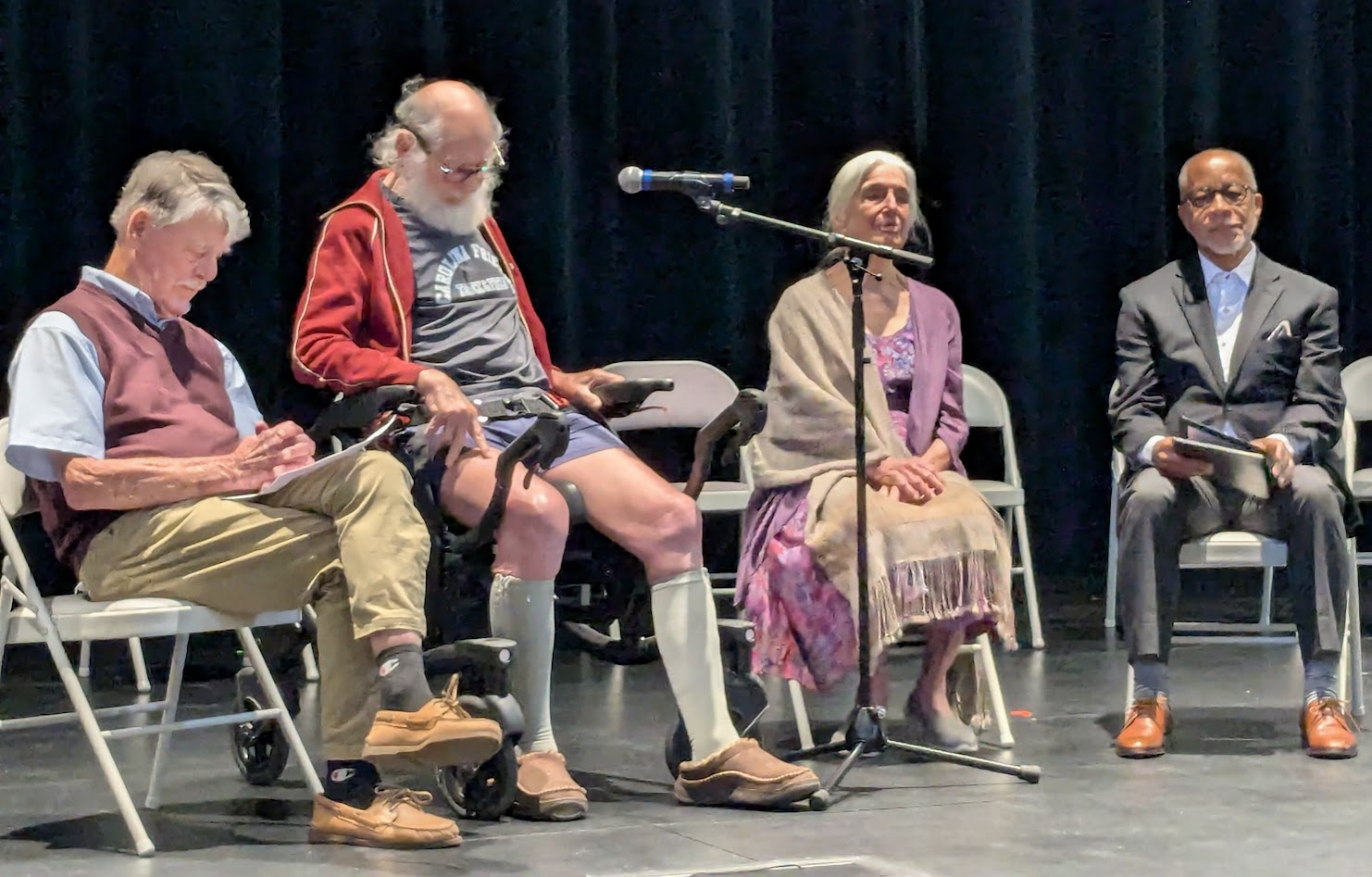
My folks–Peter & Martha Klopfer, in the middle–kicking off a Founders’ Panel with some quiet “settling in”
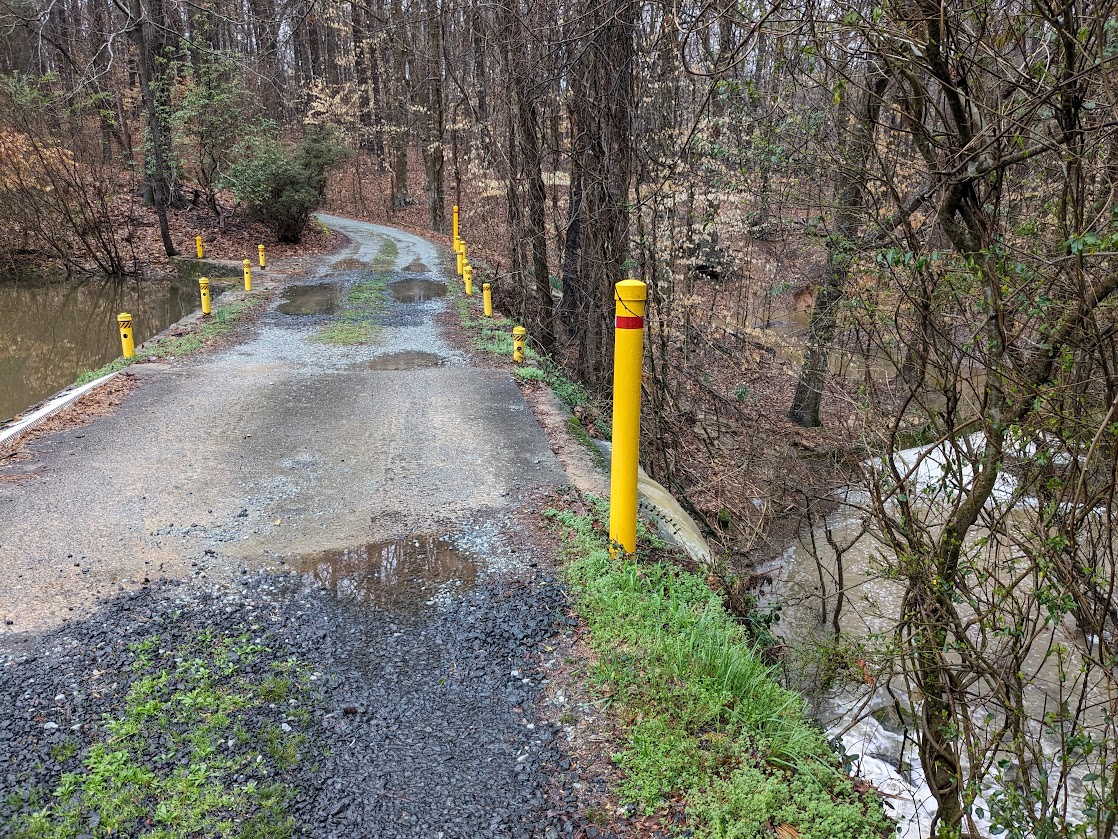
This creek separates Middle School from Upper. And I was overjoyed to see it still hold balls and frisbees, just as it did back in the early 1970s.

Like a number of my fellow “oldies,” I’d worried, in recent years, that CFS was getting too big for its britches. It has sports teams now–with uniforms and everything! And tennis courts. And a performing arts center. At our humble old school?

Like Raj, the Last Equine Standing at my folks’ Tierreich Farm…(which will one day go to the school)…

Age 37! And he can still canter!!

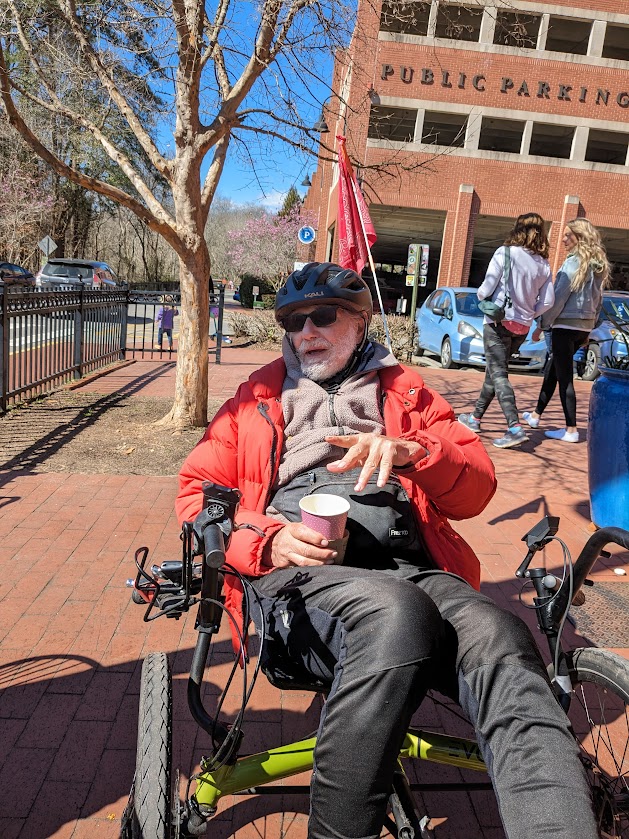
…and my dad, who uses the golf cart to get to his walking workout at the new CFS track, but makes his dog get her workout on the way there (just as me & my sisters used to get ours–OK, minus the leash!)…

Good girl. Good boy.

…and Mom, still getting hers by running, at age ALMOST-90!
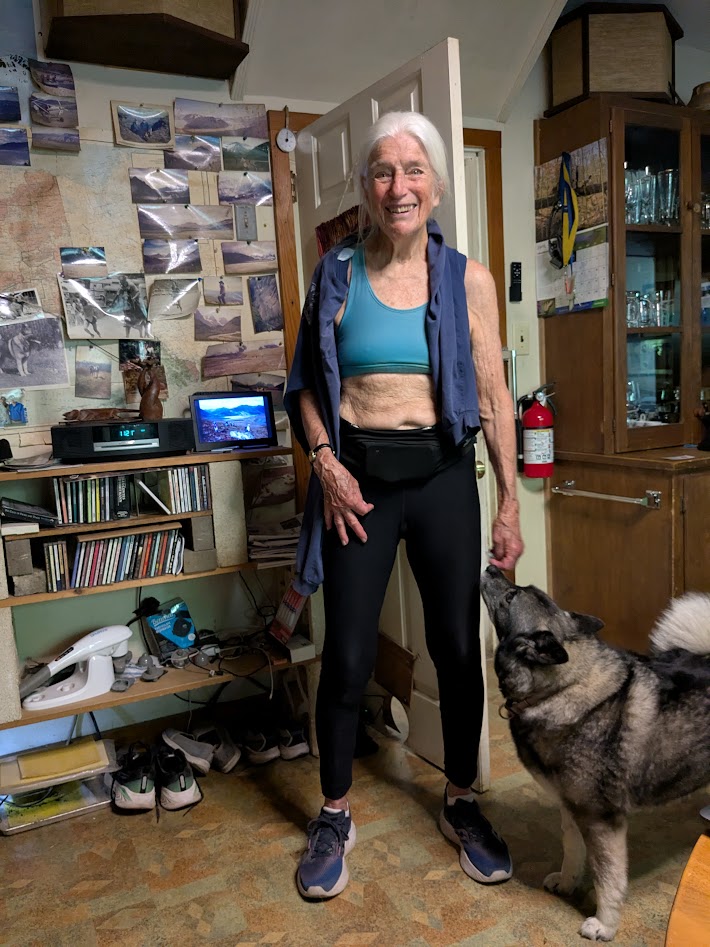
You’ve outrun me, Mom. I had to give up running for my knees 6 years ago!

Quakers don’t tend to live by tenets, but if they did, #1 would be Simplicity. What you see is what you get. But keep striving for truth, which is constantly revealed. Don’t rest on your laurels. Don’t assume you have it all sewn up because you’ve operated successfully for 60 year. Sit down, be quiet, listen…
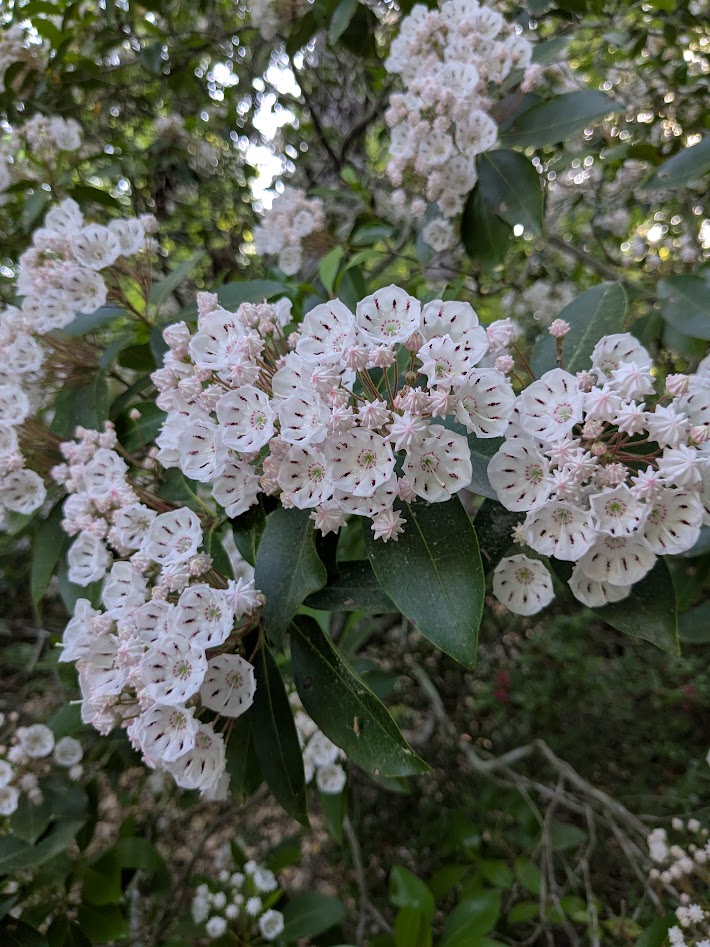
These are (mountain) laurels. Don’t rest on them. But do smell them & take their picture!

Purring vs. Mousing: On Comfort & Duty

My Quaker Meeting meets in the best space ever: a goat dairy.

…where, in the spring, after Meeting, you sometimes get to do this

A dairy is a farm, so of course Sunnyfield has barn cats. One of them, Basil, decided to join us this morning in our nice, warm yurt, for an hour of silence. (Or, for Basil: cuddles.)

Let me repeat: Basil is a barn cat. He’s supposed to be out in the barn catching mice, not sitting on nice, warm, indoor Quaker laps.

And Basil knows this. Oh, he knows! Just look how firmly he’s anchored to this lap–even with his tail!

Since when do cats have prehensile tails? (photo by Kirm Taylor)

What, I asked myself, are my own versions of purring? Me slipping into a hot tub. Me lying down on the couch with a fat novel in an empty house. Me fitting an entire chunk of sushi into my mouth. Me on a mountain, contemplating more mountains.

prrrrrrrr….. (photo by Allison Snow)

But 10 minutes in, one of our group, who happens to also co-own that goat dairy, came in and spotted Basil. Quick as a wink, she deported him back to mousing duty, outdoors.

Road Trip XII, Days 24-30: Some Things Old, Some Things New, One Thing Carolina Blue

No matter the weather when we get to Tierreich Farm, where I grew up in the Piedmont of North Carolina, we always go find the trout lilies.

Who, me?

Constant: my folks’ ridiculous driveway, which never bothered me before I drove a 22-foot-long van.

Vanna sez, “I’m driving over THAT?”

Don’t worry, Vanna. We’re parking you on this side and walking across. Because of…

…this drop. Yep.

Constant: my 93-year-old dad’s enthusiastic curiosity about ALL new gadgets, including Vanna herself. New: these days he needs a golf cart to go see things.

Dad & Mom, meet Vanna.

Actually, Dad’s a perfect combo of constancy and novelty. The fact that he had a stair-elevator installed in our basement stairs = a surprise. The fact that he really enjoys it = not at all a surprise.

I tried it. It is kind of fun.

Another example: he was one of the first I know to avail himself of the amazing technology in electric-assist tricycles (new). And he uses his just as he used to use his legs when he was marathon training: 20+ mile loop, with stop for a treat along the way.

I had to work hard to keep up with this guy!

My 88 year-old mom’s constancy exhibits itself in her physical fitness, her dedication to the woodsy life, and, I have to say, her beauty.

(though I am a little biased)

Speaking of Mom’s fitness: click here to read about last summer’s Master’s International track meet in Greensboro, NC.

These tiny bluets, also known as Quaker Ladies, always reminded me of Mom, for their simplicity and lack of ego. (Though “Women” would work better than “Ladies.”)

Hi Mom!

If you’d like to understand why this land is going to a Quaker school instead of to me and my sisters, click here for a little history.

But Stevie, World’s Cutest Ass, remains as constant (and cute) as ever–thank goodness!

Pushing 40! There’s a reason people say “donkeys’ years”. (Unless they mean donkeys’ ears?)
You’ll have to trust me on this one.

Off course, the most constant part of The Mate’s and my Road Trips is their raison d’etre: worshipping at the altar of watching Tarheel basketball with our fellow Tarheel fanatics. Again, for those of you new to Wing’s World, click here for a brief recap.

Some food is also involved. (NC-style BBQ; collards; slaw; hush puppies & fried okra.)

One new thing I noticed, in DURHAM, of all places–home of arch-enemy -rival Duke: this supermarket display, featuring Carolina’s AND Duke’s colors.

How open-minded! Maybe this diversity stuff is taking hold after all. Or maybe they just want to sell more soda.

Another new thing, on the disturbing end of the scale: the heat here. 70-degree weather in March is quite common in this part of the state (as is snow and ice storms…click here on that topic). But 80 degrees? When the woods haven’t leafed out yet? That just feels WEIRD.

Pictured here: Gretchen trying to make the most out of too much sun in trees.
Go Tarheels!

“Living and Dying Without a Map”: Companionship for People Suddenly Rocketed to Planet Cancer

I have never had cancer, and neither has any close member of my family, other than my grandfather who died when my father was still a child. So I don’t know. But I imagine a diagnosis of terminal cancer, for oneself or one’s dearest, to feel like being yanked away to a unknown world on the dark side of the moon–a planet which healthy people don’t think about enough to realize they’re not thinking about it.

So I wouldn’t normally be drawn to a book titled Living and Dying Without a Map: One Family’s Journey Through the World of Glioblastoma, despite the hauntingly lush black-and-white photo on its cover. I only chose this book because I knew the author, and I thought I knew the story.

Nancy Ewert, a long-time Lopez Islander, is also one of the founders of the Quaker Meeting here which I attend. And my very first day attending, the month we moved here–August of 2010–I walked into a Meeting focused on support for the Ewert family. Nancy and her husband Greg and their three nearly-adult daughters were still reeling that day from Greg’s shockingly sudden diagnosis of brain cancer at the age of 61.

Greg–a beloved teacher at our island’s middle school–was given a year to live. He lived for two. And I watched, humbled, from the sidelines as this family that represented the very core of our island community struggled to reshape its life on Planet Cancer.

Photo by Greg Ewert. The man was, among other things, a hell of a photographer.

There are many cancer books out there. I cannot speak to how they compare to this one. All I know is, Nancy’s book is one of the rawest, truest forms of memoir I’ve ever encountered, and here’s why: it is composed entirely of journal entries. And almost entirely from those two intense years.

God bless Caringbridge. Greg Ewert’s brain tumor introduced me to the website, whose founders envision “a world where no one goes through a health journey alone.”  I’ve become more familiar with it since 2010, through the health challenges of other friends. In this book, Nancy’s and Greg’s Caringbridge postings become the main narrative vehicle, carrying us along on their story now as much as they did almost ten years ago.

But these sections are interspersed, even more intimately, with entries from Nancy’s personal journal  at the time. I can’t imagine the guts that took.

Nancy’s first Caringbridge post in the book begins, “Greg has been diagnosed with a brain tumor. It is shocking, terrifying and sad for all of us.”

But her first personal journal entry reads, “Oh God, Greg has a brain tumor. How can I even write these words?”

Catch the difference in tone? Ripping that curtain aside, allowing readers into that personal, personal shock and pain–THAT is what makes this book different. Like being ushered from the waiting room straight into the ICU.

Nancy shares her exhaustion. Her anguish at being so needed by husband and daughters and family and friends that nothing is left for her own emotional needs. Her anger at having to explain why she’s even feeling angry. Gratitude, yes, plenty–but also pure seething confusion. These entries lay it all out there–sometimes very, very admirable, sometimes–whoa! Honest! And REAL.

And even though I’ve never lived on Planet Cancer, if and when I have to? These are the words I’d turn to–not for comfort, but for company in my fearful despair. Which, I suppose, may be a kind of comfort after all.

Greg’s Caringbridge entries form another part of the story’s arc–an insider view, obviously. His first one reads:

Only one week ago our family vacation was rudely interrupted by a trip to the urgent care facility because I was having difficulty forming my words–not like me!

Over the course of the next nearly two years, until Greg finally had to switch to dictation and then stopped writing during those last weeks, he shares his outrage at having his future ripped away; his wry-but-fierce personification of his tumor (“B.T.”) and his strong, humbled, grateful spirit (“the Griz”). He shares the deepening of his gratitude for his family and loved ones and community to a point impossible to describe without maybe imagining of the lyrics of “Amazing Grace.” He shares humor, and–

oh, I thought while reading, how unfair that I only got to meet this man after he’d been given a year to live!

But then…how much more of a gift is this book, bringing him to life for people who never got to meet him, or travel to Lopez Island, but are trapped on Planet Cancer and looking desperately for someone to please, please just hold their hand?

If you or a loved one have had to make that journey–Nancy Ewert’s book will hold your hand as you walk in the darkness.


‘Tis the Season of What, Exactly? On Spring, Food, Coronavirus and Quakers

My local Friends Meeting has an expression for when we want to think about something before making a group decision: “Let’s season this for a month and come back to it.” I think it’s a modern term (don’t remember running into it during my Quaker upbringing), and right now it’s feeling extra appropriate.

Season: to sit with something and allow it to show itself more fully.

But also: Flu season. Which has since become pandemic season. How long will pandemic season be? As I write this, it feels like our country is beginning to split even on THAT question: whether or not we should all hunker down for a few more weeks to protect each other.

And literal seasoning? While I’m hunkering, I’ll be on furlough from my bakery job. I already miss the thought of mixing ginger into fruit for pies, or adding garlic to sautéed greens for strata.

On the other hand, while hunkering, I’m also cooking up a storm, like millions of people right now lucky enough to have food—and seasoning the heck out of things.

Like adding sriracha to fresh-picked, steamed nettles to blend with hummus!

Finally, since hunkering can also be done outdoors (at a safe distance), we have signs of the season—wildflowers, songbirds, lambs, daylight. That sense of “season” brings me comfort, as if the Earth is saying, “We got ya. It’s okay. Everything comes around.”

Right now the satin flowers are blooming. They bloom only for a week, only in this one tiny spot on our whole island. Satin flowers ALWAYS hunker in place.

I think I could handle that.

Can we stand to think of ourselves as satin flowers for a little while? Do we need to season that thought?

“People Are Hard to Hate Up Close. Move In”…And Eat Lunch.

I experienced two things last month that had nothing and everything to do with each other. I listened to a podcast. And I ate a potluck lunch.

The podcast was one of my favorites, On Being with Krista Tippett. This particular episode caught my attention with its title: “Strong Back, Soft Front, Wild Heart”–an interview with Brené Brown, a research professor at University of Houston’s Graduate College of Social Work. 

Right away I knew Prof. Brown was speaking my language when she talked about the damage being done by our increasingly polarized culture in America.

And I talk about this high lonesome culture that we’re living in right now, where we are the most sorted that we’ve ever been…we’ve sorted ourselves into ideological bunkers. And so I would argue that…nine times out of ten, the only thing I have in common with the people behind those bunkers is that we all hate the same people. And having shared hatred of the same people or the same — I call it “common enemy intimacy” — is just an intimacy created by hating the same people, is absolutely not sustainable. It’s counterfeit connection.

And so this first practice of true belonging is, “People are hard to hate close up. Move in.” When you are really struggling with someone, and it’s someone you’re supposed to hate because of ideology or belief, move in. Get curious. Get closer. Ask questions. Try to connect. Remind yourself of that spiritual belief of inextricable connection: How am I connected to you in a way that is bigger and more primal than our politics?

That part I highlighted in red? That’s something I’ve been challenging myself with ever since the election of 2016 made me feel like I hated half of America. So far that challenge has taken the form of reading and listening to the words of bridge-builders and people whose life experiences are very different from mine. But because I now live in a very small community (worlds away from my previous life as a public school teacher in Tacoma), I hadn’t yet pushed myself to “move in” toward people of different political views who are my actual neighbors.

Last month, that changed. Along with about 69 other people, I sat down to an Interfaith Potluck for people of all faith-based groups on Lopez–Lutherans, Buddhists, Catholics, Quakers, Seventh Day Adventists, you name it–and ate lunch.

Nothing like breaking bread…or deviled eggs, or salad, or brownies…together!

Actually, the “moving in” part started for me back in January, when I pulled together, via email, a small group from various churches to help organize the event. Even though the idea originated with me and was approved through the Quaker Meeting I attend, it was important that it not be a “Quaker thing” (which most people would read, correctly, as politically left-leaning), but completely inter-faith from the get-go. And so, after sitting down several times to organize with people from some churches with very different approaches to both faith AND politics (which we did not get into), I was already feeling the benefits of that “hard-to-hate” thing by the time lunch was served in May. (Hate, are you kidding? I LOVE these people!)

I can’t show too many pictures without violating people’s privacy; just enough to give an idea. And to encourage others. Do you live somewhere that feels divided? Your town, your neighborhood, your block, maybe even your street or your building? Try this:

  1. think of a handful of folks who you KNOW are very different from each other and from yourself
  2. invite them to sit down with you somewhere neutral (like a cafe) to discuss the possible benefits of some kind of event
  3. as a group, create a rough vision of that event: lunch? tea? BBQ? Indoors? Outdoors? When?
  4. craft a statement of purpose to share with others; designate a larger group that each of you will “report back to” or “recruit”
  5. set a date for your next meeting to work out the next level of details: logistics, activities, responsibilities, etc.
  6. And you’re off!

    Look at all these folks leaning in!

At your event, you get to decide how programmed you want to be. We went with the very minimum–icebreaker questions in jars on every table–so as to keep the comfort level high. Some folks used the questions, others didn’t. But it felt good having them there.

We also had feedback forms on every table so people could let us know what was well done and what to work on next time. And should there be a next time? Our folks all said Yes!!!! …but could we find a meeting hall with better acoustics?

Oh, you mean so you can listen to each other better? Yes. Yes. I can lean in to that. 

When Horizontal Space Disease Spreads to Your Calendar (It Isn’t Pretty)

The other day I went for a walk with a friend who has been spending time meditating and going to Buddhist retreats, and I felt a bit of envy. Inner peace? Yes, please!

(Courtesy IndiaMart.com)

But I know myself too well to think I’m going to take up any of those habits now, in middle age, when I can barely get myself to Quaker Meeting. Instead, I’m finding ways to turn my own weakness–Horizontal Space Disease–into a strength.

HSD is my #1 disorder, according to my Mate. Its symptoms: I see an empty horizontal space, and–according to him–I instantly need to cover it with something. Books. Laundry. Flowers. Little caches of rubber bands, paper clips, and batteries for guitar tuners. (Hey, that stuff is USEful.)

Over the years we’ve found a good compromise: certain areas of the house are fair game for my stuff, others are kept shipshape. So this is NOT a Wing house picture.

(…although they do have nice stuff…(Courtesy Sugar Pond, Wikimedia Commons)

But something of mine I’ve noticed is looking a lot like this photo these days: my schedule. It’s a cluttered mess.

A typical day generally involves the following:

2:30 or 3:15 a.m. rise, depending on whether I’m riding or driving to work

8 1/2 hour workday at the bakery

mini-power nap (20 minutes) before heading off to writing group, or music practice, or a meeting for some community organization

ride home, OR drive home to power-walk or do indoor workout

dinner/catch up with The Mate

study Spanish/practice music/catch up on correspondence/see how those spinning plates are doing–anything crashed yet?–good, keep spinning, and…time for bed so you can do it again tomorrow!

Understand, I am NOT complaining. Just noticing. Noticing that life feels a tad hectic these days. So the other morning, I used my starry morning bike commute to list all the ways I can keep myself feeling in charge of my schedule, instead of the other way around.

  1. Start the day with a poem, preferably about nature. It puts everything in perspective before little things start assuming too much importance.
  2. Use my drive or ride to air-journal about what’s on my mind, or to sing, or to call up memories that bring me joy.
  3. Use my power-walk to do the same, or, if I’m riding the indoor bike, listen to a thoughtful podcast like On Being.
  4. Even when I have a lot to do in a short time, I try to move my body deliberately. It’s amazing how un-rushed that makes me feel.

Could I clear my calendar, quit some groups, attend fewer meetings, do less? Absolutely! But I don’t WANT to. I like my full life. Just got to find a way to live comfortably with my “disease.”

Any HSD/Calendar fellow-sufferers out there? What are your remedies? Please share!


Facing History and Ourselves, Quaker Style: Indian Boarding Schools Are Our Shame Too

Facing History and Ourselves is the title of a book and a mini-course in Holocaust Education. I took the course and used the book myself in my high school teaching.

But what about that uniquely American, slo-mo Holocaust, the attempted eradication of Native culture? In grad school I learned about the Indian boarding schools of the late 19th and early-mid 20th century: the kidnapping of entire generations from their homes, and the creation of generations of people who felt alienated from both communities, Native and white. And of course I shook my head over the terrible thinking of the past, and its terrible, long-term effects.

But I never realized that people of my own religious background, Quakers, were eager perpetrators of that shameful enterprise, until a friend sent me an article in Friends Journal, by Quaker writer Paula Palmer, entitled “Quaker Indian Boarding Schools: Facing History and Ourselves.”

What’s this? Quakers, you say? But we’re the good guys! Underground Railroad, helping slaves escape! Marching for Civil Rights! Becoming Conscientious Objectors in the Korean and Vietnam Wars! 

I may not be a very religious Quaker, but I’ve always been a very proud political Quaker, the product of Carolina Friends School, the first integrated school in North Carolina.

So, with a sense of unease, I read the article. I read this:

More than 100,000 Native children suffered the direct consequences of the federal government’s policy of forced assimilation by means of Indian boarding schools during the nineteenth and twentieth centuries. Their bereft parents, grandparents, siblings, and entire communities also suffered. As adults, when the former boarding school students had children, their children suffered, too. Now, through painful testimony and scientific research, we know how trauma can be passed from generation to generation. The multigenerational trauma of the boarding school experience is an open wound in Native communities today.

The National Native American Boarding School Healing Coalition says that for healing to occur, the full truth about the boarding schools and the policy of forced assimilation must come to light in our country, as it has in Canada. The first step in a truth, reconciliation, and healing process, they say, is truth telling. A significant piece of the truth about the boarding schools is held by the Christian churches that collaborated with the federal government’s policy of forced assimilation. Quakers were among the strongest promoters of this policy and managed over 30 schools for Indian children, most of them boarding schools, during the nineteenth and early twentieth centuries. The coalition is urging the churches to research our roles during the boarding school era, contribute this research to the truth and reconciliation process, and ask ourselves what this history means to us today.

And this:

In a letter dated May 26, 1853, teacher Susan Wood at the Quaker Tunesassa Indian Boarding School in New York, wrote:

“We are satisfied it is best to take the children when small, and then if kept several years, they would scarcely, I think, return to the indolent and untidy ways of their people.”

And this:

For a child’s view, we have The School Days of an Indian Girl, written in 1900 by Zitkala-Sa, a Lakota woman who entered White’s Institute, a Quaker Indian boarding school in Indiana, at age eight:

“I remember being dragged out, though I resisted by kicking and scratching wildly. In spite of myself, I was carried downstairs and tied fast in a chair. I cried aloud, shaking my head all the while until I felt the cold blades of the scissors against my neck, and heard them gnaw off one of my thick braids. Then I lost my spirit. . . . Our mothers had taught us that only unskilled warriors who were captured had their hair shingled by the enemy. Among our people, short hair was worn by mourners, and shingled hair by cowards! . . . I moaned for my mother, but no one came to comfort me . . . for now I was only one of many little animals driven by a herder.”

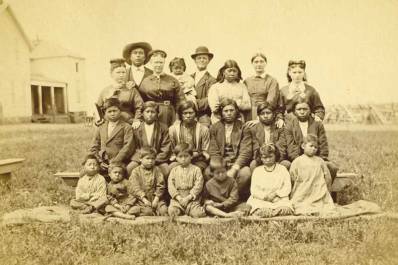
Modoc School, Indian Territory, 1877 (Courtesy Friends Journal and Haverford College Quaker Collection)

In these days of Trumpmerica, with its white supremacist marches (“some of them are good people!” said our prez), it’s easy to point fingers and say, “You are on the wrong side of history.” But, I am finding, it is even more important to look at the history of the people I most claim as “mine,” and say aloud: “We did wrong. We need to acknowledge and atone in order to help heal the damage we helped to do.”

So says Paula Palmer:

Native organizations are not asking us to judge our Quaker ancestors. They are asking, “Who are Friends today? Knowing what we know now, will Quakers join us in honest dialogue? Will they acknowledge the harm that was done? Will they seek ways to contribute toward healing processes that are desperately needed in Native communities?” These are my questions, too.

And mine.

Ottowa School, Indian Territory, 1872 (Courtesy Friends Journal and Haverford College Quaker Collection)

Was the revelation of Quaker complicity in Native boarding schools a surprise to you, as it was to me? Please consider passing this post–or better yet, Parker Palmer’s–on to someone else, or to any organization that might benefit from considering the attempt of the country’s most “politically correct” religious organization to face history, and itself.

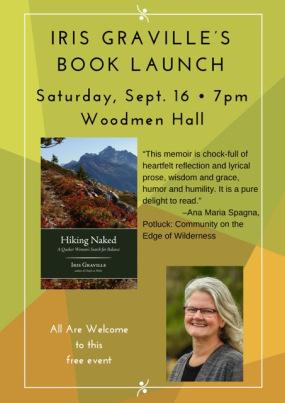
Watching Your Writing Role Model Strip Bare: Iris Graville Publishes Hiking Naked

If you’ve published your words in any form, you know the feeling when someone looks you in the eye and tells you they read what you published. It’s not like singing at a concert or displaying visual art. These are YOUR WORDS, your literal, expressed thoughts, straight from your brain into someone else’s. Who is about to tell you what they think.

Now imagine those words you’ve published are your MEMOIR. And imagine the people who are looking you in the eye are your neighbors, folks you bump into at the market, at the post office. 

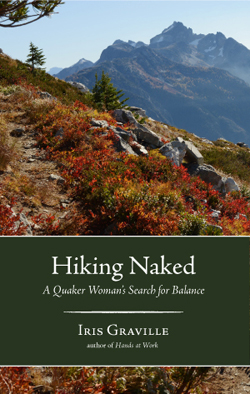
My friend Iris’s new memoir, Hiking Naked: A Quaker Woman’s Search for Balance, could not be better titled. As Iris tells it in her latest blog post, “Baring My Soul”:

I reel a bit each time someone says something like, “I’m reading your book, and it really speaks to me.” Or, “I was right there with you.” And, “My back hurt just reading about your work in the bakery!” What stuns me is the realization that, as I go about my life each day, some number of people are reading about it. There’s an intimacy in that knowing that I hadn’t anticipated. I’m discovering that the metaphor of “hiking naked” extends to how I feel about others now reading my words.

(Courtesy Homebound Publications)

My own forthcoming book, Altitude, Book Three of the Flying Burgowski series, could not be more different from Iris’s. My book’s a novel. It’s Young Adult (although I’m finding that Older Adults seem to like it just fine). It’s fantasy–not vampires nor zombies nor dystopian archer-warriors, certainly, but hey! my heroine can fly. So, yes. Fantasy enough.

The only thing my book has in common with Iris’s is that she helped “midwife” mine, via critique, while I did the same with hers (both of us with a LOT of help, and in her case, Masters-in-Fine-Arts-level help).

Well, maybe two more commonalities: they’re both set in the northwest, and they’re both about strong females.But that’s it.

So how can Iris be my writing role model? Because she is, to borrow her metaphor, hiking ahead of me on that rocky path called publication. She started years ago, creating her own press to co-publish Hands At Work: Portraits and Profiles of People Who Work With Their Hands, with photographer Summer Moon Scriver.

Then last year she published Bounty: Lopez Island Farmers, Food and Community–which is just what it sounds like, only more mouth-watering.

But all the while, Iris was working on that memoir. Crafting and drafting, re-crafting, re-drafting; pitching, pitching, pitching; writing and submitting short pieces to increase her visibility; keeping her chin up through inevitable rejections…until one day…

You go, girl.

I am still bummed to have missed Iris’s launch party because of some silly plane tickets to Ireland. But now that I’ve heard about it, I’m totally planning to follow in her footsteps at my own launch party in November.

(Not sure who took this photo…but Iris will tell me.)

Iris introduced by her own writing mentor, Ana Maria Spagna? How ’bout Gretchen Wing, introduced by Iris Graville? 

I better ask her, huh?

A Frayed Knot: Picking Our Way Through The Need

So this piece of string walks into a bar. (Stop me if you’ve heard this.) Bartender growls, “Hey, you. We don’t serve your kind in here. Beat it.” Hurt and angry, the string heads home to her apartment. There she ties herself into complicated loops, and frizzes her ends till she’s nearly unrecognizable. Then she goes back into the bar and orders a beer.

“Hmmm,” says the bartender suspiciously. “Aren’t you that same piece of string I just threw outa here?”

“Oh, no,” the string says innocently, “I’m a frayed knot.”

Ba-dum-bum.

Not the best bar joke ever…but close!

This joke popped into my head recently after reading these lines from Kim Stafford’s book of post-election poems, The Flavor of Unity,

“By writing, thinking, and talking, clarify your vocation, so you can enter the fray without being frayed.”

Copyright 2017 Kim Stafford. Thanks, Kim!

During the Civil Rights Movement, and more recent movements who use nonviolent resistance, participants had to learn to conquer their fear–of prison, of violence, even of death. The most famous freedom song, We Shall Overcome, contains the lyric, “We are not afraid.” Not being currently on the front lines of any struggle, but instead struggling to choose among the many, many causes calling for support since Trump’s inauguration, being AFRAID is not my issue–but being FRAYED? Yes. ‘Fraid so.

My email box and Facebook feed fills daily with calls to contact my congressional reps about the environment, or health care, or immigration, or…you know. If you’re an American, you’re probably getting the same emails. Sign this. Send money to that. Attend this meeting. Join that march. There is too much need out there to do it all.

Which is why I’m very much looking forward to the online course I’ve signed up for with Quaker writer and teacher Eileen Flanagan, entitled, “We Were Made For This Moment.” The intro to her course reads, 

In this time of tumult, fear, and hatred, the world needs the gifts that you were born to share. You may not be sure where to use them. You may not know how to use them to greatest effect, or even if you can make a difference at all, but you know you need to do something to work for a more just and loving world. You are not alone! The purpose of this online course is to help you to meet this moment.

Finding one’s purpose, to me, means finding my path. This means, of course, choosing some paths NOT to take. It’s never easy; we all want to contribute, be supportive, “be there” for each other, or vulnerable people, or the planet. But when we try to be everywhere, we fray…and–mixed metaphor alert–we burn out.

I want to walk a path and stick to it. I look forward to some guided discernment. I also look forward to hearing how you might have dealt with this same issue. How do you keep yourself in the fray without fraying?