“Sit In This”: Best MFA-dvice Ever

“Sit in this.” That’s what Lisa Locascio Nighthawk, Dean of Antioch LA’s Masters in Fine Arts in Creative Writing program, told us graduates the day before our ceremony.

Here on Lopez Island, some of my own writing group, the Women Writers of the Salish Sea, had the same advice: “Celebrate your achievement. Write it all down–everything you did!”

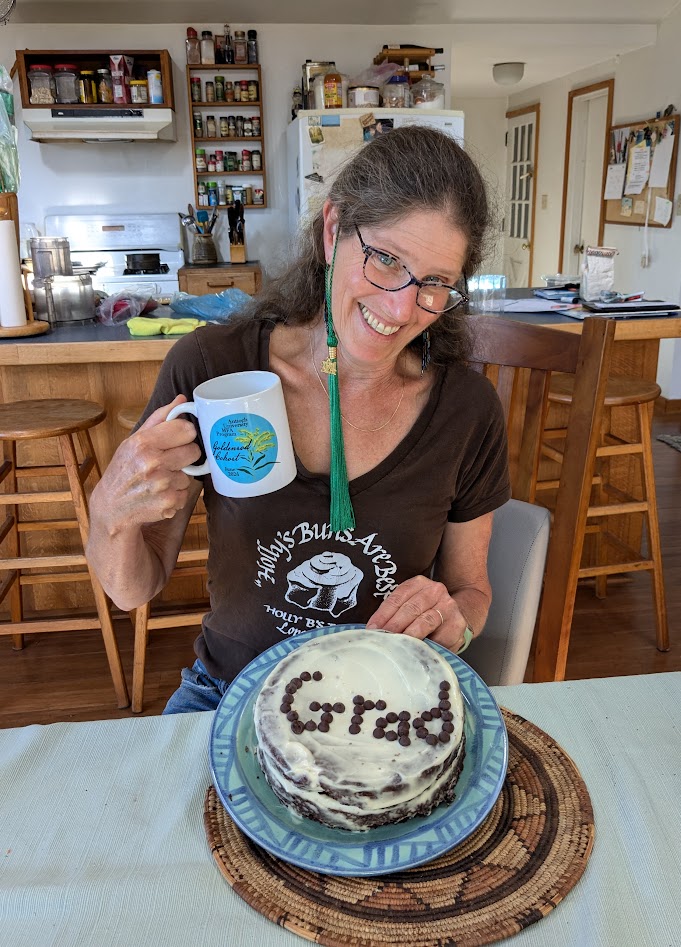
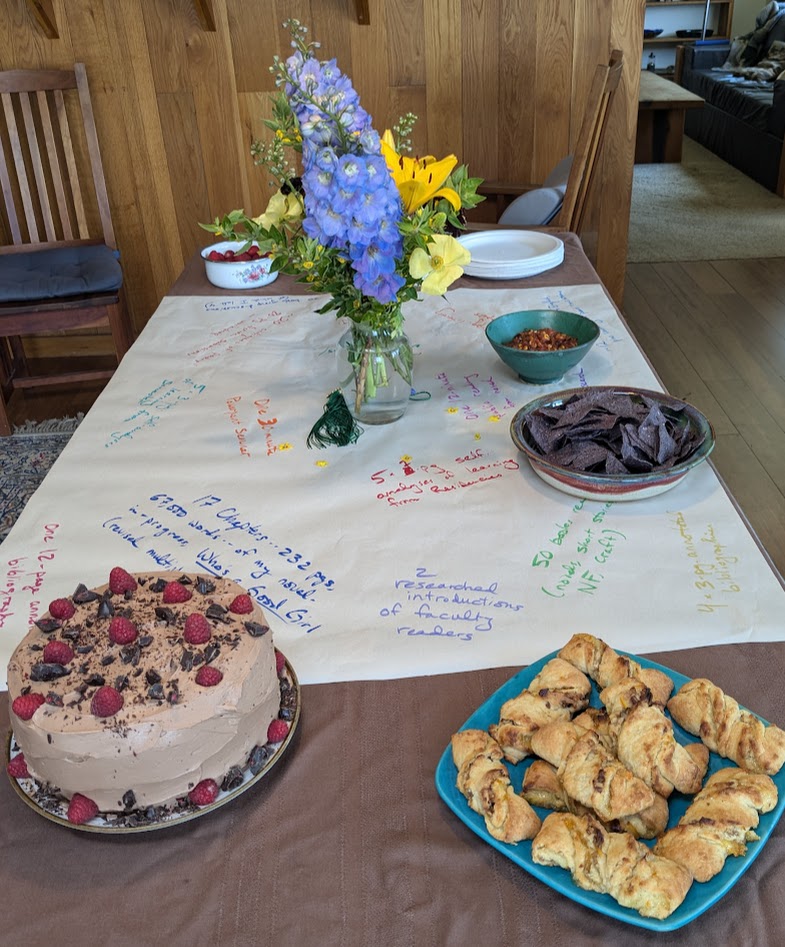
I decided to heed all of them. I sat in my achievement for a whole week. I wrote it all down, on a big piece of butcher paper. And I celebrated–with my writer friends, and with cake.

Note my grad tassel as centerpiece

The cake, I made. But the Orange Twists were a special request from me to Iris Graville–as noted in her memoir Hiking Naked: A Quaker Woman’s Search for Balance.

  • 17 chapters—232 pages, 67,000 words—of my novel-in-progress Who’s a Good Girl (revised multiple times)
  • 50 books read (mostly novels; some short stories, nonfiction, and craft books)

  • 30 x 3-page literary analyses of fiction

  • One 5-page research paper

  • One 20-page research paper

  • One dozen (approximately) poems translated into English, plus commentary on peers’ translations

  • 20 (approximately) critiques of peers’ 20-page fiction submissions in workshop

  • 20 book group discussions (of which I led 4)

  • 80 weekly email check-in discussions

  • Five 3-page self-analyses of learning

  • Five 7-page summaries of learning from residency classes

  • One 30-minute PowerPoint presentation/seminar
  • One 12-minute public reading
  • Four 3-page annotated bibliographies
  • One 12-page annotated bibliography
OK, enough of that! Let’s eat.

While we were noshing & drinking, my friends asked me to reflect on my main takeaways from the past two valuable, packed, and expensive years. Here’s what I came up with:

  1. My instinct to immerse myself among a community of diverse writers–diverse in EVERY SENSE of the word, from age to class to life experience to race to gender identity, and more–was 100% correct. As a writer, I need to be around people different from myself. (As a human being, it doesn’t hurt either.)

[not pictured: all the diversity at AULA. I don’t like violating people’s privacy in showing photos]

2. Confidence is good, in art. Pride is not. I had to have the latter stripped painfully away before I could soothe the raw spots by applying the former. That’ll be a lifelong engagement.

3. Novelists need the help of other novelists. Poets and nonfiction writers can offer EXTREMELY valuable critique. But in the end…see sentence one.

OK, we got it. You worked hard. Now, about that novel-in-progress…

After a week of “sitting,” though, I’m ready to get back to work. Of course, it’s high summer now–a season that always has other plans for me than writing. But the last thing I learned will get me where I need to go, and that is:

MFA in LA: Final Chapter

Two years and a couple of weeks ago, I deliberately stepped away from blogging. That’s when I began my low-residency Master’s in Fine Arts in Creative Writing at Antioch University in Los Angeles.

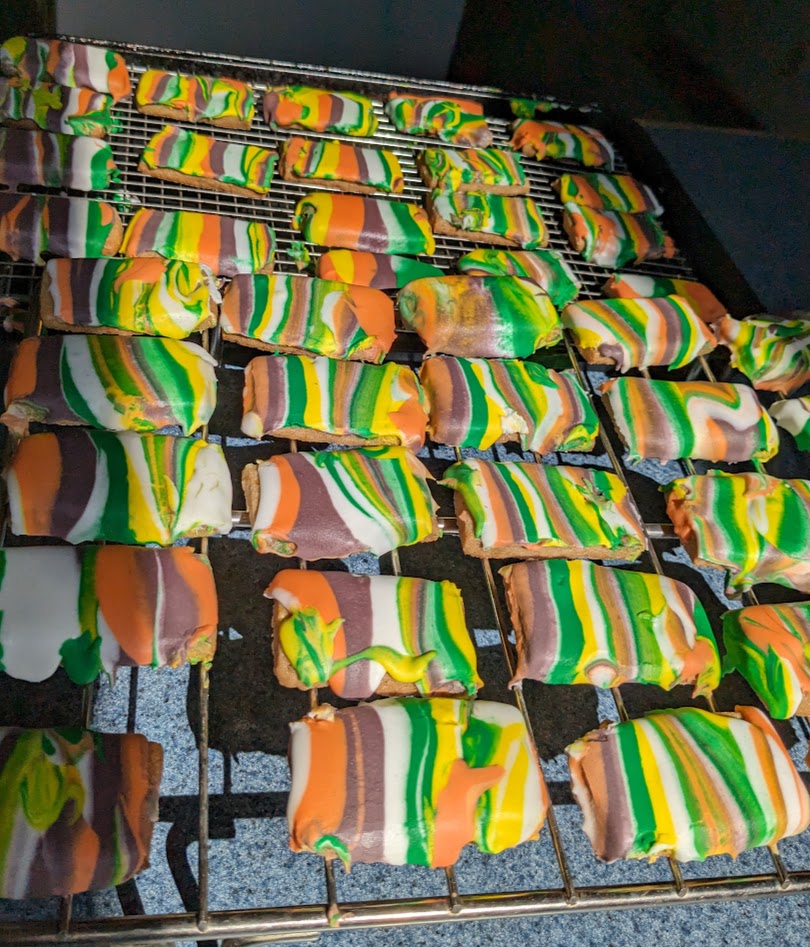
Two weeks ago, I headed back to LA one last time, loaded down with thank-you cookies:

NYT’s Technicolor orange-spice shortbread, anyone?

Back in 2022, in what became the last post for quite a while, I described the program as a switch from hiking to rock climbing. Now, having reached a comfortable ledge called “graduation,” I’d love to linger for a minute and talk about it before climbing on.

As the kids say: this happened

…So?

But that’s between me and me. What I’d really like to do here is celebrate LA a little–more accurately, Culver City–and the urban experience I benefitted from, which was 100% more lovely and positive than what I’d feared coming in (country girl and small-island woman that I am).

Example #1: this car.

Zoom in on that window decal to see why this was my LA poster vehicle

Two years ago I took its picture–“LA as car!” But this summer, I realized two things: A, I walked past this zippy jalopy every single day for all five residencies. Clearly it lived on that street, so it became a friendly neighbor rather than a symbol of glitz.

And B, this particular car wasn’t the silver of the one I’d photographed in ’22. This one now matched the beautiful jacaranda blossoms of its street.

Is that sweet or what?

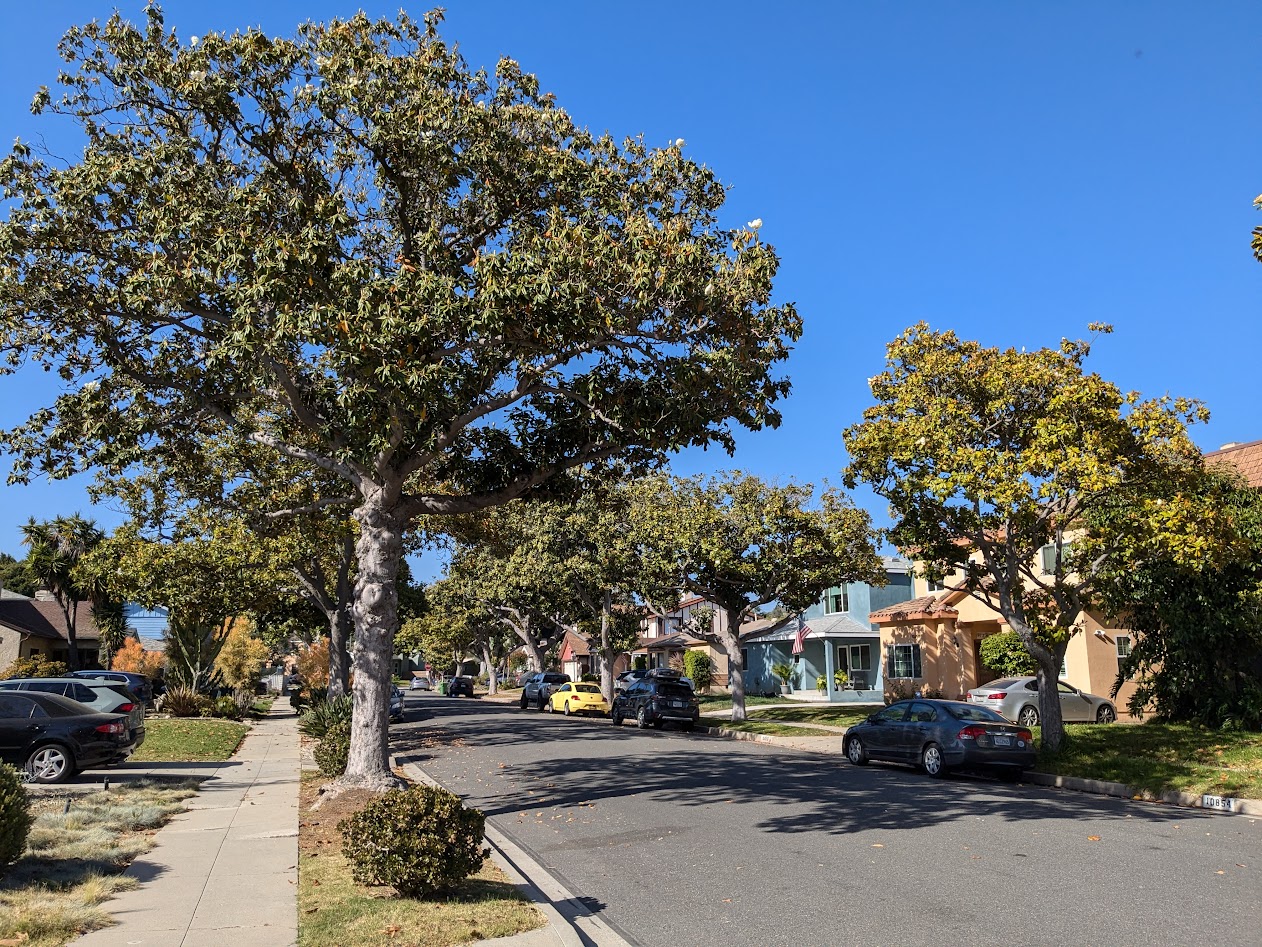
Speaking of matching trees: how about one more shout-out to Culver City’s amazing tree-themed streets?

This one’s magnolias

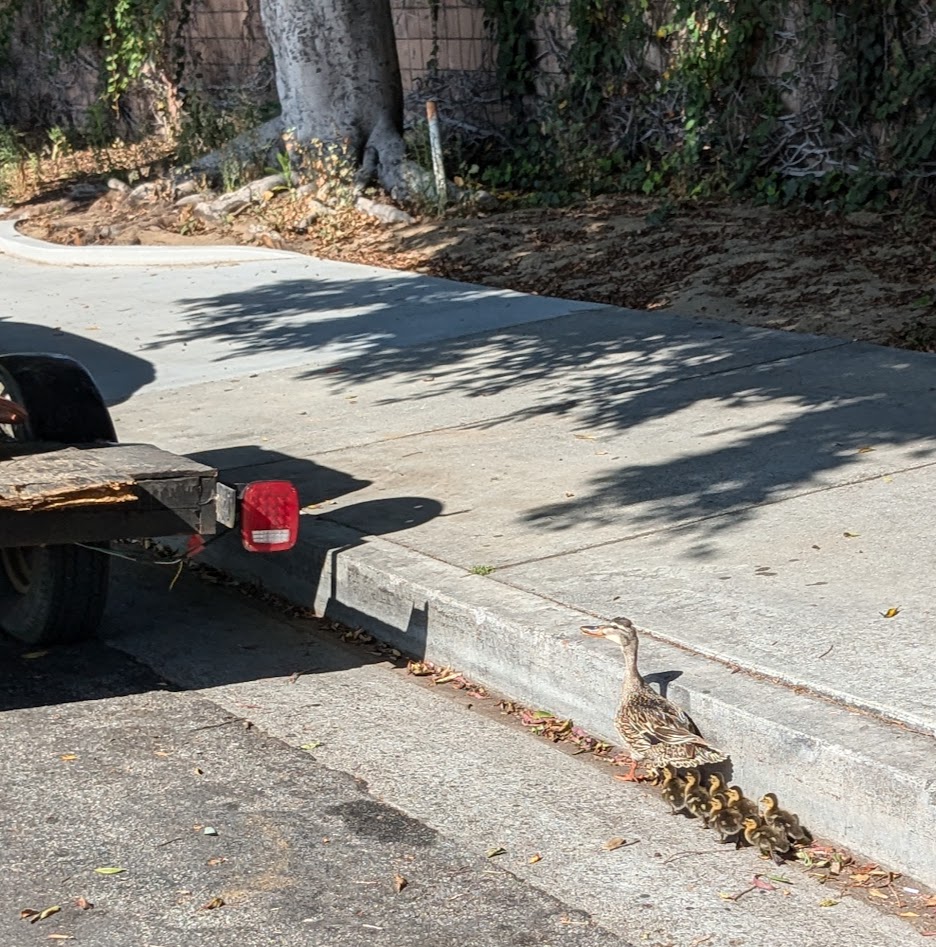
Culver’s a lot closer to nature than you might guess from its situation at the edge of a megalopolis.

Make way for ducklings!

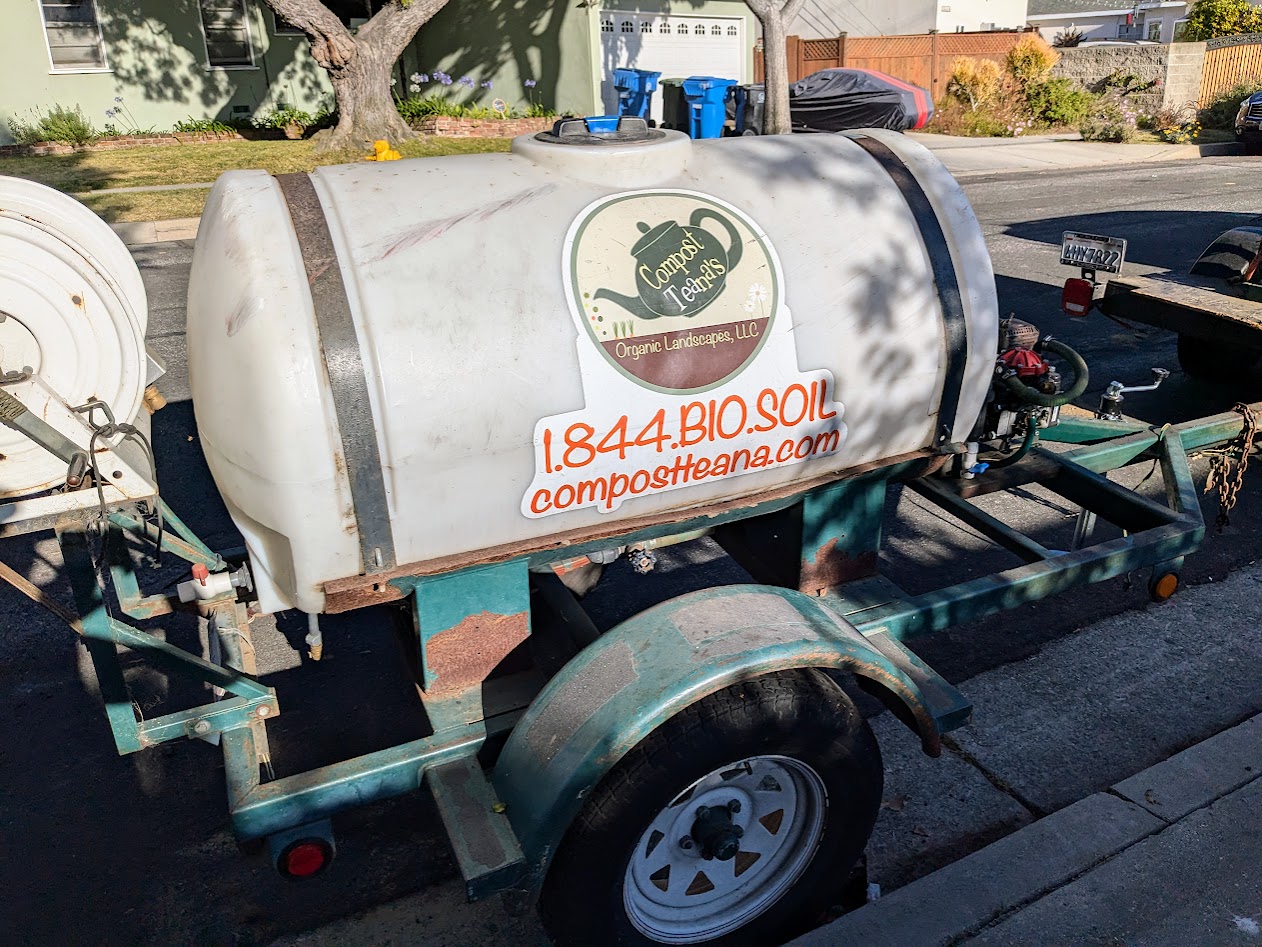
And the vehicle Mama Duck is leading her brood past also surprised me. “Ugh, it’s one of those lawn-spraying trucks,” I thought, but then:

Organic fertilizer!! Good job, Angelenos.

Then there were the Little Free Libraries. Often those are stocked with throwaway books, but I was so impressed with the quality in this one:

all very readable

Finally, the Antioch LA campus itself: two years ago, I noted its corporate ugliness (housed near such artistic fellows as Norton Security and TikTok).

No ivied halls here

I even took a photo of a madrona tree chained to its concrete planter:

SYMBOLISM!

But this time around, feeling mellow and grateful, I focused on the beautiful touches added to that soulless architecture, giving it…

…soul. Thanks, Corporate America.

Because it was my final “Rez,” I took advantage to visit my writing mentor in Pasadena for a hike. Finding a writing mentor was probably my #2 goal in my program, and…

Found her!

Goal #1 = finding a more diverse critique group: check! I’m not going to violate their privacy by picturing them here, but this photo captures how I feel about them:

But maybe you’re still wondering about those cookies?

and these: chocolate-chunk spice w/ cranberries (not pictured: lemon-rosemary-corn cookies)

I hauled three containers in my carry-on: for my mentor; for an incredibly helpful Writing Center tutor who walked me through all the ghastly formatting issues of final requirements, plus an entire PowerPoint presentation; and for our WONDERFUL FRIENDS who shared their home with me, FIVE TIMES over the course of two years. And their car, their bike, and their cats.

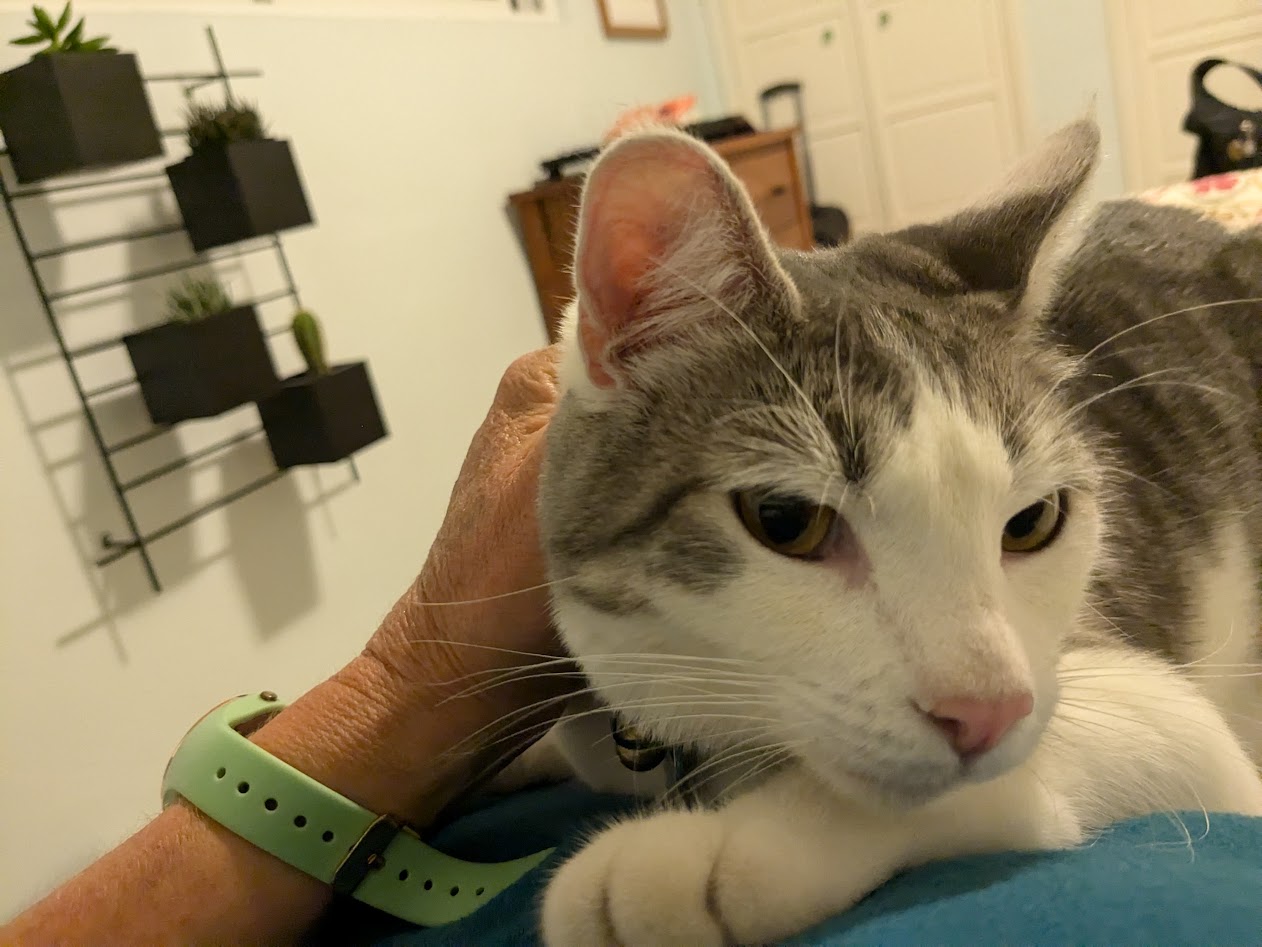
Love you too, Joey. Now get off me, I have to finish this edit!

THANKS, Y’ALL.

And while I’m saying my gratitudes: BIGGEST thanks to my Lopez Island writing group, which got me to this point, especially Iris Graville, whose own MFA foray lit the spark for mine.

Lopez Island: home of the Women Writers of the Salish Sea
The mug depicts my AULA graduating cohort–we’re the Goldenrods!

Gratitude for this wacky beautiful community I get to call home:

Just your average mailbox-guarding owl

Road Trip XI, Days 17-21: We Interrupt This Travel Blog…

…for a special promo for a special person, and a special book. My friend and writing buddy Iris Graville is about to launch her book of essays, Writer in a Life Vest, and when you’re done reading this, I think you’ll want to order a copy or two.

Coming soon to a (hopefully independent) bookstore near you, IF YOU ORDER IT!

Just in case you’re wondering, “But Gretchen, aren’t you still on the road? Has nothing happened during the past week?” the answer is, Yes, and No. We’re happily ensconced at Tierreich Farm (“Kingdom of the Animals”), a.k.a. the home of my Amazing Parents.

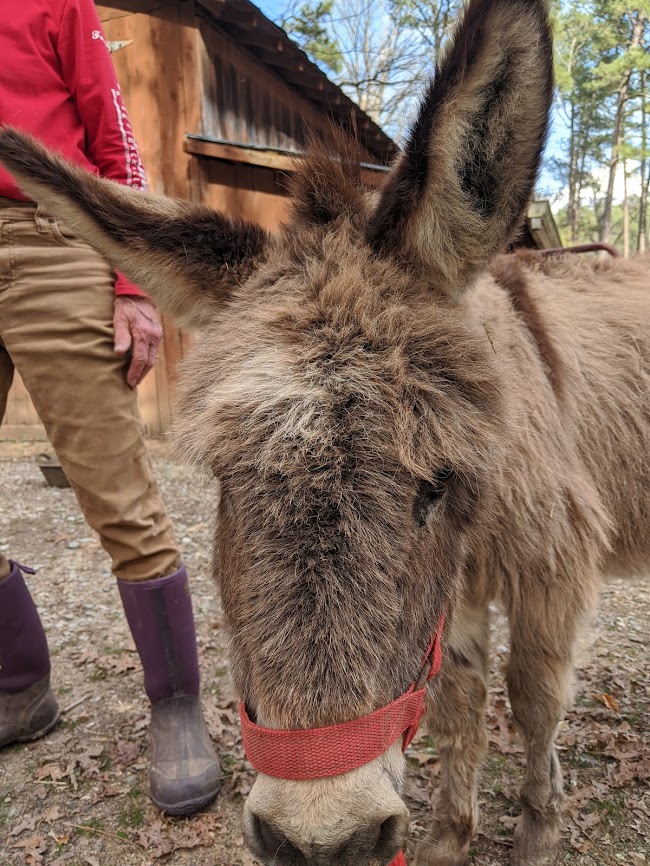
And Stevie, World’s Cutest Donkey

We’ve seen a ton of ACC basketball, eaten a ton of Mama Dip’s fried chicken and Allen & Son BBQ, walked and ridden our bikes through what’s left of the country woods of my youth (this place sure has grown in 30 years), and caught up with many of our Far & Dear.

We suspect the new owners of tweaking the recipe–easy on the vinegar, guys!

But since that’s always been the purpose of these road trips, I don’t feel the need to re-describe the above. Check out any of my old blog posts from the second week of March and you’ll find it there.

Instead, let me introduce you to Iris. As her Author Page on Homebound Publications puts it,

Iris Graville has lived in Washington State for four decades, after childhood and early adulthood in Chicago and small towns in Southern Illinois and Indiana. A long-time Quaker, an environmental and anti-racism activist, and a retired nurse, Iris believes everyone has a story to tell. She’s the author of two collections of profiles—Hands at Work and BOUNTY: Lopez Island Farmers, Food, and Community. Her memoir, Hiking Naked, was a 2019 recipient of a Nautilus Award. 

…but as I put it, Iris is also a remarkable example of a writer at her most humble, hard-working, and creative. To start with, she created the post of “Writer in Residence” for the Washington State Ferries–just came up with the idea, got in touch with the Ferry Powers That Be, and made it happen! Then she rode the ferry at least once a week for the year, writing–you can read about that fascinating “job” here while you wait to read about it in her book.

And humble? As a member of her writing critique group, I was privileged not only to read many of this book’s essays in their early form, but also to listen to Iris grappling with the challenge of learning as much about the Salish Sea and its inhabitants as she possibly could, in order to interact with the experts she was meeting and interviewing…in order to tell the story of the Salish Sea’s glories and vulnerabilities without setting herself up as an “expert” herself. She was a public health nurse, for goodness’ sake–but thanks to all her work, Iris can now write like Rachel Carson! (Fun fact: Ms. Carson actually makes an imaginative appearance in one of Iris’s essays.)

So that was also the “hard-working” part. But back to “creative” for a moment: in case you’re turned off by the word “essay” (apologies on the part of English teachers everywhere for possibly ruining that word for everyone), Iris’s pieces are all over the place! This book “contains multitudes,” as Whitman said: narratives, interviews, poetry, letters, even a playful messing-around with keyboard symbols (one of my faves). It features whales (and whale poop!), gorgeous marine descriptions, vessels, statistics, and challenging questions. Its pieces are dire, funny, heart-wrenching, hopeful, and above all, inspiring.

When you read Writer in a Life Vest, you will want to do more to protect whatever fragile environment you feel connected to. And who knows? You may feel inspired to invent your own Writer-in-Residence program at a place of your choosing–Farmers’ Market? Train Station? Dunkin’ Donuts? (j/k–that might kill you)

Hey Iris–you go, girl!

The book will be launched on March 24 at 5:30 pm, and will feature Iris in conversation with Lorna Reese, Lopez writer and founder of SHARK REEF Literary Magazine. They’ll discuss Writer in a Life Vest and Iris’s desire for the essays to promote resilience, inspiration, and hope. Register here to join the program in-person at the Lopez Library. There is a limit of 20 seats. Register here for online the program.

So, my friends…order two copies, one for yourself and one for a whale-loving friend. Then take a moment to marvel at the hard work behind such writing. Then maybe go do some yourself! (Or just get outside for a good, long, grateful walk.)

Delights and Downsides of Dabbling Dilettantism

You’ve heard of a square peg in a round hole? That’s not me. I’m more like the most boring bit of a Tinker Toy set, the little stick that connects to ANYTHING. Or–going literary–I’m Nick Bottom in A Midsummer Night’s Dream, trying to play all the roles: “Let me be the lion too!”

Which is why Wing’s World is sometimes a travel blog, sometimes a food blog; sometimes focused on poetry, other times social justice. Or music. Or sports. Or dogs (when Maya takes over). Or something completely random, like the way everybody starts sentences with “So” now.

You might have noticed.

(for example)

My guess is, I pay in readership for this inconstancy. I can tell by comparing Wing’s World’s comments to those in the blogs I follow. For example, this recent one by Rachel Mankowitz, about life challenges, poetry and dogs: 107 comments!

Or Raven & Chickadee, a dedicated travel blog by two folks on a years-long, slo-mo road trip, which regularly gathers dozens of comments.

Etc. I’m sure y’all know many more blogs on many of my favorite topic where the comment section is hopping.

But you know what? I am OK with my own lack of internet sizzle. Two of my favorite blogs, written by fellow Lopez Islanders, fill me up with ideas and inspiration every time I read them, and sometimes their comment section is as modest as my own. (But just in case you want to be filled with ideas & inspiration yourself and you don’t already follow these, check out:

Fact and Fable for ALL things book-and-story-related

Like this book nook! (image courtesy Reddit.com, via Fact and Fable)

and

the blog of Iris Graville for questions of spirituality and environmentalism.)

Photo of Tahlequah and Phoenix by Katie Jones, Center for Whale Research, via Iris Graville

To summarize:

Downsides: my ego needs to look elsewhere than my blog for any extra inflation.

Delights: I get to write about whatever the heck I please–like this!

So…any requests?

Limbo: Trying Not to Go Low

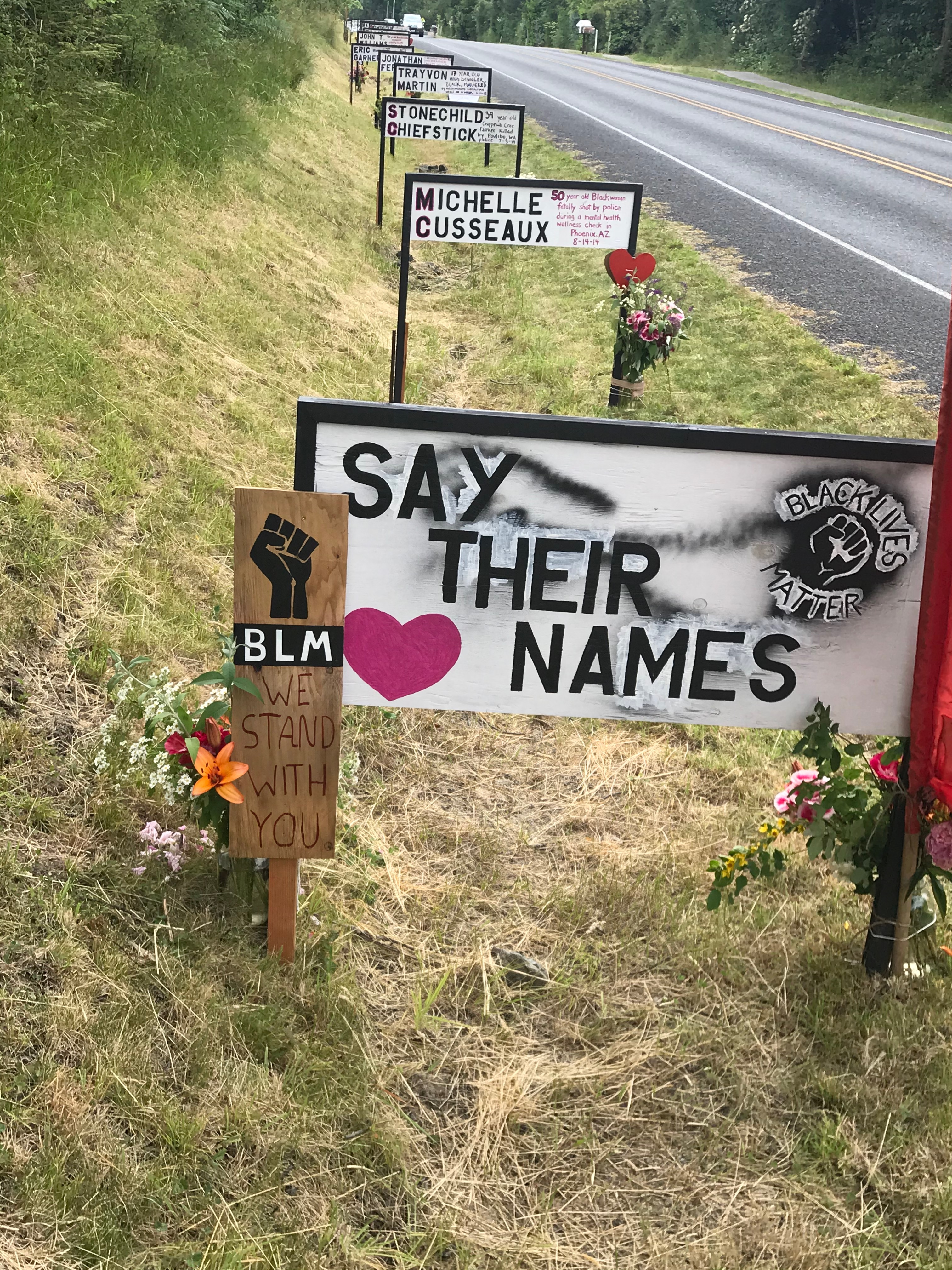
Have you noticed how long it’s been since I last blogged? Me neither. All I’ve noticed is that I haven’t felt like it. My last post, exactly one month ago, was a re-post of my friend’s, about the Say Their Names memorial in our little village.

photo courtesy Iris Graville

Now I’ve just returned home from a ceremony honoring those signs and moving them to their next home, as they were not constructed to withstand fall and winter weather. And I’m finally feeling moved to write again…about the limbo I’ve been in.

Limbo. Two definitions come to mind,* neither of them Biblical:

1) “an uncertain period of awaiting a decision or resolution; an intermediate state or condition”

2) “a West Indian dance in which the dancer bends backward to pass under a horizontal bar that is progressively lowered to a position just above the ground”

(*both definitions from Google)

Things that seem stuck in limbo:

–since the COVID shutdown, millions of people’s education, jobs, projects, plans–hell, our lives.

–the forward movement toward racial justice that many of us deeply want to believe in , as the forces against change gather for counter-attack, and as weariness or fear threaten to overwhelm action.

–somewhere in all of that–me. And, very possibly, you.

I don’t want to go into the details of my own personal limbo, which has to do with my two creative passions, writing and music. I want to write about avoiding the “how low can you go?” part of limbo.

Here’s what I am doing to “stay high” in this uncertain period:

  1. Working on the main source of mood-overwhelm: continuing self-education about the prospects for racial justice AND participating in Get-Out-the-Vote campaigns in several key states.
  2. Finding assurance and inspiration in certain voices. Right now, my main Muse is Michelle Obama, via her wonderful podcast.
  3. Sharing good food with near & dear people, and good Zooms with far & dear.

    Like picking blackberries with my sons and turning them into…

    …pie! (The berries, not the sons.)

  4. Reading good books–like Robin Wall Kimmerer’s Braiding Sweetgrass–and writing often in my journal.
  5. Worshipping regularly in the Church of the Great Outdoors.

    Amen! (Photo by Suzanne Strom)

How about y’all? How are you avoiding the lows of your own limbo? Please share inspiration here.

National Poetry Month And Morning Meditations: A Happy Confluence

I agree with my friend, author Iris Graville: “EVERY month is poetry month.” But I especially appreciate her post, “30 Ways to Celebrate National Poetry Month,” for its reminder of a convention I’ve been trying to lure myself back into: memorizing a poem. (That’s #4 on Iris’s list.)

When I was a kid, my dad would pay me and my sisters a dollar for each poem memorized. Go ahead, ask me to recite “I’m Nobody” or “Jabberwocky”! I still got ’em.

No one’s offering cash right now, but the rewards of having poetry in your head are undeniable. It’s SUCH a better response to the daily noise of ugly news than going, “la la la, can’t hear you!”  And, as I wrote in my last post, I’ve been starting my day with a poem since the election of 2016. If reading poetry works, how much more so memorizing? What a glorious way to start your day, with words of beauty coming out of your own mouth!

How my brain feels when NOT insulated and reinforced by poetry.

Incidentally, my other response to the “daily noise” and its lure toward tribalism has been to immerse myself in the words of bridge-builders. Relying heavily on Krista Tippett’s podcast, “On Being,” I spend at least an hour a week listening to people talk about how they’ve bridged terrible divides in their lives, or healed themselves or others, or found practices that lead toward the community they envision.

So I love the serendipity of finding this poem by Pádraig Ó Tuama in last week’s “On Being.” It offers me all three prizes at once: a beautiful, heart-opening meditation with which to start the day; a way to turn my sights toward hope and away from cynicism; and a path toward the kind of bridge-building thinking I want in my own head.

Pádraig Ó Tuama is a good guy to listen to, regardless of any hoped-for outcome. According to his “On Being” bio, he’s “a poet, theologian, and extraordinary healer in our world of fracture. He leads the Corrymeela community of Northern Ireland, a place that has offered refuge since the violent division that defined that country until the 1998 Good Friday Agreement.”

He’s also extremely Christian, which I am not. But I’ve long since found a way to put my own meanings on the names “Jesus” and “God,” so they don’t stop me. If you find that they do, in this poem, I encourage you to substitute other words that work better. I’m sure Pádraig wouldn’t mind.

Here, then, is his poem.

“Neither I nor the poets I love found the keys to the kingdom of prayer and we cannot force God to stumble over us where we sit. But I know that it’s a good idea to sit anyway. So every morning I sit, I kneel, waiting, making friends with the habit of listening, hoping that I’m being listened to. There, I greet God in my own disorder. I say hello to my chaos, my unmade decisions, my unmade bed, my desire and my trouble. I say hello to distraction and privilege, I greet the day and I greet my beloved and bewildering Jesus. I recognize and greet my burdens, my luck, my controlled and uncontrollable story. I greet my untold stories, my unfolding story, my unloved body, my own love, my own body. I greet the things I think will happen and I say hello to everything I do not know about the day. I greet my own small world and I hope that I can meet the bigger world that day. I greet my story and hope that I can forget my story during the day, and hope that I can hear some stories, and greet some surprising stories during the long day ahead. I greet God, and I greet the God who is more God than the God I greet.

Hello to you all, I say, as the sun rises above the chimneys of North Belfast.

Hello.”

I don’t have a photo of the sun rising above the chimneys of North Belfast. But here’s a photo of the view from my own rooftop, which is a bit more apropos, isn’t it?

Hello.

I’ll be working on memorizing these lines for probably the rest of the month, maybe beyond. But who cares? Isn’t every month Poetry Month?

Fighting the Empathy Dearth: How Do We Feel What Has Not Been Ours To Feel?

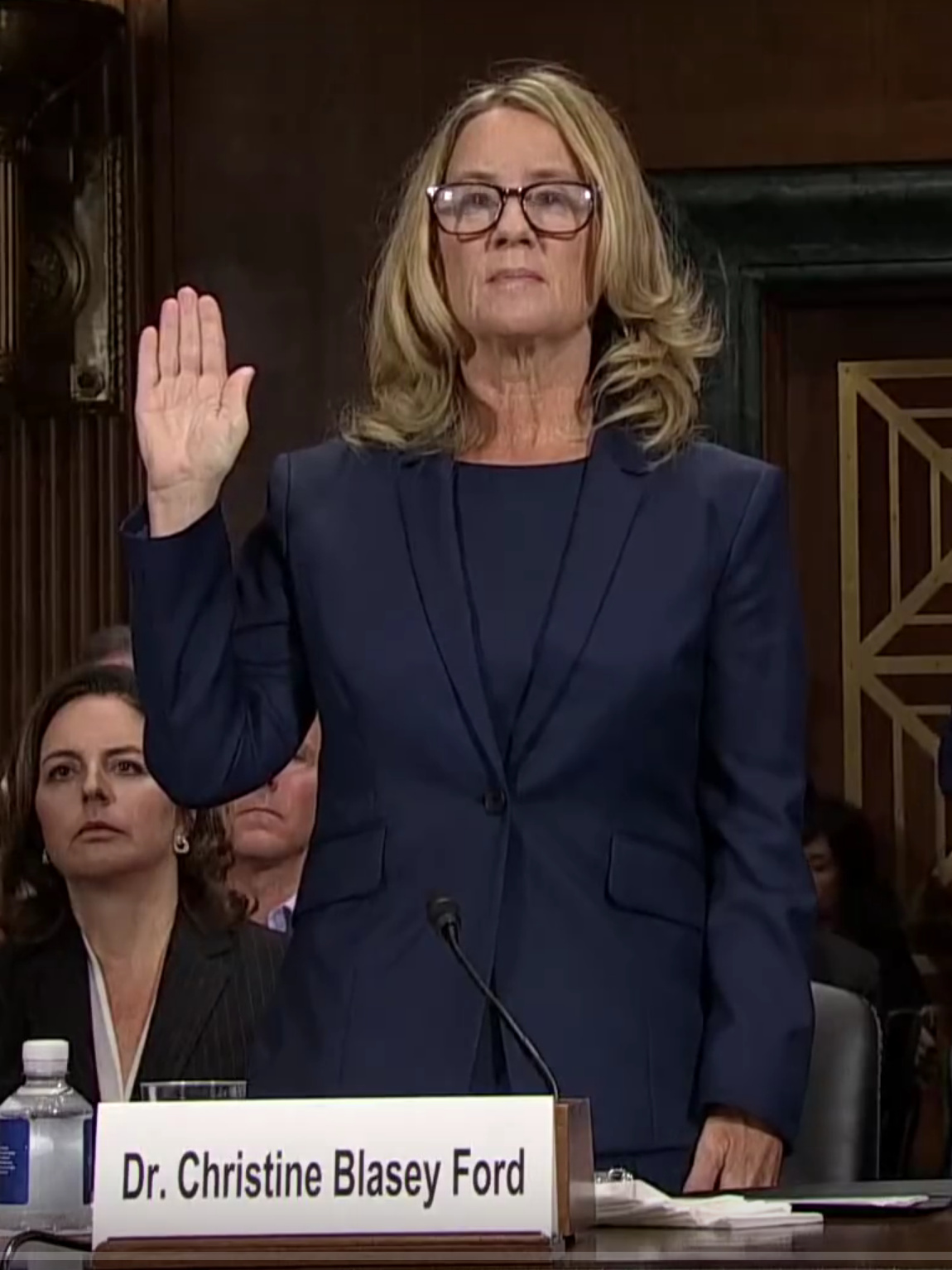
Even a blind Republican could see that Brett Kavanaugh was lying last week…about his drinking history, at the very least. The sight so many powerful men choosing to ignore this professedly devout Christian’s breaking of the 9th Commandment filled me, like so many others, with disgust.

Dr. Christine Blasey Ford swearing in (courtesy Wikimedia Commons)

But the root of their hypocrisy and misogyny is something more basic, and more troubling…a dearth of empathy. These men simply cannot see life through a woman’s eyes.

This may sound shocking, but guys–I understand. As a white person, I’ve been struggling for some time now to see our world, country, daily life for goodness’ sake! from the perspective of a person of color.

Empathy is HARD.

Empathy requires humility: “How much in the past have I unwittingly been part of the white supremacist structure?”

Empathy requires focus: “Imagine how Philando Castile’s family is feeling right now, as the President–ooh, shiny! Gotta revise my to-do list. Do I need to get milk?…wait, where was I? Oh yeah, Philando Castile…”

Empathy requires commitment: “I’m going to read this book/listen to this podcast/have this conversation even though it’s going to make me horribly uncomfortable about being white.”

And empathy requires change. What kind of change? Depends. Which means empathy also requires acceptance. Which brings us back to humility.

Not the dominant trait of white male Senators. It hasn’t had to be. What kind of humiliation have they ever experienced? I’m not talking about work performance or being rejected by a girl on the dance floor. When have they ever been humbled, brought low, much less threatened, because of their race and gender?

Individually, it appears possible to infuse empathy by trapping a lone white male Senator in an elevator. But there isn’t a big enough elevator for all the Republicans on the Judiciary Committee, and if there were more than one in there at a time, they’d just maintain eye contact with each other.

Out of ideas, out of elevators, I’m back to this: Empathy is hard, and I’m going to stick to my own work in that department. If you’re white and working on your own work, please read on.

I owe these excerpts to several women, who have passed them along: first, author Iris Graville. Second, author Heidi Barr, whose post Listen to Black Women Iris re-blogged. Third, and most importantly, author/teacher Layla F. Saad, whose post I Need to Talk to Spiritual White Women was listed as a resource on Heidi’s blog.

Layla F. Saad, photo by Anter Blackbird on Saad’s blog

This passage from Layla Saad struck me especially as I think about the empathy dearth. Notice how many times she uses the word “imagine.”

…I am a black muslim woman. I carry within me both the experience from my own lifetime of racism and discrimination, and the collective trauma of belonging to a people who were slaves for centuries.

Last year… I remember reading about the witch burnings. And how, as women and modern day witches and priestesses, we carry this trauma of being burned with us even today. And how that fear holds us back from speaking up and being seen in our full wild mystic power. I see many women in the spiritual community who understand just how much of a trauma this is for women, and who are doing the deep work of healing the witch wound and reclaiming their right to be here in their full authentic presence.

But can you imagine how it is for people of colour?

Can you imagine the trauma we carry from centuries of slavery, police brutality, discrimination and racial hatred?

The witch burnings happened at one period of time and yet we still remember. Imagine how it is for black people and people of colour. The hateful treatment against us never ended. It just went underground. And now it is resurfacing, emboldened by leaders like Donald Trump and others like him.

This weekend the KKK marched without their hoods. Do you understand what that means?

Can you imagine if a powerful group rose up in the western country you live in who wanted to burn women as witches, and they were seen as being legitimised by the country’s president? That sounds ridiculous right? And yet an angry mob of KKK white supremacists just marched with burning torches screaming racist and anti-semitic slogans in Charlottesville USA this weekend. And Donald Trump and others have said too little, too late.

Can I imagine how it is for Black folks in this country? Not fully…but it is my responsibility to try. Can men imagine how it is for women in this country? Not fully…but it is their responsibility to try.

Anecdotes, personal stories…those seem to work better. Here’s one from Saad:

The house I grew up in, in Wales, was right next to a children’s park.

My brother and I would go there everyday by ourselves, especially when the weather was good, to play on the swings and slides. We loved that park.

But one day, when I was about 6 or 7 years old, a new boy started coming to play at the park.

And the first time I saw him, he sneered at me and told me that my skin was the colour of poop.

My face still feels red just thinking about it. I felt so ashamed. I couldn’t say a thing. All I felt was the shame of being in the skin that I was in. Of not being white like everyone else. I ran straight home with tears in my eyes.

After that day I refused to go to the park anymore without my mum. I never told her what happened. I felt too ashamed to even say it to her. I believed that everyone must be laughing at me and people who looked like me, because our skin looked like the colour of poop. I took that shame and buried it deep inside myself. I internalised this idea that I was other. That I was in some way, wrong. And that I was less than. And most damaging of all, that I did not deserve to be seen, because you know, my skin was the colour of poop. I recognise how ridiculous that sounds now, but as a 7 year old I took it as total truth.

As I make my way forward into this week, I will continue the work of empathy, creating my own “elevator moments” through reading and listening…and pondering the question, “How can we help someone feel what has not been theirs to feel?”
Confessions of the Clueless, Part IV: NaNoWriMo Got You Down? Try WriBoYoWaWri!

You’ve heard of NaNoWriMo? (That’s National Novel Writing Month–an annual, Internet-based creative writing project that takes place during the month of November.)

Well, today this clueless author is celebrating something more personal: WriBoYoWaWri. That is… writing the book you (or I, in this case) wanted to write.

When I first published The Flying Burgowski, I told my writing group, “I wanted to write this book, and I did. I wanted people to read it, and they are.”

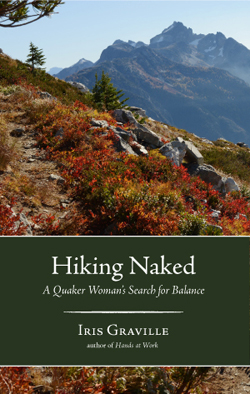
So later, when I ran into the brick wall fun challenges of marketing and book-selling, my writing buddy Iris Graville (whose memoir, Hiking Naked: a Quaker Woman’s Search for Balance was just published by Homebound Publications) reminded me of what I had said.

“You wanted to write this book, and you did. You wanted people to read it, and they are.”

Later still, when Book Two, Headwinds, came out and people would ask me that highly annoying perfectly innocent question, “So how’s your book selling?” I could always find my “happy place” by reminding myself about WriBoYoWaWri.
(Original photo: Abigail Porter)

You know: Write the Book You Want to Write.

These days, much to my surprise and DEEP gratification, both my sons are turning into novelists. And both are sharing their work, and their thoughts about their work, with me, their author-mama.

The other night, Son Two was stating his intention to end his book in a certain place. “That’ll make it very short,” I warned. “A novella. When I wrote mine, back in the nineties, all the agents I contacted told me they could never sell it.”

Son Two shrugged. “It’s what I…”

And I kicked myself and finished his sentence for him: “…wanted to write. Of COURSE. Do it. Don’t listen to me.” And I meant it.

Son One’s work will likely have the opposite challenge: length. Will I warn him about the difficulties of selling a long novel when your last name isn’t King or Stephenson?

No. No, I will not. I will joyfully chant, Write the Book You Want to Write. And I will MEAN it.

Writers, readers–your thoughts? Will you join me in WriBoYoWaWri? Don’t worry about November. WriBoYoWaWri lasts all year long.

Watching Your Writing Role Model Strip Bare: Iris Graville Publishes Hiking Naked

If you’ve published your words in any form, you know the feeling when someone looks you in the eye and tells you they read what you published. It’s not like singing at a concert or displaying visual art. These are YOUR WORDS, your literal, expressed thoughts, straight from your brain into someone else’s. Who is about to tell you what they think.

Now imagine those words you’ve published are your MEMOIR. And imagine the people who are looking you in the eye are your neighbors, folks you bump into at the market, at the post office. 

My friend Iris’s new memoir, Hiking Naked: A Quaker Woman’s Search for Balance, could not be better titled. As Iris tells it in her latest blog post, “Baring My Soul”:

I reel a bit each time someone says something like, “I’m reading your book, and it really speaks to me.” Or, “I was right there with you.” And, “My back hurt just reading about your work in the bakery!” What stuns me is the realization that, as I go about my life each day, some number of people are reading about it. There’s an intimacy in that knowing that I hadn’t anticipated. I’m discovering that the metaphor of “hiking naked” extends to how I feel about others now reading my words.

(Courtesy Homebound Publications)

My own forthcoming book, Altitude, Book Three of the Flying Burgowski series, could not be more different from Iris’s. My book’s a novel. It’s Young Adult (although I’m finding that Older Adults seem to like it just fine). It’s fantasy–not vampires nor zombies nor dystopian archer-warriors, certainly, but hey! my heroine can fly. So, yes. Fantasy enough.

The only thing my book has in common with Iris’s is that she helped “midwife” mine, via critique, while I did the same with hers (both of us with a LOT of help, and in her case, Masters-in-Fine-Arts-level help).

Well, maybe two more commonalities: they’re both set in the northwest, and they’re both about strong females.But that’s it.

So how can Iris be my writing role model? Because she is, to borrow her metaphor, hiking ahead of me on that rocky path called publication. She started years ago, creating her own press to co-publish Hands At Work: Portraits and Profiles of People Who Work With Their Hands, with photographer Summer Moon Scriver.

Then last year she published Bounty: Lopez Island Farmers, Food and Community–which is just what it sounds like, only more mouth-watering.

But all the while, Iris was working on that memoir. Crafting and drafting, re-crafting, re-drafting; pitching, pitching, pitching; writing and submitting short pieces to increase her visibility; keeping her chin up through inevitable rejections…until one day…

You go, girl.

I am still bummed to have missed Iris’s launch party because of some silly plane tickets to Ireland. But now that I’ve heard about it, I’m totally planning to follow in her footsteps at my own launch party in November.

(Not sure who took this photo…but Iris will tell me.)

Iris introduced by her own writing mentor, Ana Maria Spagna? How ’bout Gretchen Wing, introduced by Iris Graville? 

I better ask her, huh?

A Frayed Knot: Picking Our Way Through The Need

So this piece of string walks into a bar. (Stop me if you’ve heard this.) Bartender growls, “Hey, you. We don’t serve your kind in here. Beat it.” Hurt and angry, the string heads home to her apartment. There she ties herself into complicated loops, and frizzes her ends till she’s nearly unrecognizable. Then she goes back into the bar and orders a beer.

“Hmmm,” says the bartender suspiciously. “Aren’t you that same piece of string I just threw outa here?”

“Oh, no,” the string says innocently, “I’m a frayed knot.”

Ba-dum-bum.

Not the best bar joke ever…but close!

This joke popped into my head recently after reading these lines from Kim Stafford’s book of post-election poems, The Flavor of Unity,

“By writing, thinking, and talking, clarify your vocation, so you can enter the fray without being frayed.”

Copyright 2017 Kim Stafford. Thanks, Kim!

During the Civil Rights Movement, and more recent movements who use nonviolent resistance, participants had to learn to conquer their fear–of prison, of violence, even of death. The most famous freedom song, We Shall Overcome, contains the lyric, “We are not afraid.” Not being currently on the front lines of any struggle, but instead struggling to choose among the many, many causes calling for support since Trump’s inauguration, being AFRAID is not my issue–but being FRAYED? Yes. ‘Fraid so.

My email box and Facebook feed fills daily with calls to contact my congressional reps about the environment, or health care, or immigration, or…you know. If you’re an American, you’re probably getting the same emails. Sign this. Send money to that. Attend this meeting. Join that march. There is too much need out there to do it all.

Which is why I’m very much looking forward to the online course I’ve signed up for with Quaker writer and teacher Eileen Flanagan, entitled, “We Were Made For This Moment.” The intro to her course reads, 

In this time of tumult, fear, and hatred, the world needs the gifts that you were born to share. You may not be sure where to use them. You may not know how to use them to greatest effect, or even if you can make a difference at all, but you know you need to do something to work for a more just and loving world. You are not alone! The purpose of this online course is to help you to meet this moment.

Finding one’s purpose, to me, means finding my path. This means, of course, choosing some paths NOT to take. It’s never easy; we all want to contribute, be supportive, “be there” for each other, or vulnerable people, or the planet. But when we try to be everywhere, we fray…and–mixed metaphor alert–we burn out.

I want to walk a path and stick to it. I look forward to some guided discernment. I also look forward to hearing how you might have dealt with this same issue. How do you keep yourself in the fray without fraying?