It’s That Time Again: Wing’s World Hits The Road

If you’ve been following Wing’s World for at least a year, you know by now that Wing & Mate take to the road in February with the regularity of migrating swans–minus, of course, the awesome grace.* Also we’re heading east, not north, and also, swans have that life-or-death impulse behind their travels, while ours is more…let’s say … discretionary.

(*please, no Wingspan jokes)

OK, bad metaphor. But anyway, for you newbies, fair warning: Wing’s World is about to morph into a travel blog for the next several weeks.

The original draw for this trip is described in this earlier post; click here to read.

For now, I’m going to enjoy throwing out a few teasers from past trips, answering the question, “Why take seven weeks to drive across the country in the off-season?”

  1. Beautiful places at their least crowded. Like…
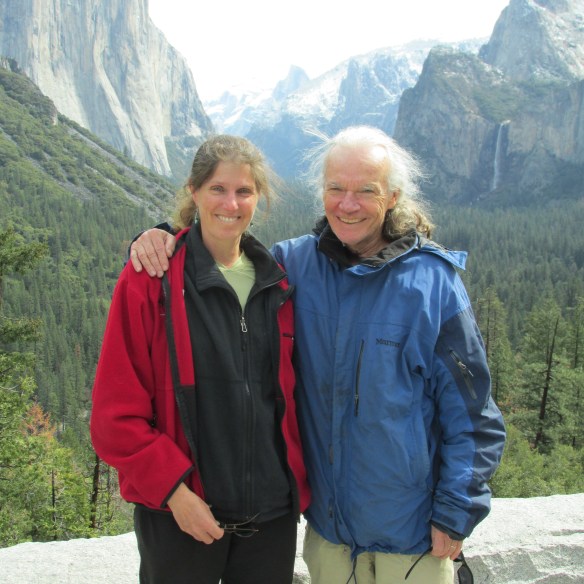
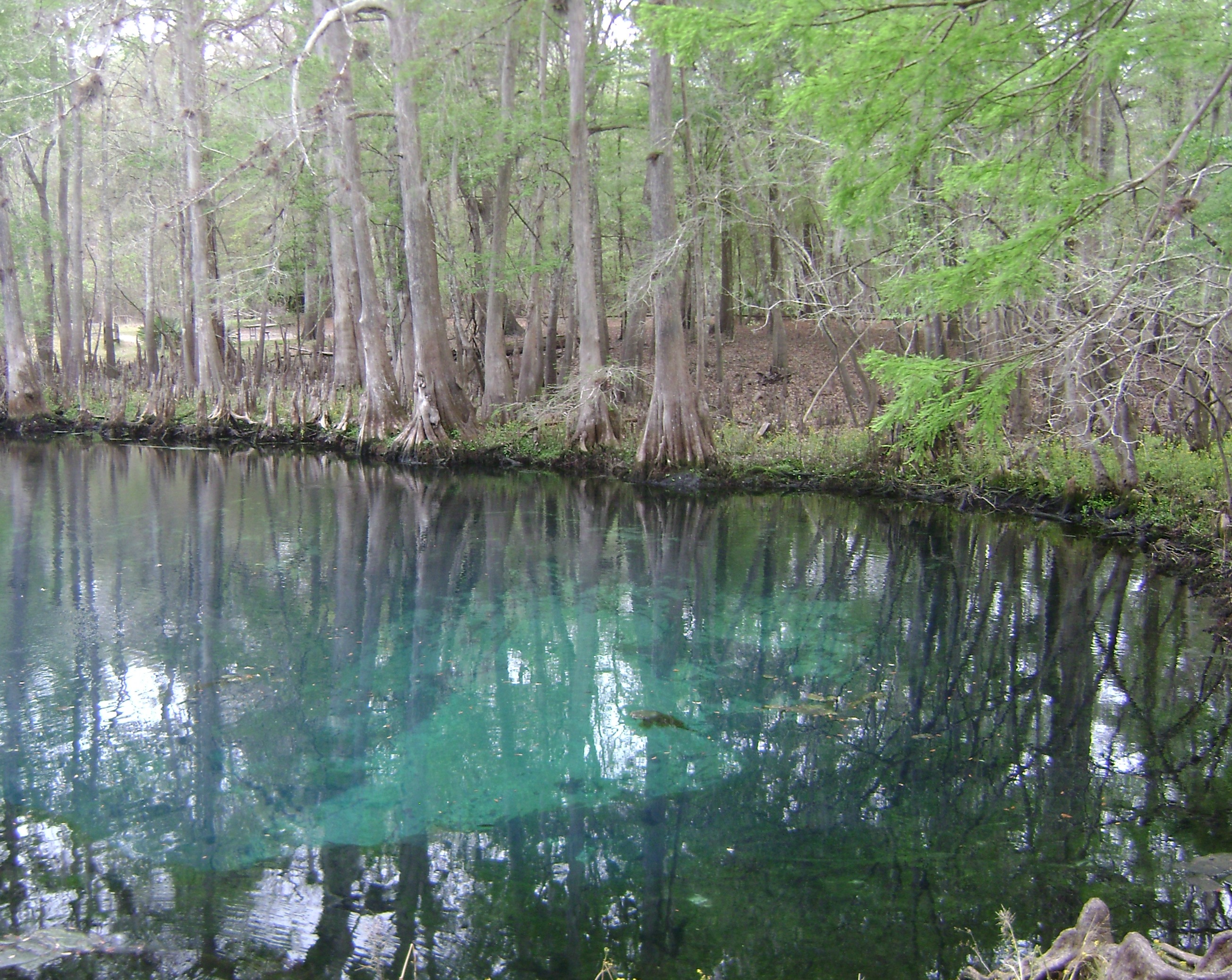
    Like Guess Where National Park
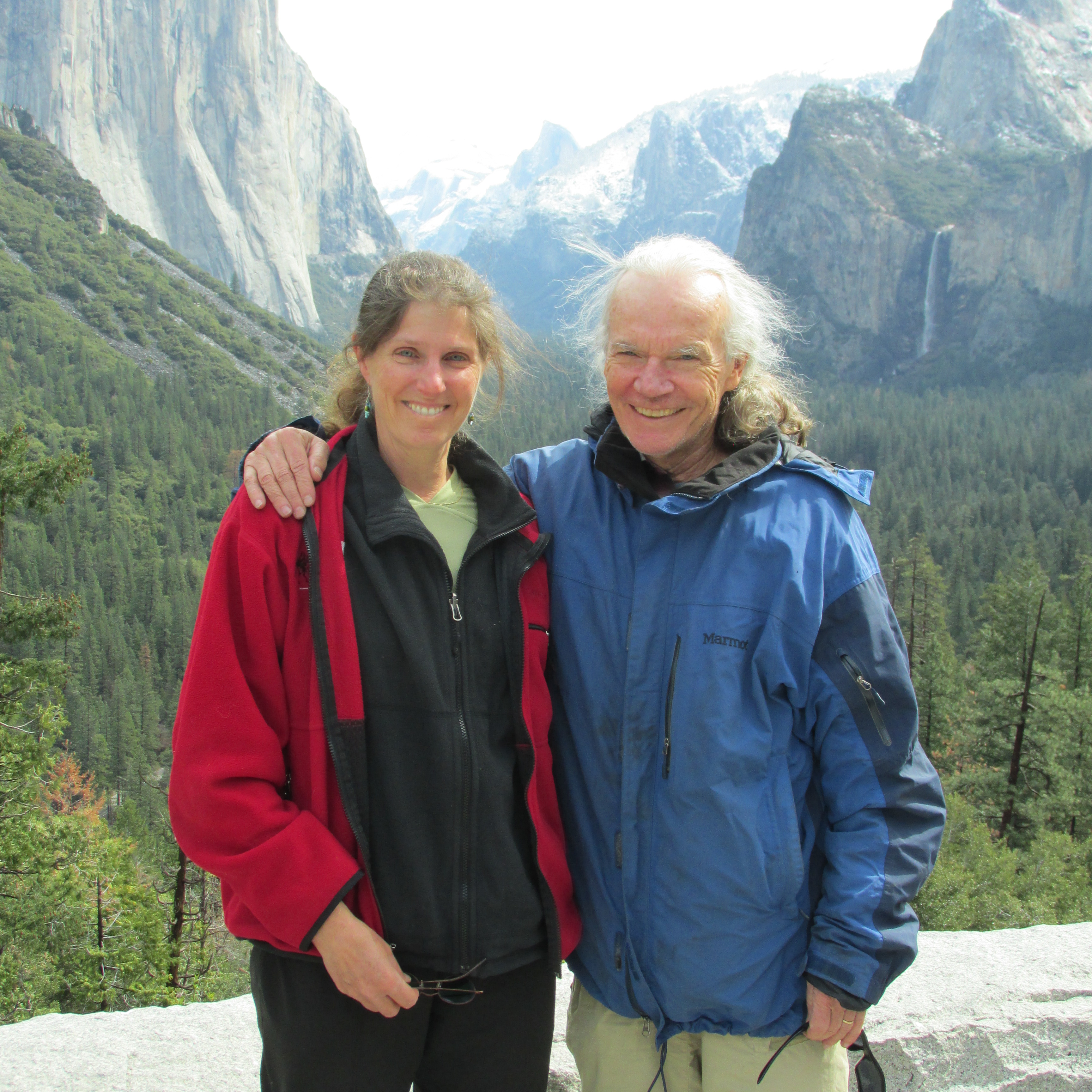
2. Beautiful places we’d never even heard of

The Source of the Missouri River, in Montana.

3. Faraway friends with ridiculously cute kids who are growing up way too fast.

NC Wildflower Walk!

4. Hidden cool spots of cities we didn’t even think we liked.

Watching an ambitious grafitti artist at work in Dallas

5. Ridiculously cute animals on the farms of family members.
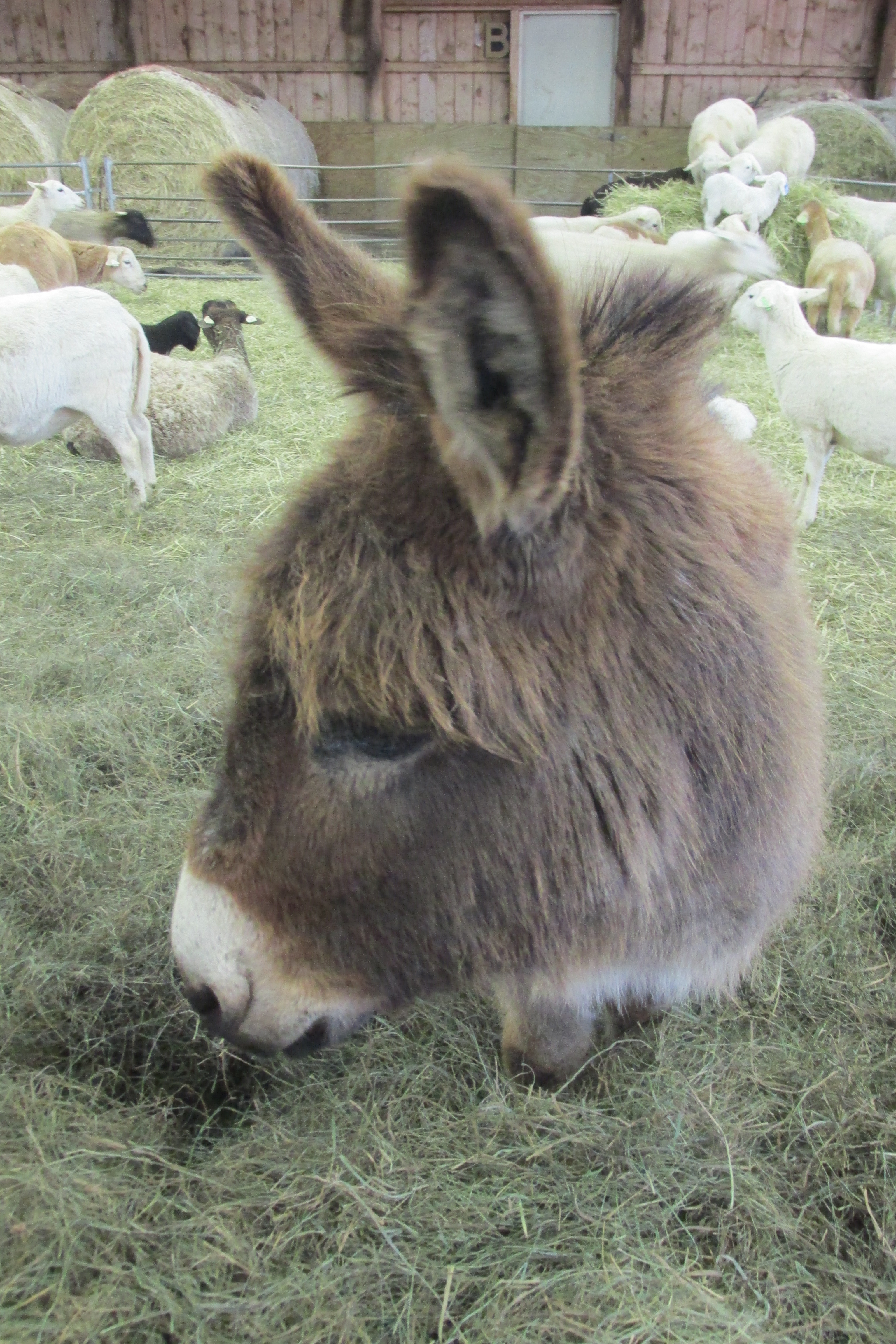
Ben the Sheepherding Donkey in Vermont 

6. Deserts!

Arches National Park (duh)

7. Mountains!

Long’s Peak in Colorado

8. Desert mountains!
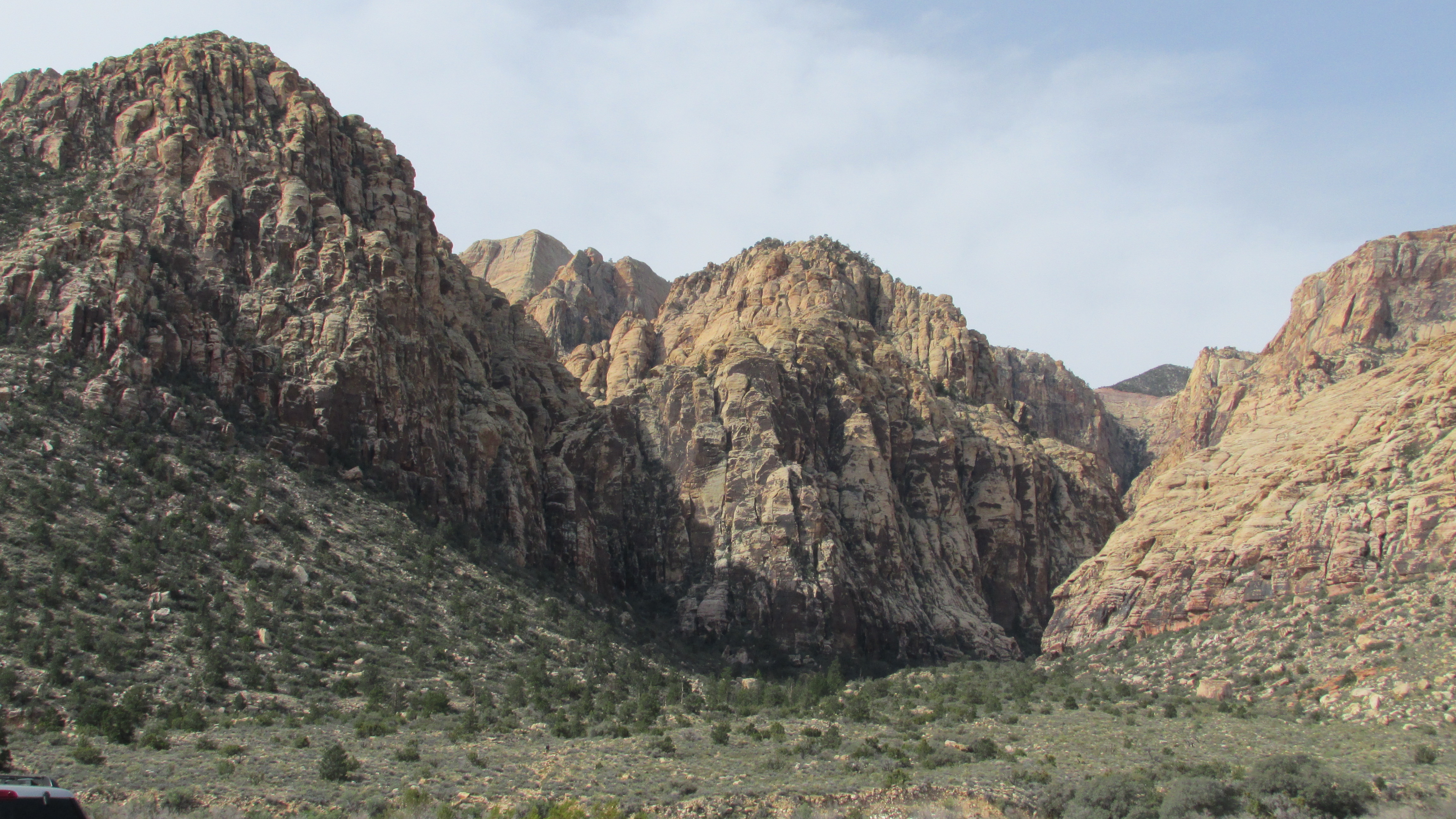
Anza-Borrego SP in California

9. Bike paths! (We are FOOLS for bike paths.)
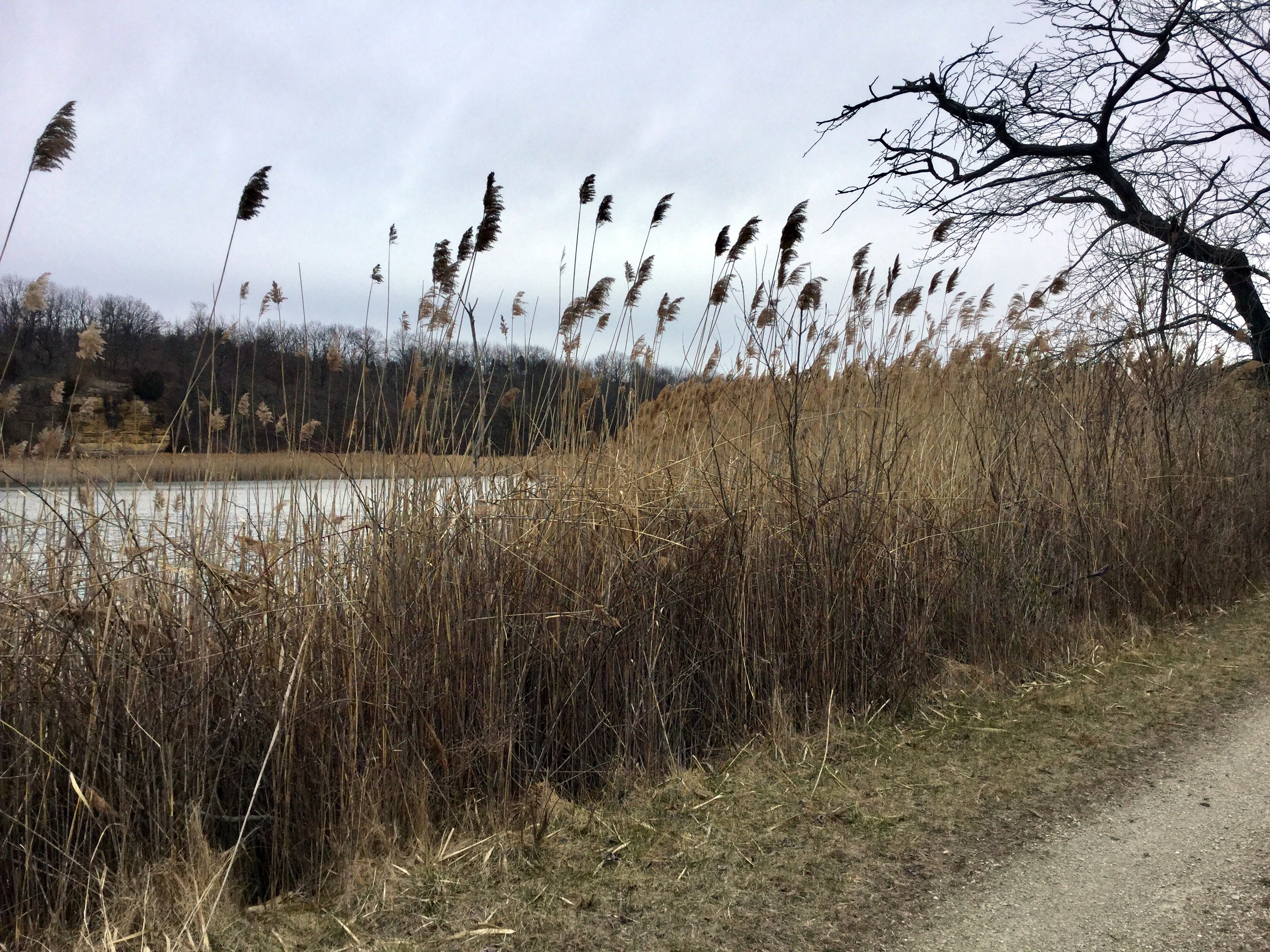
…like this rails-to-trails path along the Illinois River Canal

10. and…let’s not forget FOOD.
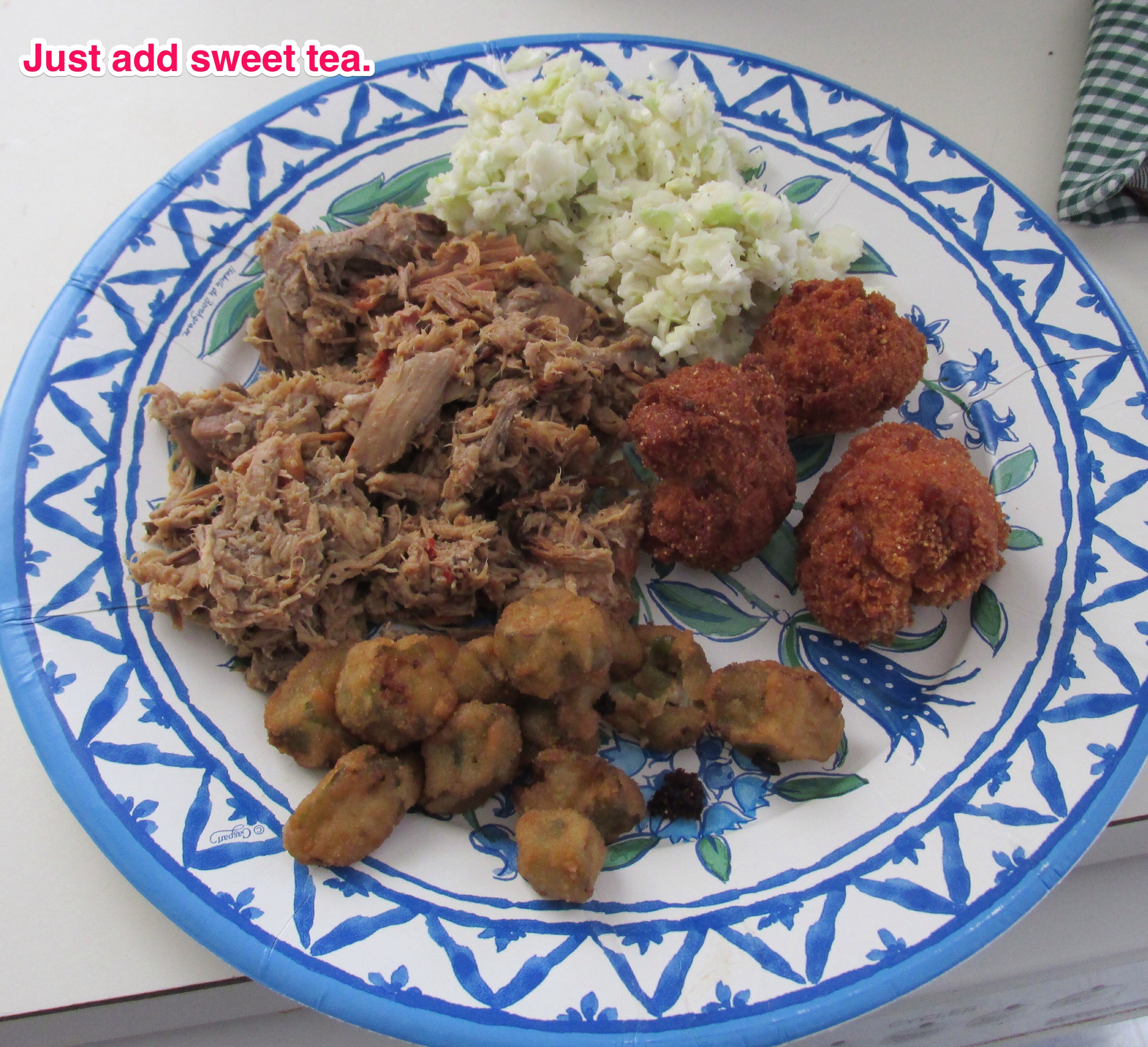
It’s all about the BBQ. With hush puppies, slaw, and fried okra. Not pictured: sweet tea.

‘Scuse me, I just got very hungry for some reason. But I’ll see you from the road!

Mango-Yogurt Parfait: Trust Me On This One

I haven’t blogged about food for a while. But I’m always thinking about it. And I’m especially pleased to share this World’s Simplest “Recipe” with you because a) It has been part of my life for so long, and b) I continue to be surprised by how few people have tried it.

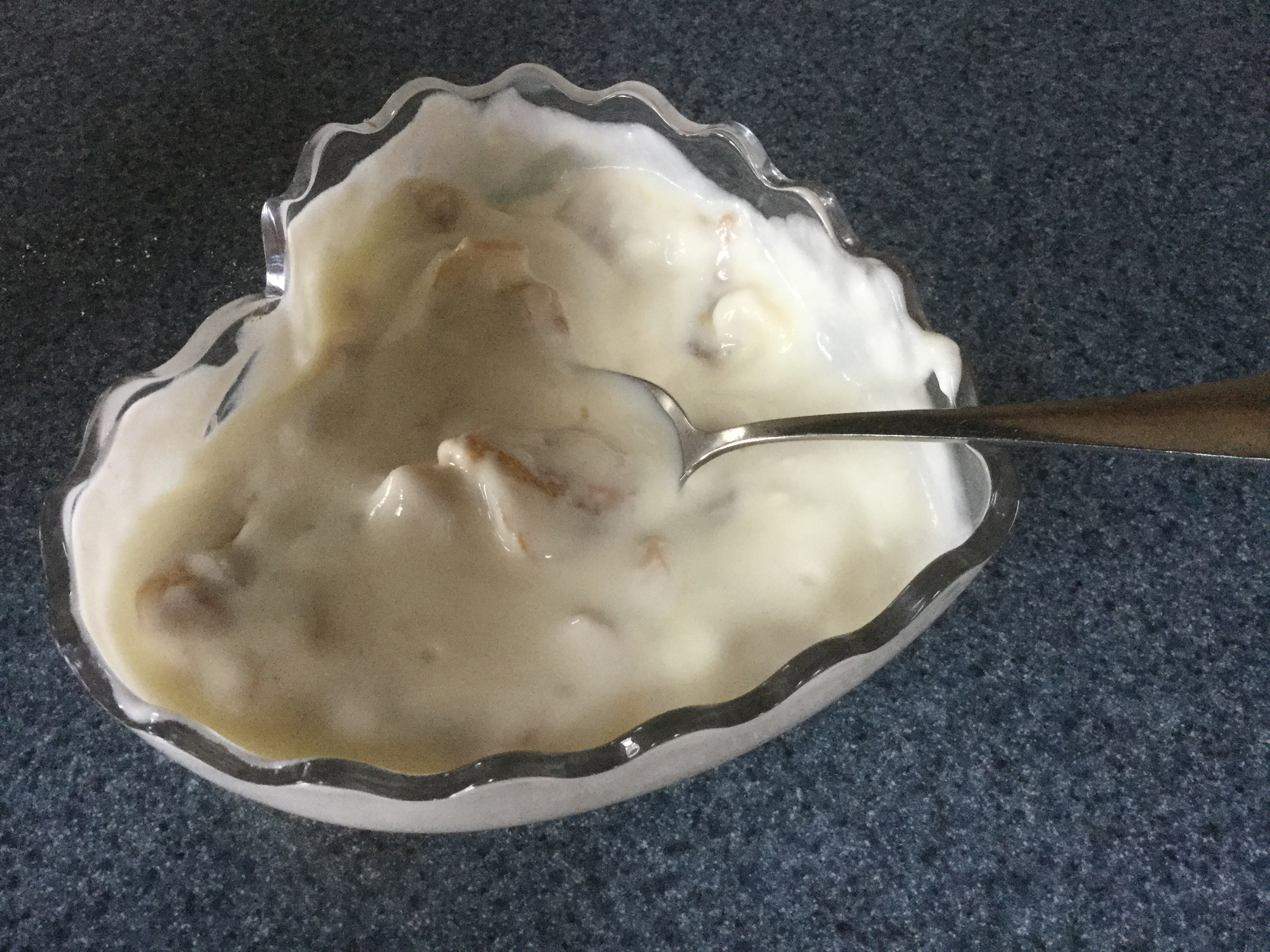
It = dried mango soaked in yogurt…which = a paradisically rich-tasting “parfait”  which is nonetheless perfectly healthy.

  1. Take some dried mango and shred it up a bit. (I use the kind with no added sugar; it’s plenty sweet. Also plenty leathery.)

Mmmm…looks so…leathery.

2. Add a cup or so of yogurt. I use plain, but vanilla is even more delicious! Here’s the key: LET IT SOAK at least three hours, or overnight, refrigerated.

Yogurt added? Check. That’s it. You’re done.

3. Stir it up and enjoy. If you like it sweeter, add some jam or maple syrup. Crunchier? Add nuts or granola. But I recommend leaving it as is. Mango leather has turned to mango velvet through the miracle of time. Mmmmmmmmmmm…..

Are you SURE this isn’t dessert?

When I was teaching, I brought this as my lunch every day for the last six years. I never got tired of it. In fact, I think I’ll go make some right now. Care to join me?

The Best Guitarist You Never Heard Of: Save “Awesome” For Beppe Gambetta

After I had the honor and pleasure of opening, with two fellow local musicians, for Beppe Gambetta’s modest Lopez Island show, several friends of mine told me I was “awesome.”

Thanks, guys, but seriously–let’s apply that “A-word” more carefully, shall we?

If you’ve heard of Beppe Gambetta, good for you. I hadn’t, till he toured out here a few years ago. Since then I’ve become familiar with the delightful story of this 11 year-old Italian kid who somehow got his hands on a Doc Watson record, over in Genova, and had his life changed by the ol’ flatpicker from Deep Gap, North Carolina. Beppe, with zero background in anything but traditional Italian music, started practicing, and kept on practicing…till he learned to do THIS:  (note–keep watching; he speeds up as he goes!)

If you check out Beppe’s website and his music, you’ll see that he actually does way more than “just” American-style bluegrass flatpicking. He plays traditional and modern Italian music, composes his own melodies, and sings in four different languages. 

Check Beppe’s tour schedule (he and his delightful wife Federica tour all but 100 days per year–year after year!). If he’s playing anywhere near you, get tickets IMMEDIATELY. And save up your use of the word “awesome” till you see him play live.

Grazie.


Miss Havisham Fights Back: When Literary Women Refuse To Know Their Place

My friend Kathleen Holliday writes poetry that always appeals to me–witty, lean, wry, poignant. But this one, published this week in the online journal SHARK REEF, really strikes me as apropos, in this year of #metoo, #time’sup, Nasty Women, pussy hats and Nevertheless, She Persisted.

Remember Miss Havisham, the creepy old maid in Charles Dickens’ Great Expectations? Well, Kathleen has given her a much-needed makeover. Enjoy.

Ms. Havisham

I, too, had great expectations.
		To be or not to be a wife
		defined my life.

		My dowry guaranteed
		 a husband, and I would be
		a mother, helpmeet, nurse.
		Nothing could be worse than 
		that damning epithet:
		old maid.

		Left at the altar – jilted.
		My bouquet wilting,
		I drew my veil down over my face
		and let the yards of lace fall
		dragging through the dust.

		Years later, I still hold the knife:
		May I cut you a slice -
		a corner piece perhaps, with extra frosting?
		Don’t mind the spiders 
		and the mice racing in and out,
		tunnels crumbling behind them.

		Mr. Dickens, I implore you - 
		change mine to a happy ending.
		No funeral pyre,
		no more desires gone up in smoke.
 		Set me in some future time
		when I could say:
		never married,
		never needed to;
		earned a degree, had a job, a car,
		a condo in the city,
		a lover who never strayed.

		I’d celebrate my singular good fortune 
		with a cake - 
		not Mrs. Beeton’s recipe - 
		no butter, no gluten, no nuts.
		I’d clear up after with a cordless vac.
		I’d sweep the ceiling free of spider webs.
		I’d read a novel in one sitting
		then I’d take a nap.

[sorry about the formatting of the first line–it resisted fixing.]

Miss Havisham then…

…and now–fresh from her nap. 🙂 (Both pics courtesy Wikimedia Commons)

OK, you poets and short story writers–let’s hear it. Who else has a revised female archetype to share?

That Big Green Lady

Could America possibly have a more relevant poem right now than this one? 

Not like the brazen giant of Greek fame,

With conquering limbs astride from land to land;

Here at our sea-washed, sunset gates shall stand

A mighty woman with a torch, whose flame

Is the imprisoned lightning, and her name

Mother of Exiles. From her beacon-hand

Glows world-wide welcome; her mild eyes command

The air-bridged harbor that twin cities frame.

“Keep, ancient lands, your storied pomp!” cries she

With silent lips. “Give me your tired, your poor,

Your huddled masses yearning to breathe free,

The wretched refuse of your teeming shore.

Send these, the homeless, tempest-tost to me,

I lift my lamp beside the golden door!”

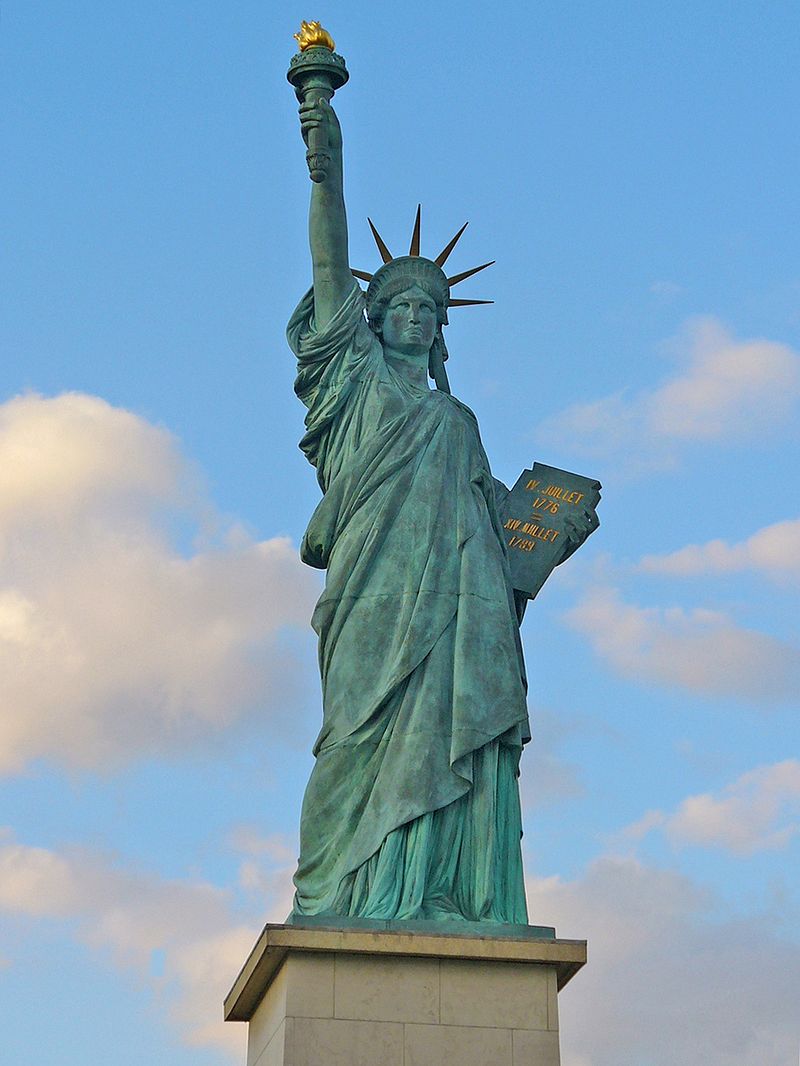
Image by H. Zell, Wikimedia Commons

Thanks to a wonderful article* by Walt Hunter in The Atlantic, “The Story Behind the Poem on the Statue of Liberty–and thanks to a very un-wonderful comment by the president–I’ve been thinking a lot  about Emma Lazarus’s poem.

Hunter’s article points out many features of  poem which I had never thought about before: its unusual structure (Petrarchan Sonnet–can I get a “yeah” from my English nerds?); its usage by various politicians in underlining our favorite dream of American exceptionalism; the nuance of the statue’s gender in contrast with statues of yore.

But here’s the passage of Hunter’s that really sticks with me:

The philosopher Simone Weil argues that the impersonal cry of “Why am I being hurt?” accompanies claims to human rights. To refuse to hear this cry of affliction, Weil continues, is the gravest injustice one might do to another. The voice of the statue in Lazarus’s poem can almost be heard as an uncanny reply, avant la lettre, to one of the slogans chanted by immigrants and refugees around the world today: “We are here because you were there.” The statue’s cry is a response to one version of Weil’s “Why am I being hurt” that specifies the global relation between the arrival of immigrants and the expansion of the colonial system.

“We are here because you were there.” America has immigrants because the global system we benefit from displaces people. But lucky us–we BENEFIT from those desperate people.

Raise your hand if you’re a child of immigrants. Thought so. Can’t find a way to talk about this with your anti-immigrant neighbor? Yeah, I struggle with that too. Meanwhile–stay involved. Stay heartened. And VOTE.

*Note: shout-out to Maria Popova’s Brain Pickings for bringing this article to my attention.

Tree Guru, Part II: Let Me Learn From Yew Too

Here’s one of those “discovering” something that was always in plain sight stories. And of course it has a moral.

A few weeks ago I was walking my favorite woodsy path on our beautiful isle and my eyes came to rest on the trunk of a tree I must have passed literally HUNDREDS of times. “Funny,” I thought, “that looks like a juniper. But they don’t have junipers here.”

It’s true. Here in Ecotopia we have Western Red Cedar and we have Douglas Fir, but juniper’s an eastern thing. I knew right away this was something special. And that’s when I remembered hearing about a handful of ancient Pacific Yews still surviving on the south end of Lopez Island. I stepped in for a closer look.

Much closer look.

Thirty+ feet in height. Flat needles. Red bark. But the width–whoa! I couldn’t get my arms around the trunk, not by a long shot. My wing span’s a good 5 feet, so this trunk’s circumference could be 80 inches. And yet it looked SO modest, tucked into the larger forest, that I had ignored it for a good six years of walks.

Not much to yew, is there?

A botanist friend tells me a yew this size is “hundreds of years” old. Impossible to tell how MANY hundreds, of course, but who cares? This unassuming tree, much smaller than the firs around it, could be their great-great-great grandma (overlooking the whole different genus thing, of course).

The obvious moral to this story is, PAY ATTENTION. Who knows what you may be walking past? The more subtle moral…well, several come to mind.

Perseverance and strength–the qualities of heroes–may come in drab packages.

Flashiness often distracts us from our best, truest role models. And of course…

Yew are who yew are.

Do you have your own story of an unobtrusive hero or role model you came to notice after much time? Do share, won’t yew?

My Guru The Tree

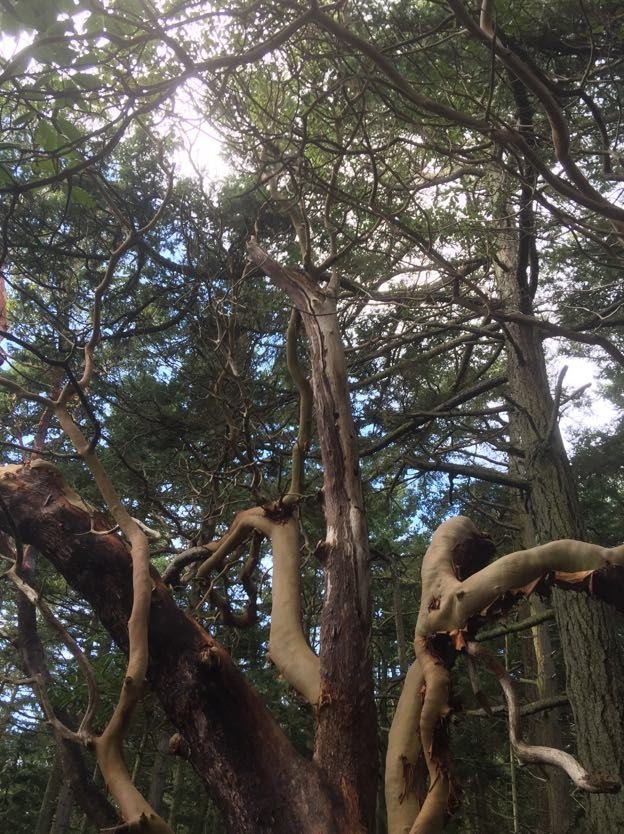
If you look at my books you’ll see my publisher is Madrona Branch Press.

That’s me. All us Indie authors are our own presses. But Madrona Branch, the name? There’s a story there, which I’ve told before.

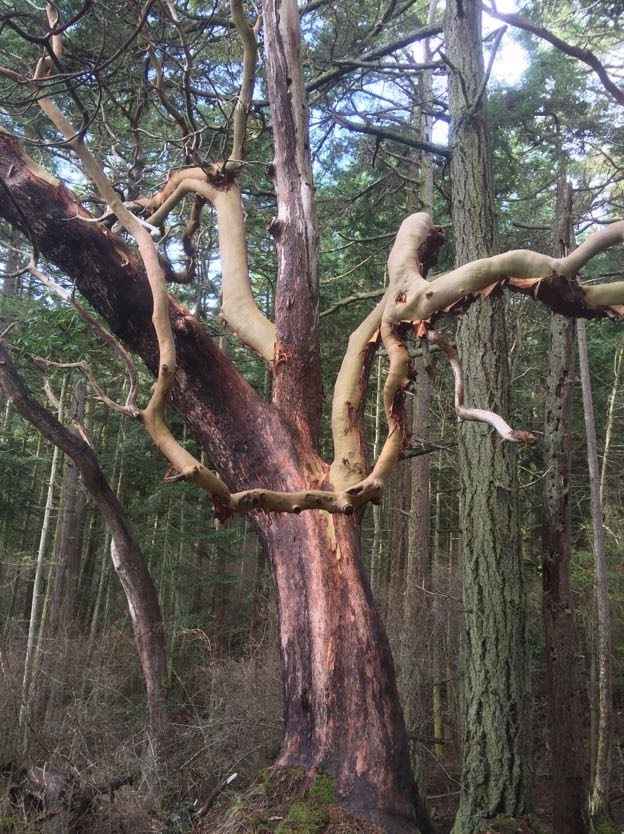
Don’t have time for the previous blog post? Just look closely at that loopy branch.

Here’s an update.

The other day I was out for a walk and stopped to hug “my” tree as I usually do.

Hello, Beautiful.

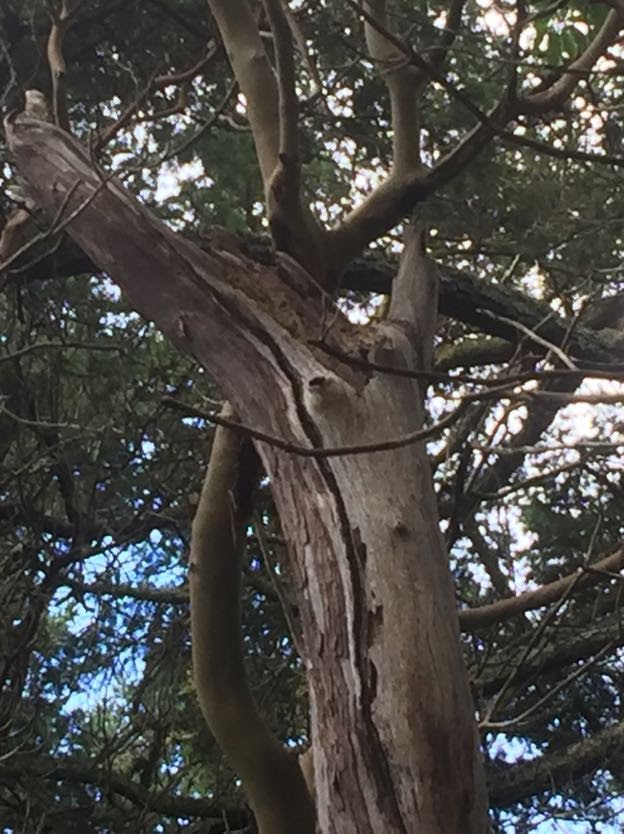
Then I stepped back and looked into its upper branches. My eyes found that astounding curl of branch which has become my personal emblem. Then, for the first time, they noticed something new that had always been there:

“I’ve been here all along, y’know.”

See it? Look closer.

“Lean on me…when you’re not strong…”

Not only is that never-say-die branch supporting itself with its own loop, it’s also leaning against an older part of the original tree trunk. A dead part. But not so dead that it can’t lend its bulk to keep “my” branch climbing toward the sunlight.

Excelsior!

So I’ve extended my metaphor. Yes, I accepted the “failure” of not being traditionally published, and supported myself to keep growing upward, into independent publication. But I was never alone in that endeavor. I leaned heavily on my writing group, on my editor, on my book designer, and on countless friends I knew only via internet, who helped me with technology or marketing questions.

Not to say any of those folks are “dead wood.” They are all solidly growing themselves. The “dead” part of that solid trunk is all the authors over time whose work inspired me and taught me. Shakespeare. Zora Neale Hurston. William Carlos Williams. Wallace Stegner. Barbara Kingsolver. Michael Chabon. And on and on and on, a trunk of growth so powerful it will never stop nourishing growth, even when it’s finally broken down into soil.

There’s also something to be learned from a tree which uses its own dead parts as scaffolding, rather than shedding them. That’s US, guys–the community of writers! We are the whole damn tree.

A little further on my walk, I ran into another new favorite tree of mine. But that’s a whole other story, so I’ll save it for my next post.

Any other metaphors strike you from these pictures? Or do you have a Nature metaphor for your own experience? I would love to hear.

White Privilege, Part…II? XVIII? Who’s Counting?

The US election of 2016 ushered me, like a lot of folks, into a new era of reading, listening, and discussion, all aimed at understanding, to paraphrase Hillary, “What the Hell Just Happened (And What Does it Mean)?”

I quickly figured out that it was mostly my fellow white people who were asking that question. People of Color (whom I’ve mostly just been reading and listening to, since leaving very-colorful Tacoma for this very-white island 7 years ago) not only sounded less surprised on the whole, but also less shook. The overall message seems to be more along the lines of, “Really? Didn’t see this coming?”

For these thinkers, Trump isn’t the blacklight lighting up the creepy-crawlies in the sofa cushions; he’s just one more creepy-crawly in a house whose infestation was built into its foundation-which some of us have been noticing only intermittently. I realized I had something to learn.

One of the most powerful passages of one of the most powerful books I’ve read this past year comes from Ta-Nahesi Coates’ Between The World And Me. He writes of the Dream—NOT Martin Luther King Jr.’s “I Have a Dream,” but quite the opposite. This Dream, to Coates, is the illusion of fundamental American fairness, decency and democracy that middle class whites cling to in order to feel good about living the way we do when we know others have not been, and still are not, able to live that way.

The mettle that it takes to look away from the horror of our prison system, from police forces transformed into armies, from the long war against the black body, is not forged overnight. This is the practiced habit of jabbing out one’s eyes and forgetting the work of one’s hands. To acknowledge those horrors means turning away from the brightly rendered version of your country as it has always declared itself and turning toward something murkier and unknown.

Coates concludes that stark paragraph with this statement:

It is still too difficult for most Americans to do this. But that is your work. It must be, if only to preserve the sanctity of your mind. —pp. 88-89

I think I might change that last word to “soul,” or perhaps “heart,” because I feel Coates’ challenge more there than in my mind. And for me the challenge is not to change my opinion about America so much as it is to change my focus. To think about what I haven’t had to think about. And to let new voices have my ear.

One such new voice I heard recently on Stephen Colbert’s Late Show: Grammy-winner Chance the Rapper, debuting his new song, “First World Problems,” accompanied by Daniel Caesar.

Son One likes Chance and Caesar, and urged me to listen. I now urge you to do the same. Not your style of music? It’s not mine either. But give this song—pun intended—a chance. And pay attention to the lyrics.

These lyrics especially–notice the connection with Coates’ Dream?

Now—think about what you are thinking about. And let me know. Keep the conversation going.


How To Gift Yourself With Inspiration Without Drowning

I should really re-title this post and add a question mark, because sorting through all the inspiration available on the web is as daunting as it is delightful. I’m still a novice. So I’ll tell you what I do, and then I hope to hear back from some of you with even better strategies.

I limit the springs of inspiration I drink at, as much as possible, to the following:

  1. a daily poem, read first thing in the morning (before other stuff gets clogged in there). At first I used Poetry Daily, but, finding I wanted my poetry less random, I later switched to favorites like Mary Oliver and Brian Doyle, working my way through their books one poem at a time. But who knows? I may go back to randomizing just to see who appears.
  2. Brain Pickings, by Maria Popova. I became a subscriber this year, and after a few months I became, out of sheer gratitude, a paying subscriber. But Maria is so incredibly wide-ranging that I’ve had to learn how to pick my own Pickings. Survival tip to avoid inundation: assign myself ONE article per issue to read, then share with a friend or relative, including my own question or comment to create a real connection/dialogue. 
  3. On Being, the podcast by Krista Tippett. Survival tip to avoid inundation: listen to one episode per week while exercising.

Drink deep…but take time to savor and swallow!

This is what I try to hold myself to. Then there are BOOKS. How to limit the stack that grows beside my bed, and the list that threatens to run right off the notes-page of my calendar? Uh…gonna have to wait for one of you to advise me on this.

So…daily inspirations: how do YOU control the flow, pick your Pickings, or otherwise keep your sources of empathy and joy and motivation from drowning you? Please share your strategies, Wise Ones.


Family Pranking: Fun New Resolution for 2018?

Meet Ali the Gator:

“Could someone lick me clean, please?

Oh, why’s he covered in whipped cream and jam? Therein lies a tale. Allow me.

Ali joined our family a couple of years ago when the Mate was out doing yardwork. Spotting a lizard near the compost bin, he decided to catch it, in honor of Wing Son One, who does such things. So he stalked it, for several minutes, before realizing…

a) it was plastic

b) it was an alligator, not a common lizard,

c) it was missing two of its feet (likely a lawn-mower accident)

So he brought it inside. Of course I decided to place it under Son One’s pillow the next time he visited. (Gratifying yell of surprise.) Ali then showed up successively in…

a) the soap dish in the shower

b) my tin of Earl Grey

c) the Mate’s tin of coffee beans

d) my hiking boot

The hiking boot prank was especially good, because I was putting on that boot at the visitor center of Haleakala on Maui, last winter. So I sent Son One this photo of “Ali in Paradise”:

Later, he took a hula class and attended a luau.

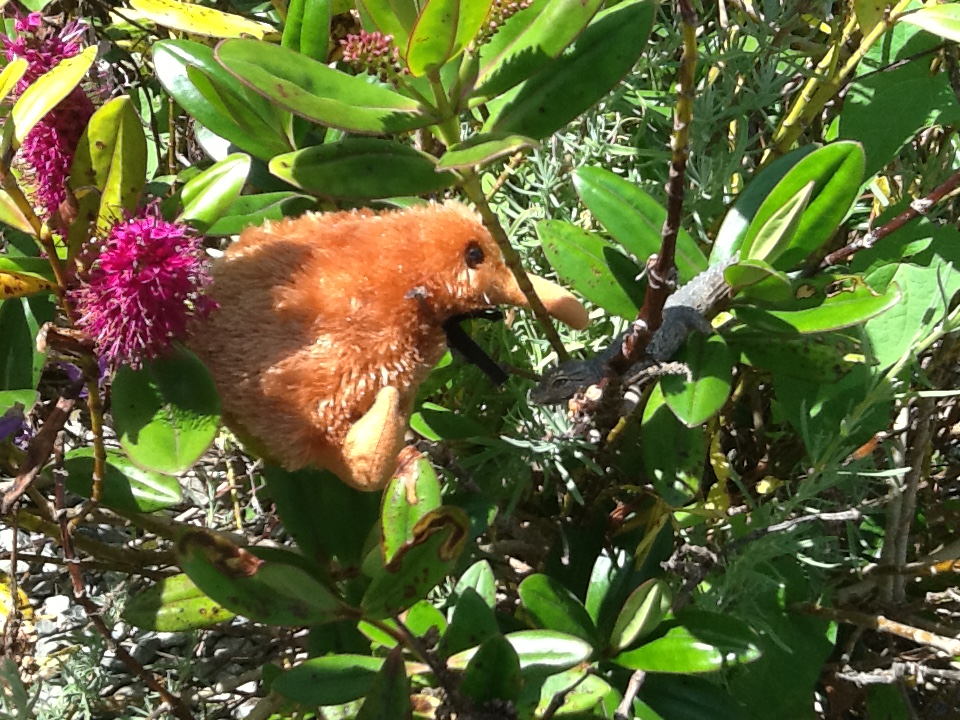
From Maui we continued our Epic Journey to New Zealand, so there I took another photo of “Ali with Kiwi Mate”:

“Hey, it’s OK–I can’t fly either, mate.”

This past summer, both sons + Mate gathered in Vermont for a construction blitz on our cousins’ “new” old house. Ali flew there in a care package of cookies, to make a legendary appearance inside an ear of corn the Mate was shucking. (Sadly, no picture of that.)

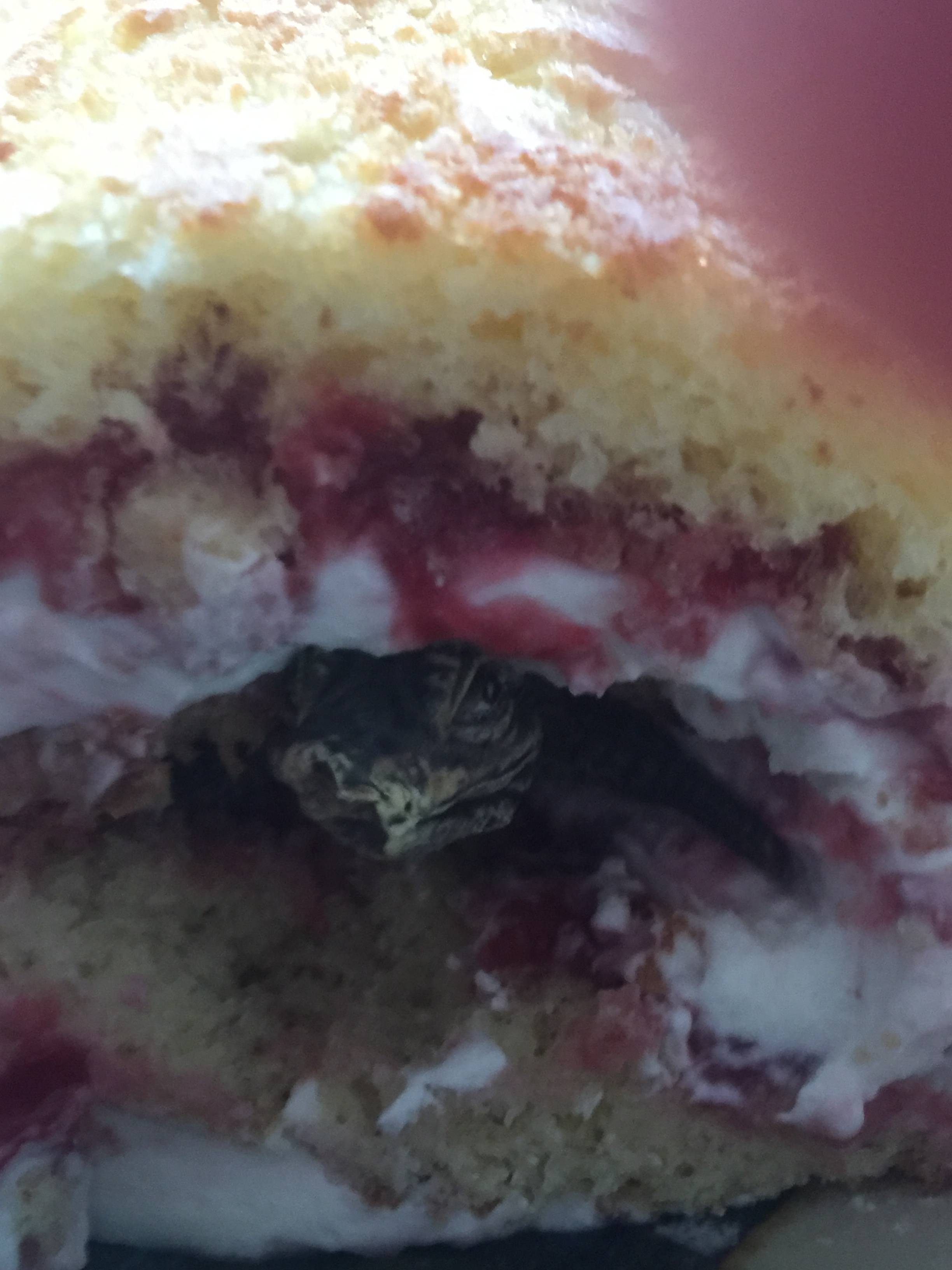
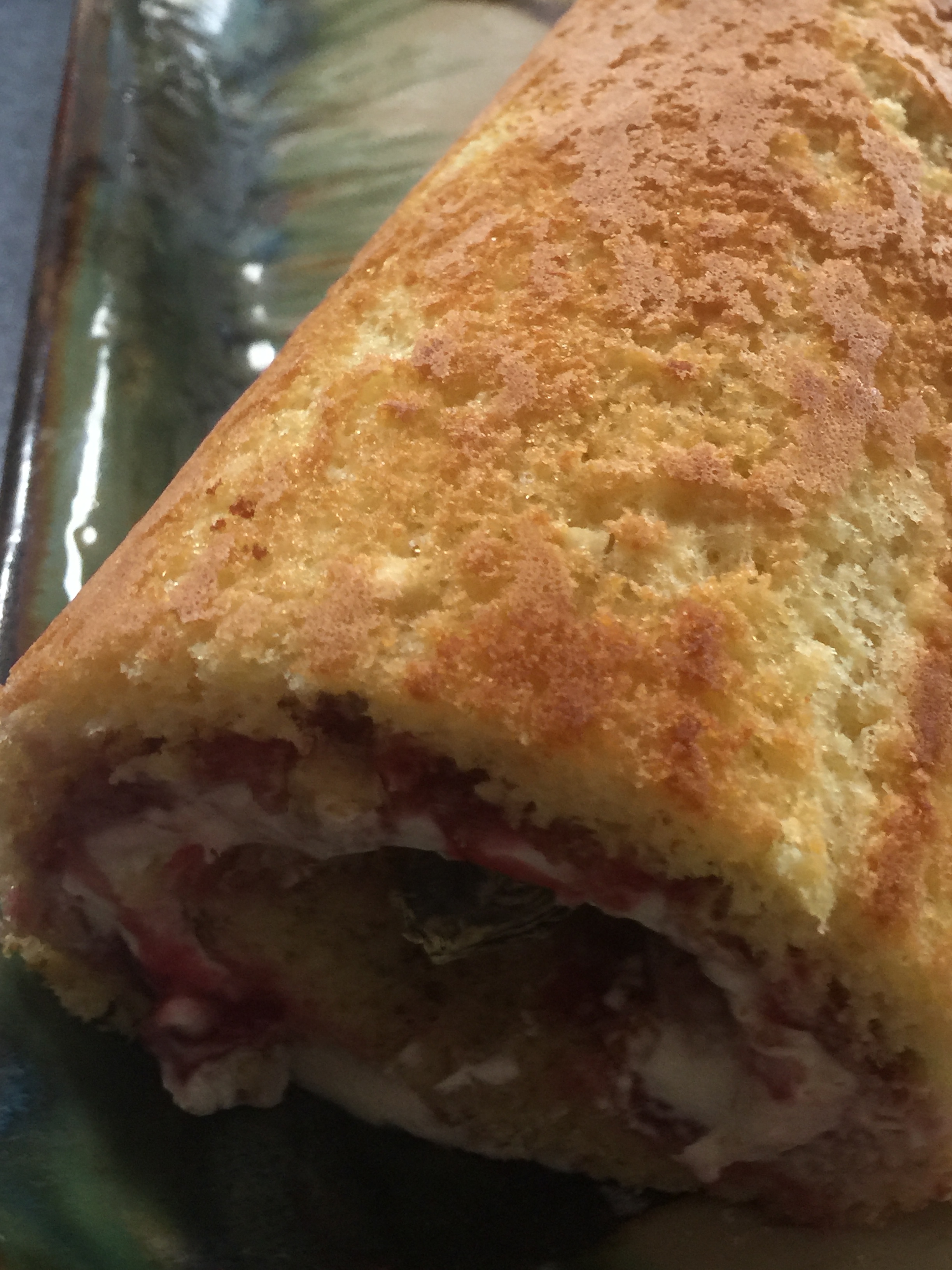
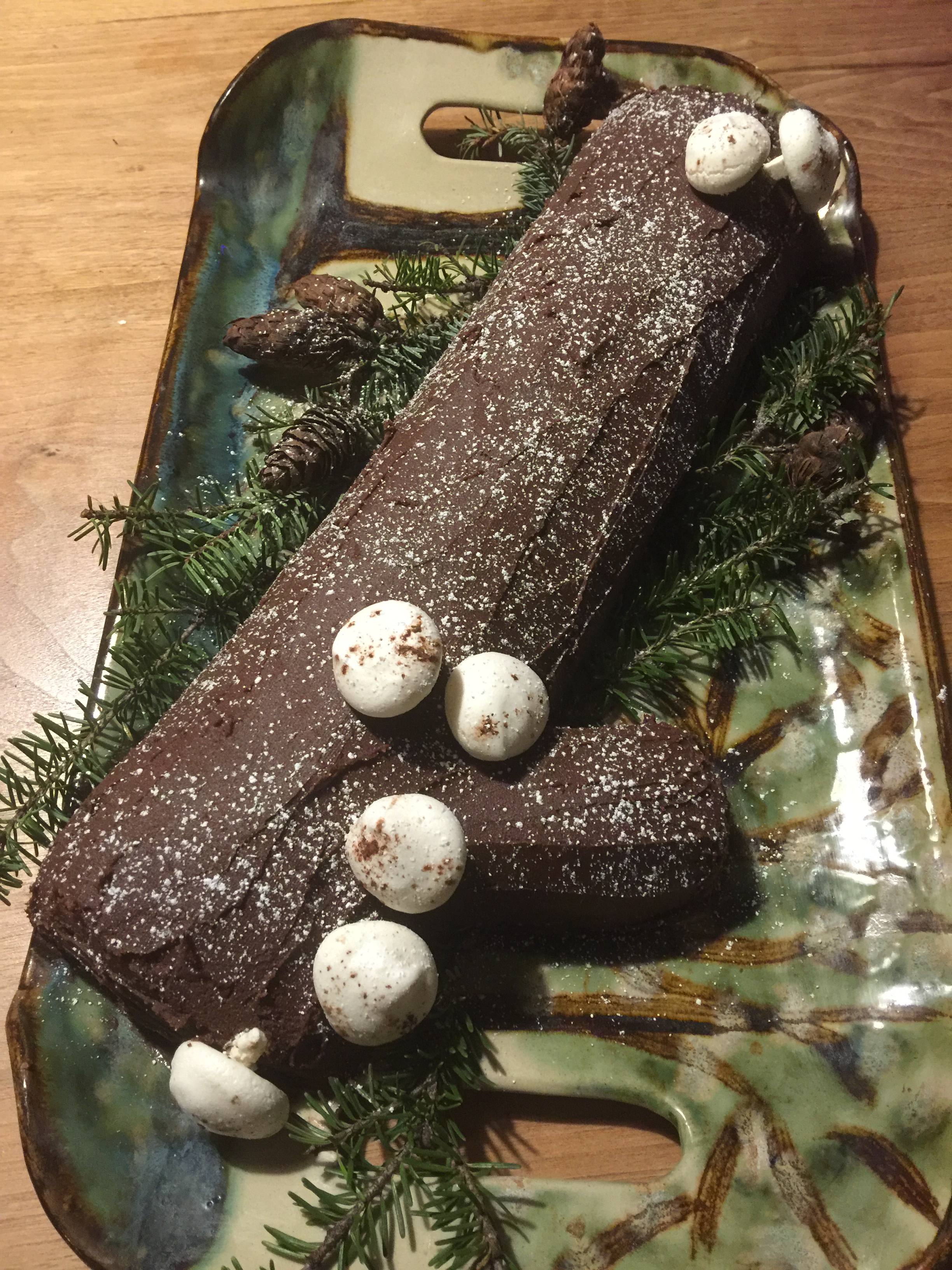
Don’t know how Ali made it back to the Wet Coast, but he reappeared this past month, folded inside the ferry commuter ticket in our glove box. I decided Ali must have a special Christmas. So I stuffed him inside the yule log cake (Buche de Noel) I was creating.

In you go, lil’ guy!

Don’t eat too much whipped cream in there!

Of course I made sure that one of our sons got the “special” piece of cake. (Son One got the honor.)

Alligator? What alligator? Have a slice of Yule Log! Merry Christmas!

We actually borrowed this idea of family pranking from our Vermont cousins. They did the same thing with an evil-looking doll they called “Malice.” The idea of finding a creepy doll inside, say, one’s freezer, veers too close to heart-attack-land for my taste.

But a cute little alligator? All he does is make us laugh, and think of how much we enoy each other. 

Anyone else out there have an ongoing family prank to share? Anyone want to start 2018 with a new tradition? Be sure to take pictures!